It's not just climate – we've already breached most of the Earth's limits. A safer, fairer future means treading lightly
- Written by Steven J Lade, Resilience researcher at Australian National University, Australian National University
People once believed the planet could always accommodate us. That the resilience of the Earth system meant nature would always provide. But we now know this is not necessarily the case. As big as the world is, our impact is bigger.
In research released today, an international team of scientists from the Earth Commission, of which we were part, identified eight “safe” and “just” boundaries spanning five vital planetary systems: climate change, the biosphere, freshwater, nutrient use in fertilisers and air pollution. This is the first time an assessment of boundaries has quantified the harms to people from changes to the Earth system.
“Safe” means boundaries maintaining stability and resilience of our planetary systems on which we rely. “Just”, in this work, means boundaries which minimise significant harm to people. Together, they’re a health barometer for the planet.
Assessing our planet’s health is a big task. It took the expertise of 51 world-leading researchers from natural and social sciences. Our methods included modelling, literature reviews and expert judgement. We assessed factors such as tipping point risks, declines in Earth system functions, historical variability and effects on people.
Alarmingly, we found humanity has exceeded the safe and just limits for four of five systems. Aerosol pollution is the sole exception. Urgent action, based on the best available science, is now needed.
So, what did we find?
Our work builds on the influential concepts of planetary boundaries by finding ways to quantify what just systems look like alongside safety.
Importantly, the safe and just boundaries are defined at local to global spatial scales appropriate for assessing and managing planetary systems – as small as one square kilometre in the case of biodiversity. This is crucial because many natural functions act at local scales.
Here are the boundaries:
1. Climate boundary – keep warming to 1℃
We know the Paris Agreement goal of 1.5℃ avoids a high risk of triggering dangerous climate tipping points.
But even now, with warming at 1.2℃, many people around the world are being hit hard by climate-linked disasters, such as the recent extreme heat in China, fires in Canada, severe floods in Pakistan and droughts in the United States and the Horn of Africa.
At 1.5℃, hundreds of millions of people could be exposed to average annual temperatures over 29℃, which is outside the human climate niche and can be fatal. That means a just boundary for climate is nearer to 1°C. This makes the need to halt further carbon emissions even more urgent.
2. Biosphere boundaries: Expand intact ecosystems to cover 50-60% of the earth
A healthy biosphere ensures a safe and just planet by storing carbon, maintaining global water cycles and soil quality, protecting pollinators and many other ecosystem services. To safeguard these services, we need 50 to 60% of the world’s land to have largely intact natural ecosystems.
Recent research puts the current figure at between 45% and 50%, which includes vast areas of land with relatively low populations, including parts of Australia and the Amazon rainforest. These areas are already under pressure from climate change and other human activity.
Locally, we need about 20-25% of each square kilometre of farms, towns, cities or other human-dominated landscapes to contain largely intact natural ecosystems. At present, only a third of our human-dominated landscapes meet this threshold.

3. Freshwater boundaries: Keep groundwater levels up and don’t suck rivers dry
Too much freshwater is a problem, as unprecedented floods in Australia and Pakistan show. And too little is also a problem, with unprecedented droughts taking their toll on food production.
To bring fresh water systems back into balance, a rule of thumb is to avoid taking or adding more than 20% of a river or stream’s water in any one month, in the absence of local knowledge of environmental flows.
At present, 66% of the world’s land area meets this boundary, when flows are averaged over the year. But human settlement has a major impact: less than half of the world’s population lives in these areas. Groundwater, too, is overused. At present, almost half the world’s land is subject to groundwater overextraction.
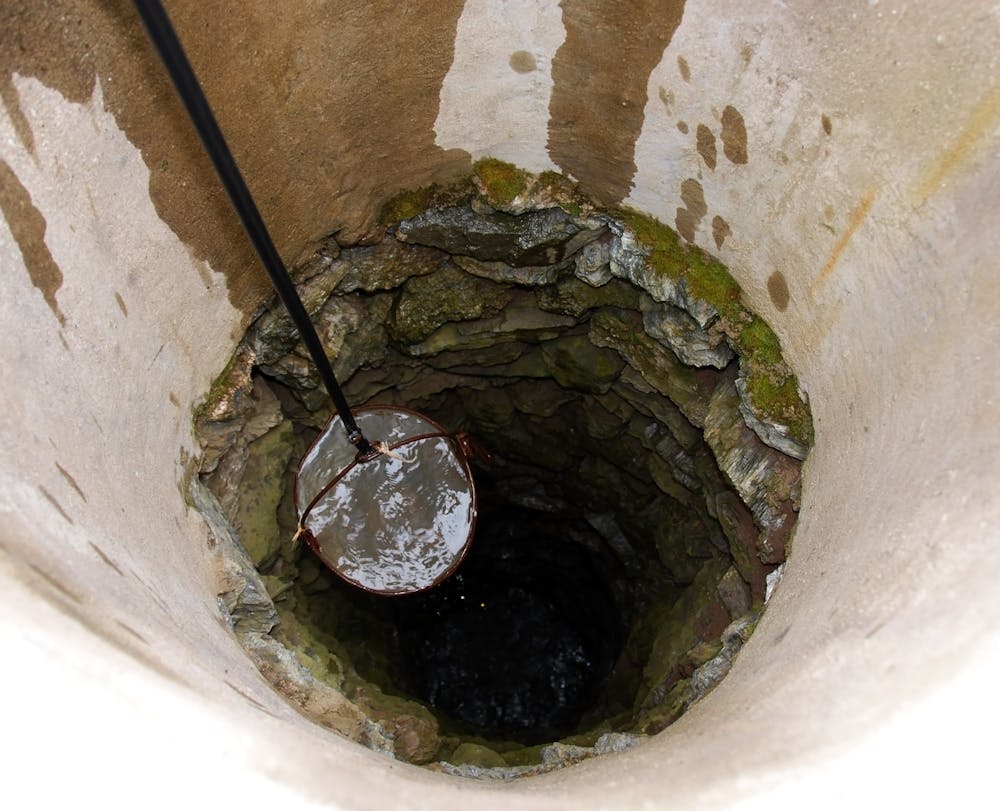 Fresh water is vital to life on land. Over-extraction is dangerous.
Shutterstock
Fresh water is vital to life on land. Over-extraction is dangerous.
Shutterstock
4. Fertiliser and nutrient boundaries: Halve the runoff from fertilisers
When farmers overuse fertilisers on their fields, rain washes nitrogen and phosphorus runoff into rivers and oceans. These nutrients can trigger algal blooms, damage ecosystems and worsen drinking water quality.
Yet many farming regions in poorer countries don’t have enough fertiliser, which is unjust.
Worldwide, our nitrogen and phosphorus use are up to double their safe and just boundaries. While this needs to be reduced in many countries, in other parts of the world fertiliser use can safely increase.
5. Aerosol pollution boundary: Sharply reduce dangerous air pollution and reduce regional differences
New research shows differences in concentration of aerosol pollutants between Northern and Southern hemispheres could disrupt wind patterns and monsoons if pollutant levels keep increasing. That is, air pollution could actually upend weather systems.
At present, aerosol concentrations have not yet reached weather-changing levels. But much of the world is exposed to dangerous levels of fine particle pollution (known as PM 2.5) in the air, causing an estimated 4.2 million deaths a year.
We must significantly reduce these pollutants to safer levels – under 15 micrograms per cubic metre of air.
We must act
We must urgently navigate towards a safe and just future, and strive to return our planetary systems back within safe and just boundaries through just means.
To stop human civilisation from pushing the Earths’s systems out of balance, we will have to tackle the many ways we damage the planet.
To work towards a world compatible with the Earth’s limits means setting and achieving science-based targets. To translate these boundaries to actions will require urgent support from government to create regulatory and incentive-based systems to drive the changes needed.
Setting boundaries and targets is vital. The Paris Agreement galvanised faster action on climate. But we need similar boundaries to ensure the future holds fresh water, clean air, a planet still full of life and a good life for humans.
We would like to acknowledge support from the Earth Commission, which is hosted by Future Earth, and is the science component of the Global Commons Alliance
Authors: Steven J Lade, Resilience researcher at Australian National University, Australian National University