Drivers and pedestrians are unsure who gives way at stop signs. A simple rule change can end this dangerous confusion
- Written by Geoffrey Browne, Postdoctoral Research Fellow, Melbourne School of Design, The University of Melbourne
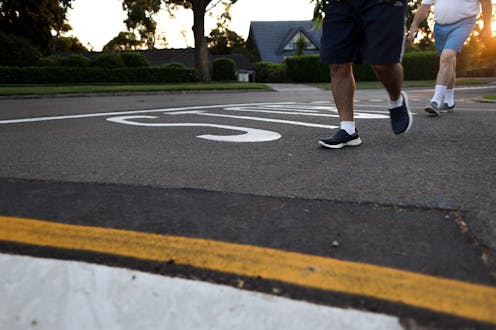
When a driver and a pedestrian approach a T-intersection, who has to give way?
In newly published research we tested over 1,000 road users’ knowledge of the Australian road rules. We presented them with the two scenarios shown below.
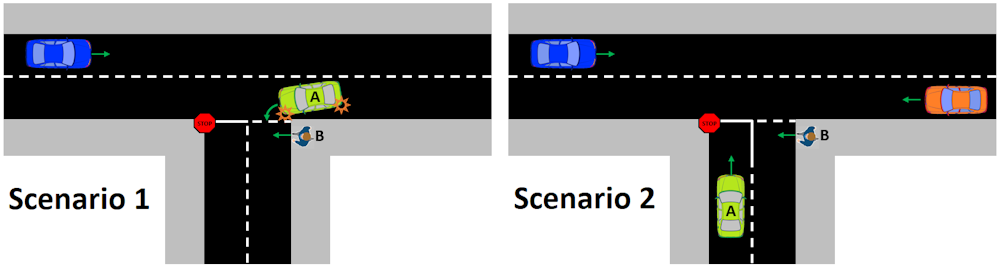
When asked who should give way, the green car or the pedestrian, in the first and second scenarios, 37% and 39% of road users respectively answered incorrectly.
So what do the Australian Road Rules say? The answer may surprise you. The rules (specifically rule 353) state:
(1) If a driver is turning from a road at an intersection –
(a) the driver is required to give way to a pedestrian who is crossing the road that the driver is entering […] and
(b) the driver is not required to give way to a pedestrian who is crossing the road the driver is leaving.
An obvious source of people’s confusion is the inconsistency between parts (a) and (b) of rule 353. In effect, it gives pedestrians “right of way across only half an intersection”.
Part (b) is also quite counter-intuitive. After all, most people would expect that a stop or give way sign would mean drivers have to stop for pedestrians as well as cars.
Changing the rules to require drivers to give way to pedestrians who are crossing the road the driver is leaving would create a “generalised and unambiguous duty to give way on turning”“. This change has been proposed before. But more recent developments have added to the case for such a rule change.
Read more: Why Australian road rules should be rewritten to put walking first
The UK’s new rule H2
The UK recently made the same change to its road rules. In late 2021, the UK Highway Code introduced rule H2 which, at a junction, requires drivers to give way to pedestrians crossing or waiting to cross a road into which or from which the driver is turning.
The change eliminated inconsistencies and the counter-intuitiveness about who has to give way.
Giving pedestrians an unambiguous right of way also encourages walking. Examples of apparently minor "urban acupuncture” like this can have long-term benefits for liveability and for public health and wellbeing.
Zebra crossings have unintended consequences
The second recent development is that local councils around Melbourne have been installing zebra crossings at prioritised locations – but not all locations – within activity centres and on routes designated as part of the so-called Principal Pedestrian Network. The purpose has been to encourage and enable walking for transport, particularly since 2020 when COVID-19 lockdowns meant people were seeking more opportunities to exercise in their local area.
Zebra crossings at T-intersections like the one pictured above are certainly well intentioned, and they over-ride rule 353(1)(b) to create pedestrian priority where it wouldn’t otherwise exist. The evidence suggests such zebras crossings do improve safety at the intersections where they are installed.
At the same time, however, there is a very real risk that, without a rule change, the crossings unintentionally undermine walkability more widely. This is because when they are installed at some but not all intersections, they can lead people to believe that at sites where they are not installed, drivers do not have to give way to a pedestrian who is crossing the street into which the driver is turning.
Our research, which was the first to examine this issue, found the risk of this unintended consequence is very real.
Read more: We all have to walk across roads — why aren't pedestrians a focus of road safety?
A rule change is the best answer
We also interviewed traffic engineers, local government planners and walking experts. A clear majority agreed a rule change that requires drivers to give way to pedestrians at a stop or give way sign would improve road safety and promote walking.
It would taking some getting used to, but road rules have been changed before.
In 1993 the road rules in Victoria were changed for vehicles turning left at intersections to have the right of way before vehicles turning right. Previously, and somewhat counter-intuitively, it was the other way around.
From April 2021, motorists across Australia were required to give cyclists clearance of at least one metre when overtaking.
Both of these rule changes were accompanied by public awareness campaigns to ensure the community knew about them.
Encouraging walking has broader public benefits
Requiring drivers approaching and turning at a T-intersection from any direction to give way to pedestrians would be an important simplification of the road rules. And the more the rules are biased toward the convenience of walkers, the more walkers there will be.
Importantly, changes like this can send subtle but powerful social signals that society values walking for transport because it reduces pollution and encourages incidental exercise. Such changes can play a small part in shifting communities from being car-dominated to enabling everyone, but particularly children, older people and people with disabilities, to feel safe to walk more.
Authors: Geoffrey Browne, Postdoctoral Research Fellow, Melbourne School of Design, The University of Melbourne