El Niño combined with global warming means big changes for New Zealand’s weather
- Written by Kevin Trenberth, Distinguished Scholar, NCAR; Affiliate Faculty, University of Auckland
El Niño is officially here, according to the US National Oceanic and Atmospheric Administration, and with it comes a change from the La Niña weather patterns New Zealand has experienced for the past three years.
In particular, a switch from prevailing northeasterlies to southwesterlies means New Zealand is one of the few countries where cooler conditions are felt during El Niño. But what “flavour” will this El Niño be?
Time will tell, but El Niño has been looming for some time. Evidence of its imminent arrival could be seen last year in subsurface ocean temperatures, with a buildup of warm water in the Coral Sea and western tropical Pacific.
Moreover, it was overdue. When La Niña finally gave up the ghost in March this year, global sea surface temperatures were suddenly the highest on record (Figure 1 below), as the tropical Pacific abruptly began to warm.
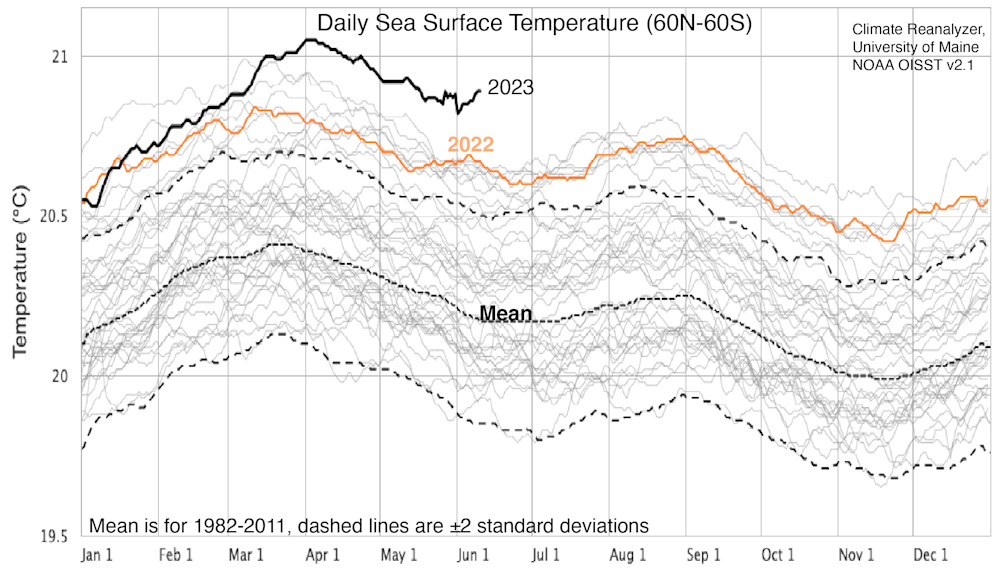
Meanwhile, record high sea surface temperatures in the extratropical North and South Pacific were partly a signature from La Niña and partly a sign of global warming. The resulting “atmospheric rivers” delivered torrential rains to California in the north and New Zealand in the south.
These sea surface temperature changes can be readily seen by comparing variations from mean temperatures for December 2022 versus May 2023 (Figure 2 below). We can see a startling transformation throughout the central tropical Pacific, with a coastal El Niño off Peru and Ecuador strongly evident.
Modest cooling in the eastern North Pacific is associated with the train of storms that barrelled into the West Coast of the US and in northwest Australia from Cyclone Ilsa.
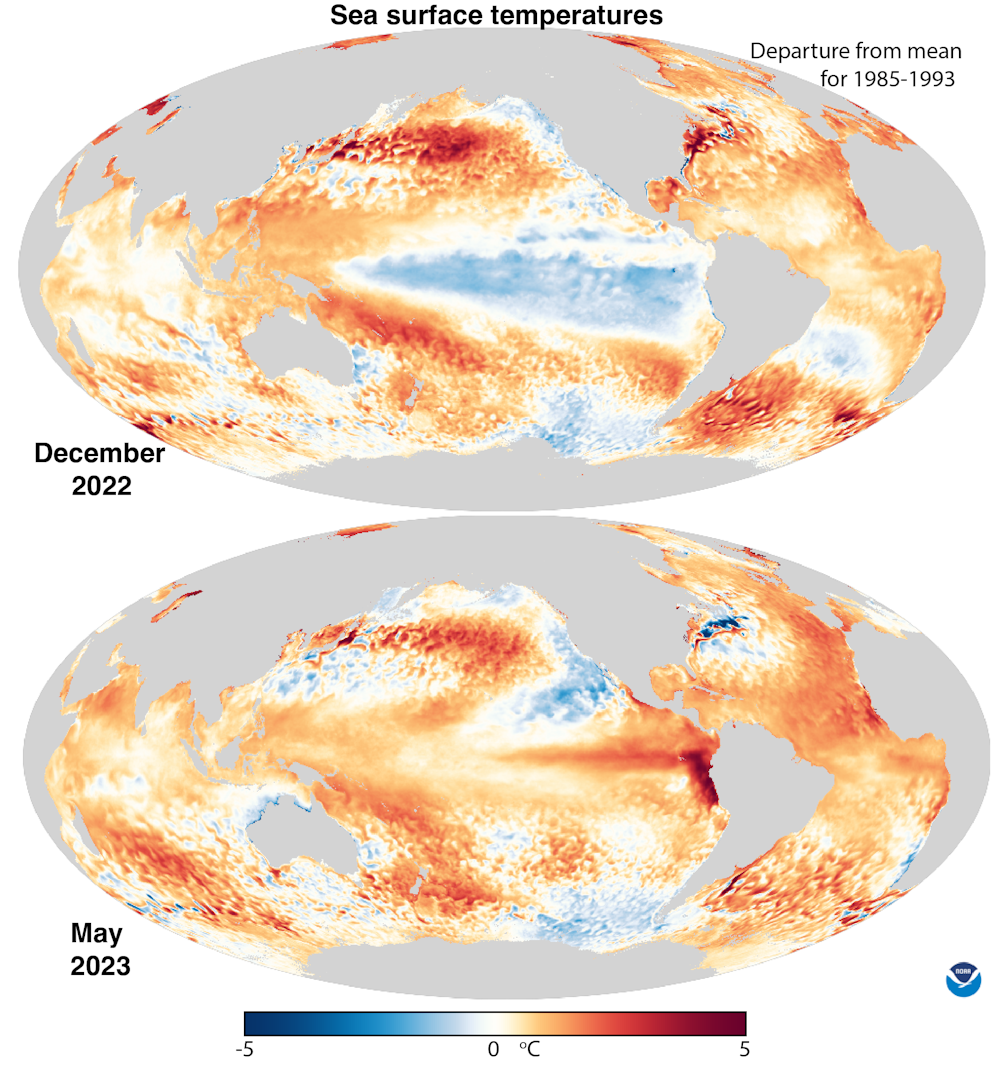 Fig 2. Sea surface temperature changes (measured by departure from the mean), comparing December 2022 and May 2023.
National Oceanic and Atmospheric Administration, Author provided
Fig 2. Sea surface temperature changes (measured by departure from the mean), comparing December 2022 and May 2023.
National Oceanic and Atmospheric Administration, Author provided
El Niño and New Zealand
The weather in the tropics is seldom average, however. It tends to fluctuate more like a roller coaster. In the atmosphere, this is referred to as the Southern Oscillation. The combined atmosphere and ocean phenomenon is often referred to as the El Niño-Southern Oscillation (ENSO).
The bottom of the roller coaster is the cold phase: a basin-wide cooling of the tropical Pacific, named La Niña, while the top of the roller coaster is El Niño, which occurs every three to seven years or so. The most intense phase of each event typically lasts half a year.
But El Niños can be very strong, and hence highly anomalous. La Niñas, by comparison, are usually moderate in strength and occur more often.
El Niños tend to peak in December, although their biggest atmospheric impacts may not be until February. The last major El Niño was in 2016-17, while a weak El Niño occurred in 2019-20.
Read more: El Niño is back – that's good news or bad news, depending on where you live
Coupled oceans and atmosphere
In the tropical Pacific Ocean, the atmosphere and ocean are strongly coupled. Surface winds drive surface ocean currents, and largely determine the sea surface temperature distribution, the differential sea levels, and the heat content of the upper ocean. In turn, the sea surface temperatures determine the winds.
Cool waters limit atmospheric convection and storm activity, while high sea surface temperatures attract convection, clusters of thunderstorms, and tropical cyclones (off the equator, where Earth’s rotation comes into play).
Heat that was stored up in the tropical western Pacific during La Niña is moved around and into the atmosphere during El Niño, mainly through evaporation. This cools the ocean and moistens the atmosphere.
This alters where the main rainfall occurs. In turn, it changes the latent heating of the atmosphere that sets up “teleconnections” (links between weather phenomena in different parts of the globe) and major changes in the jet streams and extratropical storm tracks in both hemispheres – including across New Zealand, especially in winter.
Because most action occurs over the tropical Pacific Ocean, more settled weather and dry spells often occur over land.
The warmest years in terms of global mean surface temperature are the latter stages of El Niño events. 2016 is the world’s warmest year on record, in part because of the very strong El Niño event. But 2023 could beat that record – and odds are that 2024 will beat it by a lot.
So far, there is little evidence that climate change has altered ENSO events themselves. But all impacts of El Niño are exacerbated by global warming, including extremes of the hydrological cycle involving floods and droughts, which are already common with ENSO.
Impacts of El Niño
Of course, major events related to El Niño have serious social and economic impacts, too. Droughts, floods, heatwaves and other changes can severely disrupt agriculture, fisheries, health, energy demand and air quality (mainly from wildfires).
Research shows El Niño “persistently reduces country-level economic growth”, with damage now estimated in the trillions of US dollars.
Globally, El Niño is the largest cause of droughts; they are more intense, set in quicker and increase the risk of wildfires, especially in Australia, Indonesia and Brazil. In the weak 2019-20 El Niño, smoke from fires in eastern Australia affected the southern hemisphere to the extent that it blocked the sun and may have exacerbated the subsequent La Niña conditions.
Meanwhile, torrential rains are heavier, with greater risk of flooding, especially in Peru and Ecuador. Very wet conditions can also (though not always) occur in California and the southeast US.
Read more: New study helps solve a 30-year-old puzzle: how is climate change affecting El Niño and La Niña?
Another ‘super’ El Niño?
New Zealand had its highest annual mean surface temperature on record in 2022. In the past year the preponderance of northeasterlies due to La Niña has seen an unprecedented number of tropical and subtropical storms bombarding the country.
The record rain event in Auckland on January 27, and Cyclone Gabrielle just three weeks later, were just two among many such events.
By contrast, New Zealand tends to experience stronger and more frequent winds from the southwest in winter and from the west in summer during El Niño. This can encourage dryness in eastern areas and more rain on the West Coast, with generally cooler conditions overall.
But El Niño varies, and there have been three “super” El Niños: 1982-83, 1997-98 and 2015-16. It remains to be seen whether the latest will join them. But together with the augmenting effects of global warming, any El Niño can be very disruptive. We need to be vigilant.
Authors: Kevin Trenberth, Distinguished Scholar, NCAR; Affiliate Faculty, University of Auckland