Why is the sky dark at night? The 200-year history of a question that transformed our understanding of the Universe
- Written by Jonathan Biteau, Maître de conférence en physique des astroparticules, Université Paris-Saclay
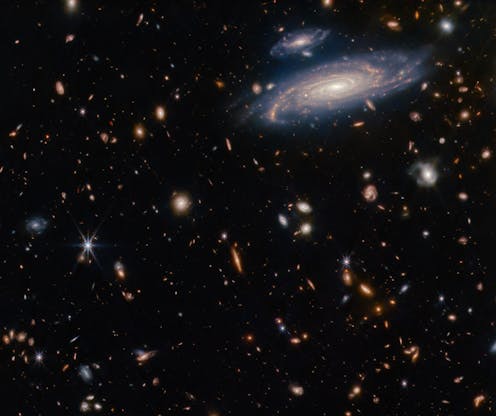
As dawn rose over the German city of Bremen on May 7 1823, Heinrich Olbers put the finishing touches to an article that left his name in history. After the deaths of his wife and daughter, Dr Olbers had recently given up his work as an opthalmologist to devote himself to his nocturnal passions: the stars, the Moon, meteorites and comets.
Like many of his peers, Olbers trained himself in astronomy. He gained a solid reputation in the academic world and spent long nights observing the sky from the observatory on the second floor of his house.
On that morning, Olbers had come to a strange conclusion: based on all that was known about the Universe at that time, the night sky should not have been dark. In fact, the entire heavens should have been glowing as brightly as the Sun.
Olbers was not the first to note this paradox. But his name is the one we attach to it today. The enigma of the night sky’s darkness has echoed down the centuries from Olbers and the poet Edgar Allan Poe to 20th-century astronomers and space probes today.
Finite light in an infinite Universe
Like many of his contemporaries, Olbers followed Isaac Newton and René Descartes in believing the Universe was infinite.
If the Universe were finite and static, the force of gravity should draw all the stars together at a central point. But if the Universe stretched on forever, gravitational forces would on average be balanced in all directions.
But Olbers realised this model of the cosmos was inconsistent with observations. In a limitless Universe filled with an infinite number of stars, wherever we look at night our gaze should land on the surface of a star, in much the same way as every line of sight in a forest ends at a tree.

This is the problem Olbers raised in his paper of May 7 1823: the cosmological model of the time suggested every point in the sky should be as bright as the surface of the Sun. There should be no night.
Olbers proposed a solution: the light from more distant stars was absorbed by dust or other material floating in space. The English astronomer John Herschel later pointed out this couldn’t be right, because anything absorbing that much light would eventually heat up enough to glow.
When Olbers died on March 2 1840, at the age of 81, the riddle we know today as Olber’s paradox was unsolved.
A poet’s intuition
Eight years later, on the other side of the Atlantic Ocean, poet and writer Edgar Allan Poe thought he had found an answer. On February 3 1848, he gave a public lecture about his ideas to 60 people at the New York Society Library.
Veering between metaphysics and science, Poe argued the cosmos had emerged from a single state of matter (“Oneness”) that fragmented and dispersed under the action of a repulsive force.
This meant the Universe was a finite sphere of matter. If the finite universe is populated by a sufficiently small number of stars, then we won’t see one in every direction we look. The night can be dark again.
Even if we assume the Universe is infinite, if it began at some point in the past then the time taken by light to reach us would limit the size of the amount of the Universe we can see. This travel time would create a horizon beyond which distant stars would remain inaccessible.
Poe’s audience at the New York Society Library did not give him the rapturous reception he had hoped for. Later the same year, he published his theories in the prose poem Eureka, which was little circulated.
The following year, on October 7 1849, Poe died at the age of 40. It would be more than a century before scientists confirmed his intuitions about the enigma of the dark night sky.
Two and a half facts
In the first half of the 20th century many new theories of the cosmos were developed, spurred on by Einstein’s theory of general relativity, which explained gravity, space and time in new ways. In the second half of the century, these cosmological theories began to be tested with observations.
In 1963, British astronomer Peter Scheuer argued that cosmology was based on only “two and a half facts”:
- fact 1: the night sky is dark, which had been known for some time
- fact 2: galaxies are moving away from each other, as shown by Hubble’s observations published in 1929
- fact 2.5: the content of the Universe is probably evolving as cosmic time unfolds.
Strong controversies on the interpretation of facts 2 and 2.5 agitated the scientific community in the 1950s and 1960s. Was the Universe essentially stationary, or had it begun in an enormous explosion – a Big Bang? Supporters of both sides conceded, however, they needed to explain the darkness of the night sky.
The lifetime of stars
British cosmologist Edward Harrison resolved the conflict in 1964. He showed that the main factor determining the brightness of the night sky is actually the finite age of the stars.
The number of stars in the observable Universe is extremely large, but it is finite. This limited number, each burning for a limited time, spread over a gigantic volume, lets darkness manifest itself between the stars.
Harrison later realised this solution had already been proposed not only by Edgar Allan Poe, but by British physicist Lord Kelvin in 1901.
Observations in the 1980s confirmed the resolution proposed by Poe, Kelvin and Harrison. Olber’s paradox had finally been put to rest.
Fossil light
Or perhaps not quite. Viewed from a different angle, there is another resolution to the paradox: the night sky is not actually so dark after all.
After the discovery of the expansion of the Universe in the late 1920s, scientists realised the Universe could have started off extremely compact, dense and hot. This is the “hot Big Bang” model we have today.
One core prediction of this model is the existence of “fossil light” released in the cosmic dawn. This fossil light should be observable today – but not with the naked eye, as the expanding Universe would have shifted it to longer wavelengths.
This radiation – the cosmic microwave background – was detected in 1964. Now measured with exquisite accuracy, the cosmic background radiation is the most common light in the Universe.
We now know the cosmos is also illuminated by a second, much fainter background light, produced by galaxies as they form and evolve. This light is referred to as the cosmic ultraviolet, optical and infrared background.
So we can also answer Olber’s paradox by saying the sky is not dark, but faintly glimmers with the dim relic radiation of all that has been over the finite lifetime of the Universe.
New answers, new questions
In 2023, Olber’s paradox has evolved into a rich field of research. In our own work, we carry out ever-more precise measurements of the brightness of the night sky, and simulate the stars of the cosmos with supercomputers. We can now determine the number of stars in the sky with great accuracy.
Nevertheless, puzzles remain. Last year the New Horizons space probe, out beyond the orbit of Pluto and away from the dust of the inner Solar System, found the sky is twice as bright as we expected it to be.
And so the question of the darkness of the sky lives on, crossing ages and cultures.
Authors: Jonathan Biteau, Maître de conférence en physique des astroparticules, Université Paris-Saclay