What’s a fair price to pay for music? In Australia, musicians aren’t getting paid as much as overseas artists for songs played on the radio
- Written by Rod Davies, Lecturer in popular music and songwriting, Monash University
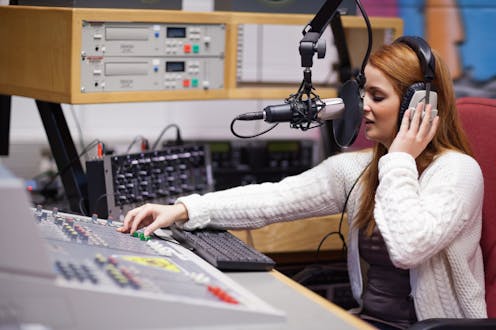
The Australian recording industry recently announced a campaign called Radio Fair Play.
The campaign argues “artists and rights holders aren’t getting paid fairly for songs played on radio”, in reference to the license fees radio stations pay for the use of songs in their broadcasts.
In Australia, sound recording license fees are collected by the Phonographic Performance Company of Australia (PPCA) who distributes the revenue as income to record labels and artists. PPCA claims Australian radio pays between just 10 and 27% of the commercial rates paid elsewhere in the world and artists here are being considerably underpaid.
It seems like a simple argument - “pay artists fairly”. But there are more factors at play than just whether radio stations will pay higher fees.
For starters, standing in the way is a 55-year-old Australian law that currently protects commercial radio and the ABC from paying more.
What are radio caps?
Formal recognition of economic rights in sound recordings didn’t exist in Australia until the introduction of the Copyright Act in 1968. Prior to this, only songwriters received royalties when their music was played on the radio.
Parliamentary negotiations leading up to the Copyright Act were dominated by the broadcasters and record companies, and focused on two crucial points of contention: who do the broadcasters have to pay? And how much do the broadcasters have to pay?
The Labor opposition supported the legislation of sound recording rights for all parties - record labels, broadcasters and performers. However, the governing coalition was dramatically split in its support. While the Liberals were keen on the proposal, the Country Party held serious concerns that license fees would severely impact regional radio, a position that threatened to dismantle the coalition.
In the end, the Copyright Act 1968 included an economic right for sound recordings, but in order to keep the government intact and appease the broadcasters, limitations on license fees were also legislated.
“Radio Caps” place an upper limit on annual license fees for the use of sound recordings, such as songs. Commercial stations are capped at no more than 1% of their gross revenue, while the ABC pays $0.005 (half a cent) multiplied by the total population of Australia.
PPCA argues these laws are unfair, “unique to sound recordings” and puts Australia in a position that is “out of step” with the rest of the world.
They have a point. The rate for sound recordings is currently set at 0.4%. In comparison, songwriting royalty rates for Australian commercial radio, which have no such statutory cap, are set at a much higher rate of up to 3.76%.
If the caps are scrapped, the market could determine what the music is worth and, effectively, the size of the revenue pool. Labels and artists expect their share of the pool, which is determined according to their proportion of airplay, to receive a significant boost.
Paying artists more for the use of their music on radio is a great concept, but the Radio Fair Play campaign cannot result solely in “better deals” for record companies and artists. It must be fair for all musicians, as well as the listeners, consumers and communities who rely on broadcast radio.
Is it as easy as removing the caps?
PPCA have “fought for decades” to remove these caps. Their claims have been supported by a number of independent reviews, and in 2006 the Australian government announced the caps would be abolished - but this has never happened.
If PPCA want to be successful this time around, they will need to have broader support across not only the music industry, but the wider community as well.
This campaign must address the potential effects of higher license fees on regional radio, such as redundancies and closures. The demise of local regional print journalism has been well documented, and radio is one of few remaining media that offers communities a local voice.
There are a number of solutions that have already been proposed for the struggling regions, such as new media monopoly laws, government advertising subsidies, and startup funding for new communications technologies.
But concrete plans to support these communities need to be designed and implemented by industry and government before regional media receive another shattering blow in being forced to pay a higher proportion of their revenue in music licensing.
Read more: Regional journalism is dying: advertising subsidies won't help
More than just an ‘artist’ issue
There is another issue for performers that needs to be addressed as well. New laws that aim to grow the royalty revenue pool should also remunerate musicians that are currently not being supported by license fees.
While the Copyright Act 1968 offered no economic rights to performers at large, there has since been global advancements in intellectual property rights and equitable remuneration.
From the late 90s, session musicians on sound recordings have received a share of broadcast license fees all around the world - except in Australia, where session musicians get no royalty payments at all.
This issue is absent from the Radio Fair Play campaign. If the recording industry believes fixing one anomaly is important, they should also support fairness overall.
It will take a unified approach and some bold reform to ensure there is a whole-of-industry solution that covers all of the issues and equitably remunerates all of the players. Australia painted itself into a corner in 1968, and now there’s quite a lot of renovating to do.
Authors: Rod Davies, Lecturer in popular music and songwriting, Monash University