What is a solstice? An astronomer explains the long and short of days, years and seasons
- Written by Jonti Horner, Professor (Astrophysics), University of Southern Queensland

Happy solstice everyone! The mid-year solstice in 2023 falls at 2:58 pm UTC on 21 June (or, in more advanced time zones like the one I’m writing from, in the early hours of 22 June).
Depending on where you are reading this, this will either be your winter solstice (for those in the southern hemisphere) or the summer solstice (for our northern readers).
But what is the solstice? What does it mean for our day-to-day lives? Well the answer all boils down to orbits – the way Earth whirls and wobbles as it wends its way around the Sun.
The seasons: the result of a moving platform
Earth is a moving platform – orbiting the Sun in a little more than 365 days. Despite our incredible orbital speed (around 30 kilometres per second), we don’t feel this motion. Instead, it appears to us as though the Sun is moving through the year.
Imagine for a moment you could remove Earth’s atmosphere, revealing the background stars at the same time as the Sun. Those stars, incredibly distant, rise and set every 23 hours, 56 minutes and 4 seconds - the true rotation period of Earth.
The Sun, though, rises and sets roughly every 24 hours – making the “solar day” 3 minutes and 56 seconds longer than Earth’s true rotation period.
That difference is the result of the Sun’s apparent motion against the background stars. From our imaginary airless Earth, we would see the Sun gradually sliding through the constellations of the zodiac, making one full lap of the sky in one year.
But things are a little more complicated. You see, our moving platform is tipped over, tilted on its side by about 23.5 degrees.
As we move around the Sun, our planet alternately tilts one hemisphere towards our star, then away again. This is the cause of the seasons.
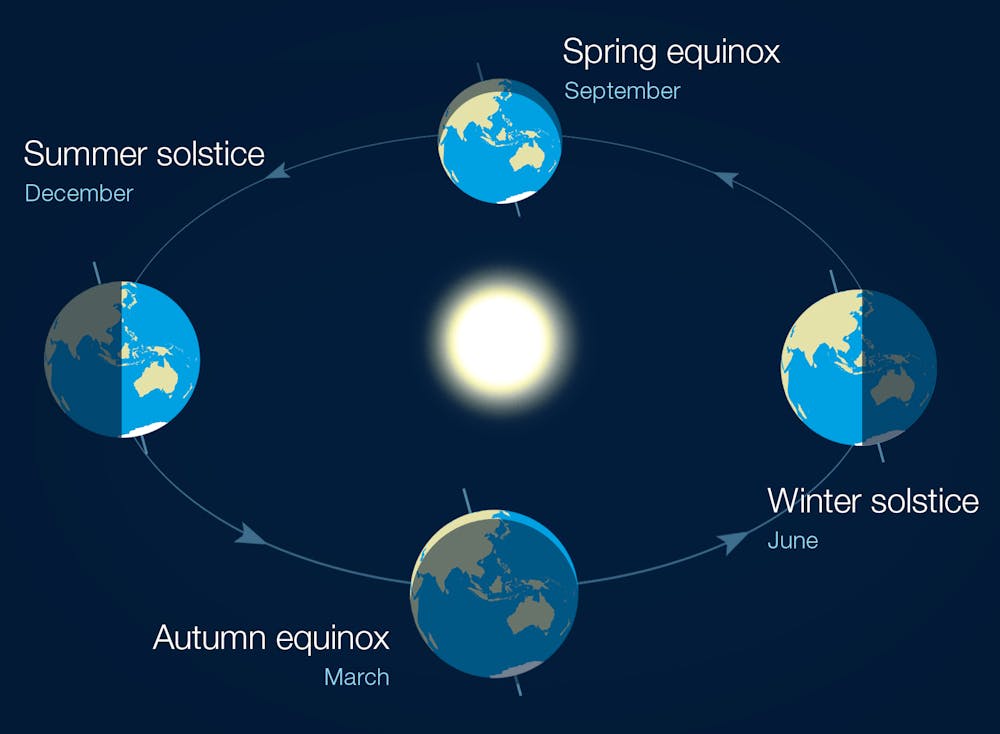
When your hemisphere is tilted towards the Sun, you have summer – long days, with the noonday Sun high in the sky. Six months later, when you are tilted away, you have winter – the noonday Sun is low, days are shorter, and there is a chill in the air.
Between those extremes, the Sun gradually drifts north and south. At the extremes of its motion, it would be overhead from 23.5° north of the Equator (northern hemisphere midsummer) or 23.5° south (southern midsummer).
In total, then, the Sun’s motion moves it between two extremes some 47° apart. Low in the sky in winter, and high in summer.
So what are the solstices?
The two solstices are the points at which the Sun is either the farthest north in the sky (which is what we have today), or at its most southerly location.
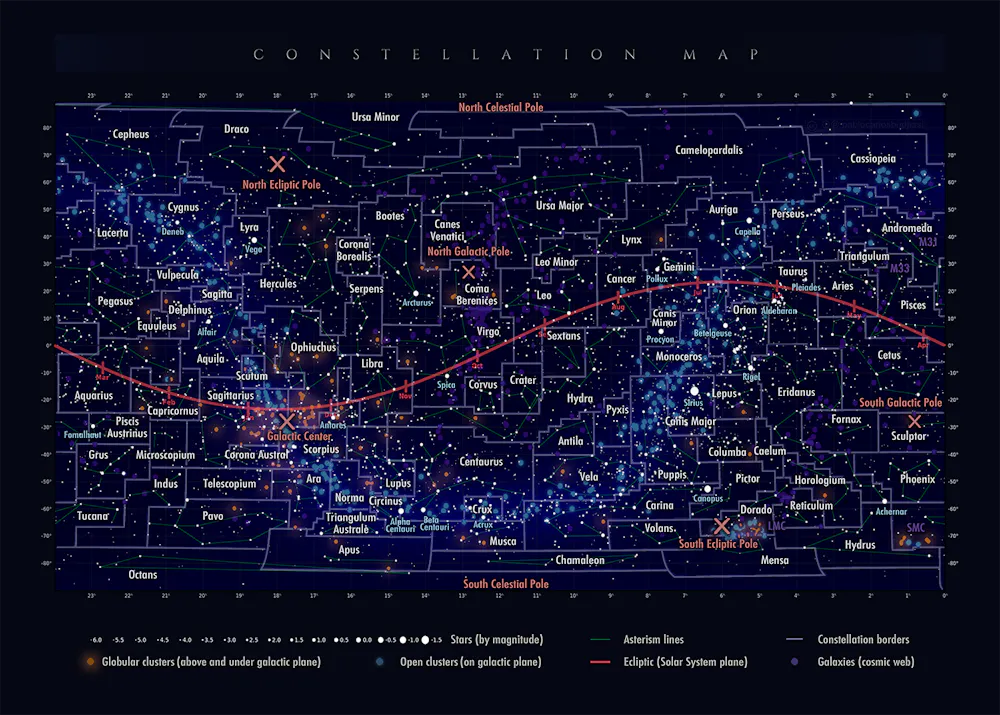 A map of the entire night sky, like a map of the Earth, showing (in red) the path followed by the Sun through the course of the year - a path known as the ‘ecliptic’.
Pablo Carlos Budassi/Wikipedia
A map of the entire night sky, like a map of the Earth, showing (in red) the path followed by the Sun through the course of the year - a path known as the ‘ecliptic’.
Pablo Carlos Budassi/Wikipedia
When the Sun is farthest north in the sky, it will appear lowest in the sky at noon from locations in the southern hemisphere. This also means the shortest period of daylight of the calendar year.
For the northern hemisphere, the situation is reversed – the summer solstice places the noonday Sun high in the sky, with the longest period of daylight of the year.
Read more: Why the sunrise is still later after the winter solstice shortest day
In six months’ time, on December 22 this year, we will have the other solstice – marking the point at which the Sun is at its most southerly point in the sky. That will bring with it the longest day for those in the southern hemisphere, and the shortest for those in the north.
It’s easy to find out when the Sun will rise and set at your location. Many websites provide this information these days - here, for example, is all that information for my home town – Toowoomba, in southeast Queensland.
Defining the seasons: climate or cosmology?
To an astronomer, and to many people around the world, today marks the change of the seasons. In the southern hemisphere, it is the first day of winter. In the north, the first of summer.
Strangely, the solstices are also known as midsummer’s day and midwinter’s day – which leads to the strange idea that winter starts at midwinter!
By this astronomical definition for the seasons, summer runs from midsummer to the autumnal equinox (when the Sun crosses the Equator). Autumn runs from that equinox to midwinter’s day. Winter goes from midwinter to the spring equinox, and spring goes from the spring equinox through to midsummer.
In Australia, however, most people are familiar with seasons beginning on the first day of the months of March, June, September and December.
The reason is down to how our climate behaves. In a simple universe, one would expect the longest day to be the hottest (with most time for the Sun to heat the Earth) and the shortest day to be the coldest (the most hours of darkness for things to cool down).
However, things are somewhat more complex. The atmosphere, the ground, and particularly the oceans, take a long time to heat up and to cool down. The result? The warmest time of the year for many places (but not all!) comes a few weeks after midsummer.
While the days are getting shorter, the ocean, ground and air continue to warm up. Similarly, the coldest time in winter is usually a few weeks after midwinter.
Our concept of summer (rather than the astronomer’s definition) is built around this. We think of the middle of summer being the hottest time of year, and the middle of winter being the coldest.
There’s always another secret
Before I leave you to enjoy the rest of the year’s shortest (or longest) day, there’s one extra cool fact about the seasons that most people don’t appreciate. We imagine the seasons are of equal length - three months of each, in a 12-month year.
But we forget. Not all months are alike. Some are shorter than others (poor February).
Look at a calendar, and add up the days in each astronomical season, and you find something surprising.
The southern hemisphere summer (northern winter), from December 22 to March 21, lasts just 89 days. The southern winter (northern summer), by contrast, is almost 94 days long!
Read more: The messy history of our modern, Western calendar
The southern autumn (March to June) is almost 93 days long, while the northern autumn (September to December) is only 90 days.
The reason behind these variations is, once again, all down to Earth’s orbit. As we move around the Sun, the distance to our star varies slightly.
Sometimes, we are closer to our star, and Earth moves faster in its orbit. At other times, we are more distant, and move slower.
In just a couple of weeks time, on July 7, Earth will reach its farthest point from the Sun, which astronomers call “aphelion”. On that date, we will be more than 152 million kilometres from our star.
Six months later, on January 3 2024, we will be at our closest to the Sun – “perihelion” – just over 147 million kilometres distant.
This really highlights one of the beauties of astronomy. Simply put – there’s always another secret – the deeper you look into something, the more beautiful complexity you will find.
So here’s to another 93 days of winter!
Authors: Jonti Horner, Professor (Astrophysics), University of Southern Queensland