

The Zaporizhzhia nuclear power plant is a 'dirty bomb' waiting to happen – a nuclear expert explains
- Written by: Tilman Ruff, Honorary Principal Fellow, School of Population and Global Health, The University of Melbourne
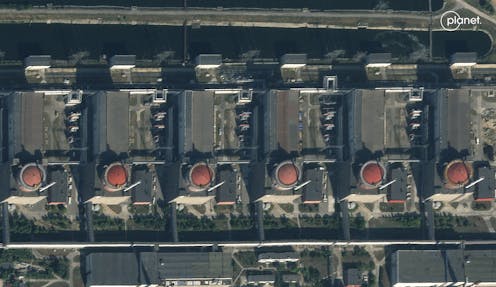
After the explosion at the Kakhovka Dam in Ukraine last month, many Ukrainians feared the Zaporizhzhia nuclear power plant could be next.
These concerns have been heightened in recent weeks as both Ukraine and Russia have accused each other of planning an attack of the plant, which has been under Russian control since March 2022.
The International Atomic Energy Agency (IAEA) has not found any evidence of explosives in recent inspections, but also said it had yet to be granted access to all parts of the huge plant.
So, how serious are the risks of an attack at the power plant? And how disastrous would this be for Ukraine and the wider world?
Europe’s largest nuclear power plant
Construction of the Zaporizhzhia power plant began in 1981. Five reactors were commissioned between 1984-89, and a sixth in 1995. The reactors are more modern than the graphite-moderated reactors at Chernobyl, and are similar to the pressurised water reactors in widespread use in the United States and Europe.
The plant is Europe’s largest, built on the southern bank of the Kakhovka Reservoir on the Dnipro River, from which it draws its cooling water. Before the Russian invasion, Ukraine generated about half its electricity from 15 nuclear power reactors across four sites, with Zaporizhzhia generating almost half of this.
The plant has cooling ponds for spent nuclear fuel, which require continuous power and water (like the reactors themselves). It also has a dry cask storage facility for spent reactor fuel when it no longer requires continuous water cooling.
In 2017, Ukraine reported there were just over 2,200 tons of highly radioactive spent fuel at Zaporizhzhia, in the spent fuel pools and dry cask storage.
Read more: Could the Ukraine dam attack pose risks to the Zaporizhzhia nuclear power plant? Experts explain
How quickly a meltdown could happen
Barely a week after the invasion began, Russian forces captured Zaporizhzhia. During heavy combat, a fire broke out in a training facility, while other parts of the plant were damaged.
In September 2022, the plant was fully disconnected from the electricity grid. Five reactors were put into cold shutdown. The sixth was maintained in hot shutdown at around 200 degrees Celsius, producing steam for the plant.
The Ukrainian nuclear regulator ordered a cold shutdown of this reactor last month, but this has not happened. Extensive maintenance work on the reactors is overdue.
The fuel inside nuclear reactors needs continuous, active cooling for many months after a reactor shutdown because of the heat that continues to be produced by the decay of hundreds of different fission products. The longer the fuel is inside a nuclear reactor, the more radioactive it becomes. That is why when fuel is removed from a reactor, it still requires continuous, active cooling for years.
The world saw in dramatic fashion in Fukushima, Japan, in 2011 what can happen when continuous, active cooling of nuclear reactors is disrupted.
More than 70% of the total radioactivity at the Fukushima power plant was in the spent fuel ponds, which have none of the carefully engineered containment layers that reactors typically have.
In his classic 1981 book Nuclear Radiation in Warfare, Nobel Peace Prize-winning physicist Joseph Rotblat documented how
in a pressurised water reactor, the meltdown of the core could occur within less than one minute after the loss of coolant.
The radioactivity released from damaged spent fuel ponds could be even greater than from a meltdown at the reactor itself, he wrote.
His study makes clear that a military attack on a reactor or spent fuel pond could release more radioactivity – and longer-lasting radioactivity – than even a large (megaton range) nuclear weapon.
As nuclear physicist Edwin Lyman makes clear, if the Zaporizhzhia reactor cooling was interrupted, there might be a day or two before the spent fuel began to overheat and degrade.
The melting reactor core would then collapse onto the floor inside its steel primary containment vessel and melt through to the floor of the building. Large amounts of radioactive gases and aerosols would be released into the environment, potentially explosively.
The radioactive release could possibly be at Chernobyl-scale or even larger amounts if multiple reactors and spent fuel ponds were involved. This could then spread across borders and continents with the wind, rivers and currents, and come down in hotspots in rain and snow.
A nuclear plant under continuous assault
The Russian invasion of Ukraine is the first time war has engulfed operating nuclear plants and, in a real sense, weaponised them as potential radiological weapons, or “dirty bombs”.
As IAEA Director General Rafael Grossi has documented, Zaporizhzhia has been under comprehensive and unprecedented assault. This has included:
repeated shelling of the plant
frequent interruption of the critical electricity supply to the plant, forcing operators to rely on emergency diesel generators as the last line of defence
a full-scale occupation by Russian troops, with far fewer than the normal staff working at gunpoint under extreme psychological and physical duress
the facility being turned into a military base laden with heavy weapons and surrounded by landmines and other explosives.
Then, on June 6, the explosive breach of the Kakhovka Dam jeopardised the plant’s ultimate source of cooling water.
The other three nuclear power plants in Ukraine have also experienced interruptions to their electricity supply. In addition, other nuclear facilities have been shelled, struck by missiles or otherwise damaged.
A wake-up call to the dangers of nuclear power
Some nuclear experts have inappropriately downplayed the risk of deliberate or accidental breach of the containment structures at Zaporizhzhia.
However, the IAEA and independent experts have highlighted the very real risk of a catastrophe.
Russia has already launched large-scale attacks on civilian infrastructure in Ukraine, including its energy grid. Evidence also suggests it was behind the dam explosion. We cannot discount that Russia might resort to turning Zaporizhzhia into a radiological weapon, despite how close the plant is to its own territory.
Russia’s ongoing failure to agree to the IAEA plea to establish a demilitarised zone in and around Zaporizhzhia also does not inspire confidence.
The reality is that as long as nuclear power plants continue to operate, we are frighteningly vulnerable not only to severe accidents, but also to the weaponisation of these facilities. This is now all too clear at Zaporizhzhia.
No other energy technology is associated with such extreme safety and security risks. If Zaporizhzhia were a wind farm or solar array, the risk of a severe accident with global and intergenerational consequences – not to mention weapons proliferation or intractable waste issues – would be precisely zero.
Correction: this story has been amended to say the stated quantity of radioactive nuclear fuel at Zaporizhzhia includes just the spent fuel in the pools and dry cask storage, not the fuel inside the reactors.
Authors: Tilman Ruff, Honorary Principal Fellow, School of Population and Global Health, The University of Melbourne


















