

Another assault on Country and its precious species has begun at Binybara/Lee Point
- Written by: John Woinarski, Professor of Conservation Biology, Charles Darwin University
In federal Environment Minister Tanya Plibersek’s first major speech, she said:
If we continue on the trajectory that we are on, the precious places, landscapes, animals and plants that we think of when we think of home may not be here for our kids and grandkids.
Yet, as you read this, the bulldozers are poised to destroy habitat for threatened species, subvert traditional cultural values and jeopardise a fabulous aspect of Darwin’s natural environment at Lee Point/Binybara. The government’s decision to approve this loss shows a continuing disregard for nature, cultural heritage and the legacy our descendants will inherit.
The battle to protect Binybara – as it is known to its Traditional Owners – has galvanised the local community. But the issues at stake are much broader and expose the tick-a-box nature of our unsatisfactory environmental laws.
The clearing of over 100 hectares of savanna woodland at Binybara for a defence housing development was first approved in 2019. When endangered Gouldian finches turned up in their hundreds last year, Plibersek agreed to reconsider the approval.
But in June this year the minister decided the development could proceed with a few more conditions. Last week, Traditional Owners, Darwin locals and ecologists from a nearby conference watched as the first trees were felled.
On Friday there was a reprieve: a ten-day pause to consider the Larrakia people’s concerns.
What’s at stake?
The conflict between conservation or destruction at Binybara has global, national and local contexts.
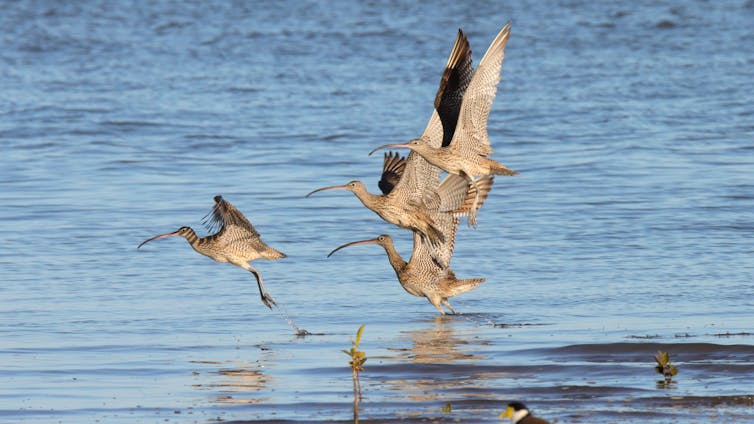
The shoreline near the proposed housing is a globally significant site on the flyway of many shorebirds that migrate from eastern Asia to Australia each year. These birds face threats from habitat loss and degradation across their range. Their numbers are in steep decline.
Northern Australia has to date provided some respite from disturbance for these travellers. But an 800-home development would increase human activity and disturbance at a site already under pressure.
The national context is that most of our threatened species continue to decline. It’s often a result of an ongoing series of small losses – a patch of bushland cleared here, a population lost there. We cannot reduce the risks of extinction, let alone restore biodiversity, if these losses continue.
Binybara’s incredible richness of birds is valued by locals and tourists alike. Regarded as one of the world’s most beautiful birds, the Gouldian finch’s presence on the outskirts of Darwin is a particular blessing. The proposed development will jeopardise this population, particularly by destroying trees whose hollows provide potential nest sites.
The project’s environmental impact statement acknowledged it would also have a significant impact on another endangered species, the black-footed tree-rat. Tree felling would likely cause deaths of individuals and loss of hollows on which the species depends.
A deep cultural significance
The Larrakia people’s deep and rich cultural ties to this area stretch back millennia. For them, Binybara is a sacred place.
It’s here that their ancestor Binybara transforms into a bird to fly out to see her husband Darriba Nungalinya.
The birdlife, from the migrating shorebirds to the owls, kites, eagles and Gouldian finches, is integral to the ecosystems and to the cultural fabric and story of this place. Generations of Larrakia people have lived, hunted, gathered foods, sourced materials and performed ceremonies here.
The woodlands provide foods such as the bowit-jba or bush potato (Brachystelma glabriflorum), datbing-gwa or sugarbag, green plum (Buchanania obovata), milky plum (Persoonia falcata), emu berry (Grewia retusifolia), possum (gutjgutjga), wallaby (milulu-la) and goanna (damiljulberreba).
Eucalyptus miniata timber is used for didjeridoo, harpoons, walking sticks, digging sticks and good firewood. Eucalyptus tetrodonta provides medicine and bark canoes. The bark and timber are also used for traditional houses. Erythrophleum chlorostachys (delenyng-gwa) leaves are used for smoking ceremonies and the inner bark for medicine to treat sores and deep wounds.
Hibiscus tiliaceus (lalwa) is a source of string for ropes, nets and harpoons. Its straight stems are used for fishing spears. Casuarina equisetifolia provides digging sticks for turtle eggs, firewood and beach shade. The paperbark from Melaleuca species (gweybil-wa) is used for cooking, bedding and roofing material, dugout canoes and rafts, while the leaves have medicinal uses.
Timber from the calendar plant, Acacia auriculiformis (gwalamarrwa), is used for clapsticks, while the pods are used medicinally. Dance practice for funerals happens here, using gwalamarrwa leaves.
It’s likely shell middens, artefact scatters and clay pits will need to be surveyed. There is a possible burial site in the area, a well and a registered sacred site at the tip of Lee Point. Tree burials, where the deceased was placed in a tree, may have taken place, so there may be scarred trees here.
The ten-day reprieve is due to an emergency application sought by the Traditional Owners under the federal Aboriginal and Torres Strait Islander Heritage Protection (ATSIHP) Act. They ask for a management plan to protect their cultural heritage to be developed with their input and that of experts and Darwin locals who value this place.
Read more: Recognising Indigenous knowledges is not just culturally sound, it's good science
A(nother) failure of national environment law
The main change to the approval was to require plans be developed to offset the loss of 94 hectares of Gouldian finch habitat. What those offsets are – or whether they are even possible – is not yet known.
This kind of “backloading” of offset conditions is highly risky. By the time the difficulty of finding a suitable offset site becomes clear, it is often too late – the habitat is gone.
Just two weeks ago, Plibersek ordered an audit of 1,000 environmental offset sites. “It’s not clear whether offset arrangements prevent environmental decline,” she said.
Read more: Developers aren't paying enough to offset impacts on koalas and other endangered species
What we do know is that old-growth habitat features, such as tree hollows, are irreplaceable. And inherently place-based cultural values cannot be offset. This is ever more important as the Northern Territory moves to ramp up land clearing for cotton growing and gas development.
Another new condition is to maintain a 50-metre buffer zone around a dam where the finches drink. It’s a tokenistic measure, as the finches disperse hundreds of metres to feed and further to nest in old-growth hollow trees, like those in the areas to be cleared.
The case of Binybara exemplifies many of the failings of the Environment Protection and Biodiversity Conservation (EPBC) Act identified by the Samuel review. The test of the government’s promised reforms to the EPBC Act will be whether decisions like this continue to be made, leading to the loss of irreplaceable habitats and sacred cultural heritage.
Right now, the future of Binybara hangs by a thread.
Read more: Get the basics right for National Environmental Standards to ensure truly sustainable development
Authors: John Woinarski, Professor of Conservation Biology, Charles Darwin University


















