

study finds plastic pollution in the world's lakes can be worse than in oceans
- Written by: David Hamilton, Director, Australian Rivers Institute, Griffith University
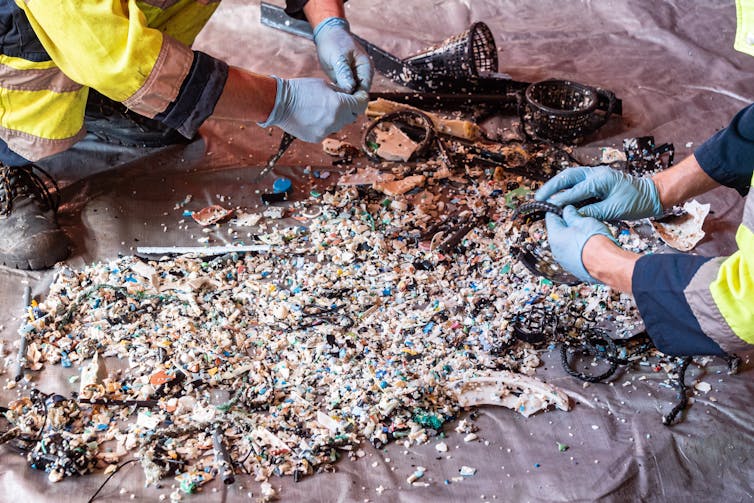
A world-first study has found concentrations of plastics in some lakes are higher than in the most contaminated parts of oceans, demonstrating the extent to which plastics have invaded Earth’s ecosystems.
In a study released today, researchers sampled 38 lakes and reservoirs around the world, including in Australia, the United States, United Kingdom and Europe. Plastics and microplastics were found at every site, including very remote locations.
Lakes are sentinels for human activity. Many lakes are already suffering from issues such as algal blooms, deoxygenation, over-extraction and drying. Plastic contamination adds yet another threat to these highly stressed ecosystems.
The plastics problem
After plastics enter the environment, they generally break up and become smaller and smaller. Eventually they become microplastics – defined as particles less than 5 mm in size.
Plastic takes decades to disappear. It can harm ocean and aquatic life and contaminate water used by humans.
Plastics can be washed into lakes from the adjacent land areas. Lake water can sit for a long time without being flushed out, allowing plastics to accumulate. We don’t yet know much about whether microplastics are absorbed by filter feeding organisms such as clams, mussels and zooplankton, and how plastics affect the food chain.
Plastic debris is widespread in freshwater ecosystems. But much of the focus has been on marine ecosystems, and knowledge of the scope of the problem in lakes and reservoirs has been hampered by a lack of appropriate data. Our research set out to close this gap.
Read more: Plastic pollution threatens birds far out at sea – new research
What we did
A global team of scientists, of which we were part, examined the abundance and type of plastic debris in freshwater ecosystems. Surface waters were sampled in 38 lakes and reservoirs across 23 countries (mostly in the Northern Hemisphere) and six continents.
Importantly, we used a standardised collection and analysis method, including very fine plankton nets to sample the plastic debris. These steps allowed for comparisons between lakes.
Broadly, we found plastic debris in all lakes studied. Most plastics were in the microplastic size range. However, concentrations varied widely.
Some 21 lakes had low concentrations – below one particle per cubic metre (m³). Of the remainder, 14 lakes had concentrations between one and five particles per m³ and three lakes had concentrations higher than five particles per m³.
Forest Lake in Brisbane was the Australian study site. It’s a popular urban lake used by many people for recreation. This lake had three plastics particles per cubic metre, ranking it sixth worst among the 38 lakes sampled.
The three most polluted lakes were, in order, Lake Lugano (Switzerland, Italy), Lake Maggiore (Italy) and Lake Tahoe (US).
In each of these lakes, plastic concentrations reached or exceeded those in “floating garbage patches” – marine areas collecting large amounts of debris, such as the Great Pacific Garbage Patch. These ocean areas were previously thought to be the worst cases of plastic pollution in water environments.
These three polluted lakes – as well as the heavily contaminated Lough Neagh in Northern Ireland – are also important sources of drinking water for local communities.
Read more: Whales and dolphins found in the Great Pacific Garbage Patch for the first time
Where is the plastic coming from?
The second part of our study sought to identify the landscape factors affecting the abundance and type of plastic debris.
More than 90% of the plastic particles belonged to two shape categories: fibres and fragments. We even found textile fibres in lakes and reservoirs in remote areas with limited human presence, such as Avery Lake in the US state of Michigan.
Our analysis indicated two types of lake are particularly vulnerable to plastic contamination: those in highly urbanised and populated areas, and those with a large surface area.
The most common colour of plastic particle was black (30%), followed by transparent (24%), blue (18%) and white (13%). The low concentrations of particles in bright colours, such as red, suggests these more visible plastics may have been mistaken by aquatic organisms for food, and ingested.
So what next?
Marine environments are generally considered the final resting place for plastic debris. But our research confirms plastic concentrations in freshwater ecosystems can be higher than those in oceans.
Our results indicate that lakes play a major role in the global plastic cycle. This points to an urgent need to develop management policies to reduce plastic pollution in freshwater lakes. This, in turn, will help prevent plastics from entering waterways and ending up in marine systems.
We don’t know how much plastic debris ends up in water supplies. We suggest this gap be addressed as soon as possible, and the ecological harm caused by microplastics should become a global management and research priority.
Our study also underscores the urgent need for coordinated, systematic monitoring of plastic pollution.
Sadly, it seems no lake can be considered truly “pristine” with respect to plastic pollution. Our research serves as yet another unfortunate reminder of humanity’s indelible signature on nature.
Read more: We have no idea how much microplastic is in Australia's soil (but it could be a lot)
Authors: David Hamilton, Director, Australian Rivers Institute, Griffith University


















