

Has Russia contained the Prigozhin threat? Its long history of managing violent mercenaries suggests so
- Written by: Mark Edele, Hansen Professor in History, Deputy Dean, The University of Melbourne
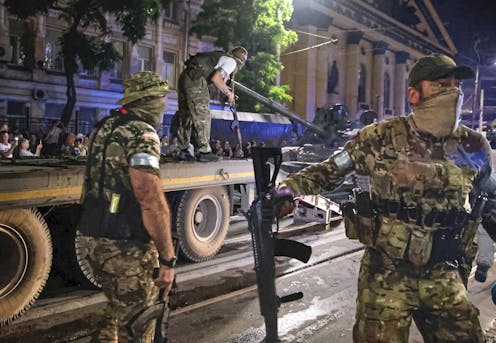
A month on since pundits declared the imminent start of a new Russian civil war, we’re still waiting. Moreover, we still know very little about what went on when Wagner leader Yevgeny Prigozhin launched a brief rebellion against the Kremlin.
The basic outlines of what happened are as follows: after months of conflict between the various power brokers around Russian President Vladimir Putin, Prigozhin made a move.
The former criminal might have been drunk with his support on social media. More importantly, his business interests and political position were threatened by an attempt to bring his Wagner Group under state control. So he set his troops in motion to prompt the removal of his rivals in Moscow. The goal was to elevate his own position within the power structure, not destroy the system which had made him.
As Prigozhin’s troops marched on Moscow, they shot down choppers and a military plane. But then, Putin publicly sided with the regular military by calling Prigozhin a traitor. Prigozhin backed down.
Since then, the story has become even more bizarre. Having agreed to move to Belarus, he instead shuttled between Belarus, Moscow and St. Petersburg, presumably in an attempt to rescue whatever he could of his business empire. This includes a restaurant and catering empire, his military enterprise, a media company and a rather effective internet troll factory, as well as various mining concessions abroad.
He even secured a meeting with Putin, who, according to his spokesman, told the mercenaries what he thought of their actions and their possible futures.
While the Kremlin sent signals the one-time traitor might have been forgiven, the Russian state simultaneously went after his assets and raided his mansion, revealing his “opulent lifestyle that contrasts with the public image of a crusader against corruption,” as one media outlet put it.
Prigozhin continues to try to contain the fallout of his misjudged adventure. Late last week, he was filmed in Belarus addressing his fighters, which suggests the agreement that ended the mutiny has been at least partially implemented. However, it also appears Prigozhin flew in from Russia for the speech and returned there afterwards.
Russia’s history of paramilitarism
What are we to make of all of this? First, while it is true Putin’s position certainly was not strengthened by the rebellion, the destabilisation should not be over-drawn. Putin’s dictatorship is “a closed, personalist authoritarian regime, potentially en route to becoming a more totalitarian model,” as one political scientist has noted.
It is highly repressive towards the population. But it is not a top-down, military-style operation, where the boss makes decisions and everybody else stands to attention. Putin is frequently indecisive and the power structure around him is dynamic. People and power-clans can move in and out of the inner layers as they compete for power and influence.
Russia is a state with a bureaucracy, army and police forces, but its monopoly of force is eroded by the proliferation of privatised armies. They are misleadingly called “private military companies”, but are an integral part of a power structure which can be described, using the terminology of historians Vesna Drapac and Gareth Prichard, as “paramilitarised”.
In a paramilitarised regime, the state can be challenged and undermined, but not completely destroyed, by semi-independent military, paramilitary or criminal organisations. This type of violent regime was observed in much of central and eastern Europe after the first world war, in many parts of the Nazi empire and in the western borderlands of the Soviet Union after the second world war.
In a civil war or warlordism (like in China after 1916 or Russia after 1917), the state either ceases to exist or becomes one of many violent actors vying over control of bits of territory. By contrast, in a paramilitarised regime, the state gradually loses its ability to control the violence, but is not complete destroyed.
Russia has existed in states of paramilitarisation for quite a long time, and the regime has learned to live with, and to control, the private armies of entrepreneurs. Russia entered the post-Soviet world in 1991 with a fragile democratic regime, barely able to control the wielding of physical force.
Some of the first private military companies emerged in this context, but more important were the violent robber barons politely described as “oligarchs”. They ran their own affairs and their private armies of leather-jacketed thugs enforced their contracts. They acted as if they owned Russia, while the state was there to serve their interests. This was a paramilitarised regime of violent entrepreneurs. The main difference to Prigozhin was that war-making was not part of the business model.
Since 2000, Putin has put them all in their place. He did so slowly and methodically. He told the oligarchs what was expected of them (as he did with Prigozhin after the mutiny).
He then took them on, one after the other, like cutting a salami, slice by slice, until nothing was left. Those who did not submit to the rebuilt Russian state were eventually exiled, arrested or killed. But this was not a one-day operation. It took years.
Joseph Stalin, one of the heroes of Russia’s history-obsessed president, called this approach “dosage”.
Challengers would be undermined gradually: first removed from the inner sanctum around the leader, then pushed from formal positions of power, and eventually arrested, exiled or shot. This whole process was designed, as historian Sheila Fitzpatrick has argued, to bring the other leaders on board who might otherwise side with the victim.
Putin presides over a much more volatile power structure. He has an even greater need for “dosage”: he needs to keep the men (and a few women) around him divided and devoted to himself as the ultimate arbiter. His own power depends on it.
And the stakes have become higher after he allowed some of them partially to privatise the state’s means of violence, undermining his earlier successful efforts to re-establish the state’s monopoly over force.
Read more: Wagner's rebellion may have been thwarted, but Putin has never looked weaker and more vulnerable
New private military companies emerge
The context of this return to paramilitarism in recent years was war: first in Iraq, then in Syria and finally in Ukraine.
In Iraq, the Russian oil companies needed to protect their assets, so they used their private armies to do so. These were illegal in Russia, but allowed to operate abroad.
Soon, Russian private military companies proliferated. Some of them then broadened their operations to escort ships in the piracy-infested waters off the African coast or security work in Africa itself. The civil war in Syria offered new opportunities.
However, the Russian state remained wary of the military entrepreneurs, particularly if they tried to establish a presence back home. Two major private military company leaders, of the Slavonic Corps, were arrested in 2013 and convicted as mercenaries.
This is where Prigozhin stepped in. Putin’s regime suddenly needed private military companies to help fight the war in eastern Ukraine from 2014 while maintaining plausible deniability: the fighters were all “volunteers” or “locals.”
Hence Prigozhin, a long-time, loyal Putin client, was put in charge of the remnants of Slavonic Corps. The mercenaries were returned to Russia and “curated” by the restaurateur into the Wagner Group, which then fought in Ukraine and Syria. Contracts to secure Russian oil and gas installations in North Africa and Venezuela soon followed.
These contracts were then leveraged to negotiate deals to train special forces in Africa and Latin America. Payment was often in lucrative mining concessions.
Read more: The rise of Yevgeny Prigozhin: how a one-time food caterer became Vladimir Putin's biggest threat
From the perspective of the Russian state, these international ventures had several functions: they secured Russian military interests, raised funds and helped Russia gain diplomatic influence at a time when it had become more and more isolated internationally.
Finally, sending the mercenaries abroad removed them as a threat to the Russian state at home. Even during the battle of Bakhmut in Ukraine, Prigozhin’s greatest claim to fame, the core of the Wagner group had “remained in Africa.”
Can the threat be contained again?
This was how the Russian state managed the paramilitary threat and deployed it to its own ends. The Prigozhin rebellion, however, showed how risky this tactic is when the mercenaries are deployed next door, in Russia’s war against Ukraine. Russia had veered back to paramilitarism – but of a new type, driven by modern-day entrepreneurs of violence rather than the violent entrepreneurs of the 1990s.
A month later, however, it appears this was only temporary. Putin’s regime is in the process of containing the threat. And it uses tactics it has employed before: dosage, public shaming, seizure of assets, the deployment of dangerous mercenaries away from home.
This tactic might work again. One month on, it is still too early to predict the outcome, but it certainly appears that expectations for Russia’s dissolution or the collapse of Putin’s regime were premature.
Putin might yet fail in reasserting his authority, but at the moment there is little evidence that he is.
Authors: Mark Edele, Hansen Professor in History, Deputy Dean, The University of Melbourne


















