

How does ice cream work? A chemist explains why you can't just freeze cream and expect results
- Written by: Nathan Kilah, Senior Lecturer in Chemistry, University of Tasmania
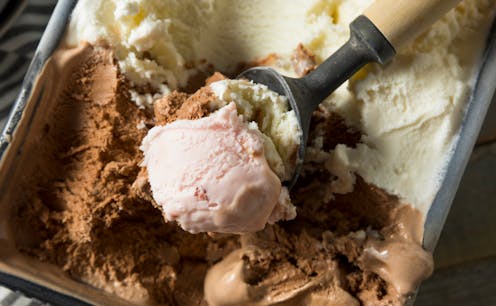
Ice cream seems like a simple concept. Take some dairy, add some sugar and flavours, and freeze.
But to get a perfectly creamy, smoothly textured frozen treat, we need more than just a low temperature – it takes a careful interplay of chemistry and three states of matter: solid, liquid and gas.
What’s in the box?
Commercial ice cream includes many ingredients: air, water, milk fat, so-called milk solids (mainly milk proteins and lactose), sweeteners, stabilisers, emulsifiers and flavours. The ingredients are mixed and pasteurised for food safety.
Homemade ice creams tend to use milk, heavy cream, sugar and flavourings, such as fruit, berries, or chocolate. The exact quantities vary with the recipe, but the processing steps are similar.
Milk is composed of everything a young cow needs to grow and develop – water, fats, carbohydrates, proteins, minerals and vitamins. These components respond in different ways when they are frozen.
Read more: Crying over plant-based milk: neither science nor history favours a dairy monopoly
First, the crystals
As the mixture of ice cream ingredients is cooled down, small clusters of water molecules assemble to form tiny ice crystals. The size of the ice crystals is responsible for the mouth feel of the ice cream – the smaller the crystals, the smoother the feel.
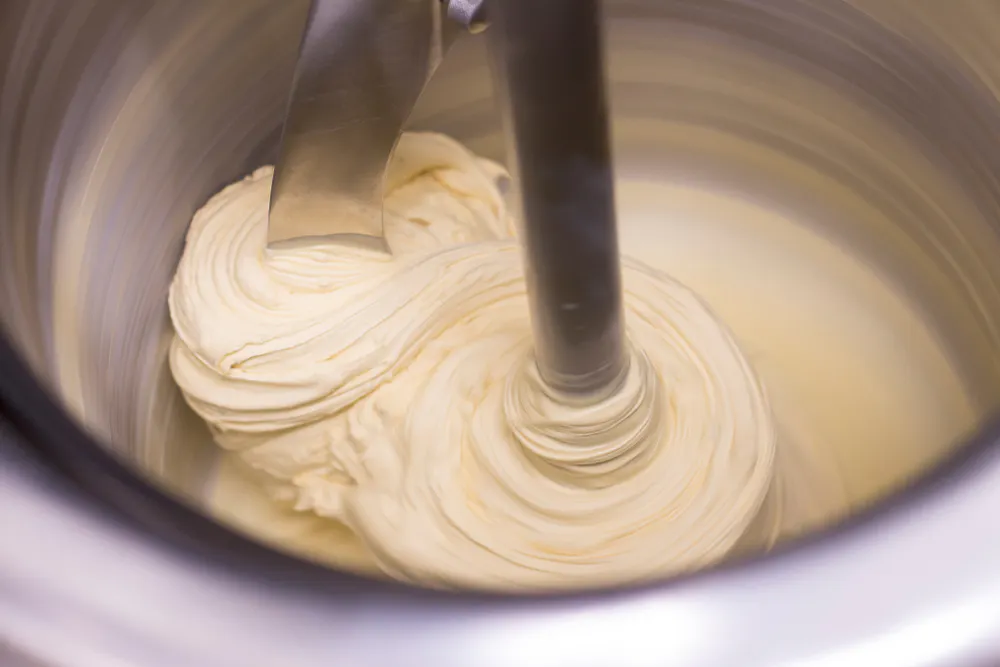
If the crystallisation is not well controlled, these crystals can get very large. Ice cream makers (commercial or for home use) ensure small ice crystals by agitating or beating the liquid as it freezes. This keeps the water molecules moving and prevents the crystals from growing larger.
The mixing process also incorporates air, which is the secret ingredient to give ice cream a lighter texture.
Next, the fat
The fat in the milk exists as globules surrounded by proteins. These proteins bridge the fat and the water, helping to keep the fats suspended. (Milk looks white because light scatters off these fat globules.)
These dairy fat molecules have different properties at different temperatures. At room temperature they are semi-solids (like butter), and are about two-thirds solid when at 0℃.
The fat globules can stick together – that’s why you get a layer of cream on top of unprocessed milk. A process called homogenisation forces the milk through a small opening under very high pressure, breaking large fat globules down into smaller ones. This process makes many small fat globules – as many as a trillion per litre. Homogenised milk ensures the mixture will freeze evenly, and separated fats won’t get stuck to the mixing machinery.
Freezing the fat globules makes them clump together, with the surrounding proteins acting as bridges to other fat molecules and to the ice crystals. These fats melt in your mouth, giving a creamy feel and taste.
Read more: Slip, slop, slurp! The surprising science of sunscreen, sand and ice cream
Then, the sugar
The sugar and other dissolved ingredients in milk are also essential to the final texture of ice cream. The presence of sugars in the water lowers the mixture’s freezing temperature to below 0℃.
Here’s why that’s important. As ice crystals start to form, the concentration of sugars and other dissolved materials in the unfrozen liquid increases, which further lowers its freezing point. By the time the majority of the ice crystals have formed, the resulting liquid is very concentrated in sugars.
This concentrated liquid, known as the “serum”, bridges between the ice crystals, solid fat globules and air bubbles. The serum remains a liquid well below 0℃ and adds enough flexibility to the mixture so the ice cream can still be scooped or shaped.
In this way, the unique chemical properties of water, fats, proteins and sugars come together with air to give the solid, liquid and gas mixture we know and love.
Not everything is ‘ice cream’
What’s called “ice cream” is actually governed by a food standards code. That’s why not all frozen desserts can be legally called ice cream, because they don’t contain enough milk fat.
There are lots of variations on the standard ice cream recipe. Gelato uses more sugar, incorporates less air, and typically has less fats and other solids. Sorbets do away with the dairy and typically contain more sugar, but have historically used egg or gelatin as a protein source.
Regardless of the exact recipe, the fundamental ice crystal formation, fat solidification, and serum phase separation steps are the same.
Product names like “soft serve”, “dairy dessert”, or “ice confection” are often an indication the ingredient list includes vegetable fats rather than more expensive milk fats.
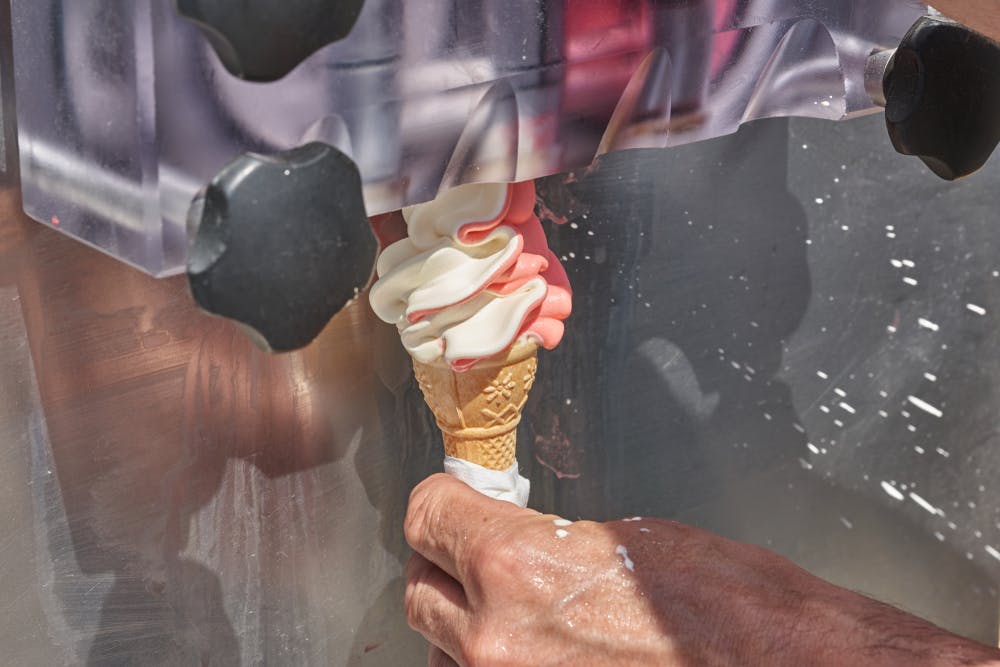 Technically, soft serve isn’t ice cream.
Shutterstock
Technically, soft serve isn’t ice cream.
Shutterstock
Soft serve products are also formed by agitation as the mixture freezes, but tend to contain less air than ice cream you’d buy in a tub, due to the constant agitation inside the dispensing machine.
Icy poles, ice blocks, freezies, or freeze pops (depending on your local phraseology) and other “water ices” are frozen inside a mould or plastic tubing. The shape of the mould limits the ability to stir the mixture, so the freezing process is typically done “quiescently”, meaning at rest. The crystallisation of the ice is not well controlled, and you may have experienced large crystals that have grown (technically “seeded”) from the popsicle stick.
Humanity has enjoyed ice cream for centuries. It’s a marvellously versatile food with endless variations of flavours, additives, and toppings coupled with memories of happiness, comfort, indulgence and nostalgia. And plenty of chemistry, too.
Authors: Nathan Kilah, Senior Lecturer in Chemistry, University of Tasmania


















