

Could the law of the sea be used to protect small island states from climate change?
- Written by: Ellycia Harrould-Kolieb, Lecturer and Research Fellow in Ocean Governance, University of Melbourne and Postdoctoral Researcher, UEF Law School, University of Eastern Finland, The University of Melbourne
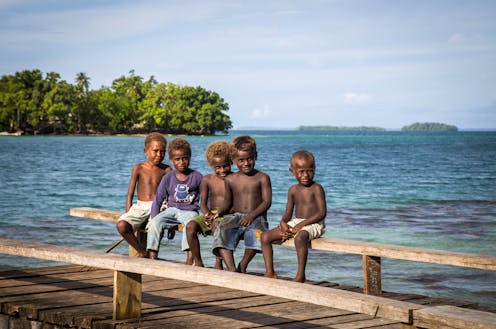
Climate change will wreak havoc on small island developing states in the Pacific and elsewhere. Some will be swamped by rising seas. These communities also face more extreme weather, increasingly acidic oceans, coral bleaching and harm to fisheries. Food supplies, human health and livelihoods are at risk. And it’s clear other countries burning fossil fuels are largely to blame.
Yet island states are resourceful. They are not only adapting to change but also seeking legal advice. The international community has certain legal obligations under the law of the sea. These are rules and customs that divvy up the oceans into maritime zones, while recognising certain freedoms and duties.
So island states are asking whether obligations to address climate change might be contained in the United Nations Convention on the Law of the Sea. This is particularly important as marine issues have not received the attention they deserve within international climate negotiations.
If states do have specific obligations to stop greenhouse gas pollution damaging the marine environment, then legal consequences for breaching these obligations could follow. It is possible small island states could one day be compensated for the damage done.
Why seek an advisory opinion?
The International Tribunal for the Law of the Sea is an independent judicial body established by the UN Convention on the Law of the Sea. The tribunal has jurisdiction over any dispute concerning the interpretation or application of the convention and certain legal questions requested of it. The answers to these questions are known as advisory opinions.
Advisory opinions are not legally binding, they are authoritative statements on legal matters. They provide guidance to states and international organisations about the implementation of international law.
The tribunal has delivered two advisory opinions in the past: on deep seabed mining and illegal, unreported and unregulated fishing activities. These proceedings attracted submissions from states, international organisations and non-governmental organisations such as the World Wide Fund for Nature (WWF).
Late last year, the newly established Commission of Small Island States on Climate Change and International Law submitted a request for advice to the tribunal. It concerns the obligations of states to address climate change, including impacts on the marine environment.
The tribunal received more than 50 written submissions from states and organisations offering opinions on how it should respond. These submissions, from Australia and New Zealand among others, were recently made public.
While the convention was not designed as a mechanism for regulating climate change, its mandate is broad enough to consider the connection between climate and the oceans. To establish this, the 40-year-old framework agreement must be interpreted in light of changing global circumstances and changing laws, including obligations to strengthen resilience in the high seas. One avenue to achieve this is through an advisory opinion from the tribunal.
The question before the tribunal
The question to the tribunal asks, what are the specific obligations of states:
(a) to prevent, reduce and control pollution of the marine environment in relation to the deleterious effects that result or are likely to result from climate change, including through ocean warming and sea level rise, and ocean acidification, which are caused by anthropogenic greenhouse gas emissions into the atmosphere?
(b) to protect and preserve the marine environment in relation to climate change impacts, including ocean warming and sea level rise, and ocean acidification?
This question invokes specific language from the convention. That provides clues as to which sections of the treaty the tribunal will refer to in its opinion.
The question refers explicitly to the part of the convention entitled “Protection and Preservation of the Marine Environment”. This part sets out the general obligation of states to protect and preserve the marine environment, as well as measures to “prevent, reduce and control pollution”. It also tells states they must not transfer damage or hazards, or transform one type of pollution into another.
Pollution of the marine environment is defined in the convention as:
the introduction by man, directly or indirectly, of substances or energy into the marine environment, including estuaries, which results or is likely to result in such deleterious effects as harm to living resources and marine life, hazards to human health, hindrance to marine activities, including fishing and other legitimate uses of the sea, impairment of quality for use of sea water and reduction of amenities.
What if states do not meet their obligations?
The tribunal will need to answer a key question for the law of the sea: can the convention be understood as referring to the drivers and effects of climate change? And if so, in what ways does the convention require that they be addressed by states?
What the commission’s question does not ask is, what happens when states do not meet their obligations? The answer is particularly important to small island states, who are dissatisfied with ongoing negotiations on addressing loss and damage associated with climate change impacts.
Obligations relating to climate change are contained within other treaties and rules, including the UN Framework Convention on Climate Change and the Paris Agreement. Small island states have sought advice from different courts to clarify these obligations.
The International Court of Justice will consider a wider set of legal issues on climate obligations next year.
The fact that the court has authorised the commission to participate in this separate advisory opinion request signals the UN’s main judicial body will take account of the tribunal’s opinion. It’s also worth noting the tribunal is likely to deliver its views on the law of the sea first, setting the stage for a broader interpretation of international law when it comes to taking responsibility for polluting the atmosphere.
Sustained pressure from small island states is advancing our understanding of the obligations of states to address climate change.
Authors: Ellycia Harrould-Kolieb, Lecturer and Research Fellow in Ocean Governance, University of Melbourne and Postdoctoral Researcher, UEF Law School, University of Eastern Finland, The University of Melbourne


















