

Modern Australian
Times Advertising

Bees have appeared on coins for millennia, hinting at an age-old link between sweetness and value

  • Written by Adrian Dyer, Associate Professor, Monash University
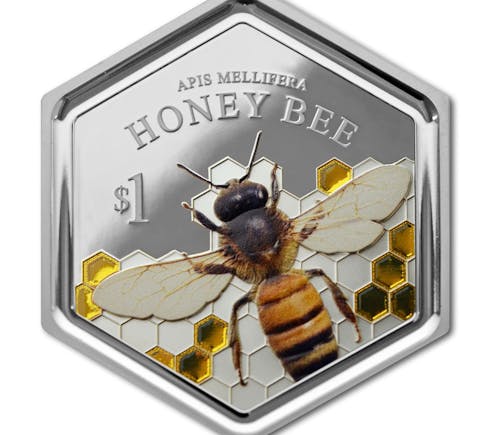
Bees have appeared on coins for millennia, hinting at an age-old link between sweetness and value

In 2022, the Royal Australian Mint issued a $2 coin decorated with honeybees. Around 2,400 years earlier, a mint in the kingdom of Macedon had the same idea, creating a silver obol coin with a bee stamped on one side.

Over the centuries between these two events, currency demonstrating a symbolic link between honey and money is surprisingly common.

In a recent study in Australian Coin Review, I trace the bee through numismatic history – and suggest a scientific reason why our brains might naturally draw a connection between the melliferous insects and the abstract idea of value.

A Royal Australian Mint 2022 two-dollar coin representing 200 years since the introduction of the honeybee to Australia.

What is currency and why is it important?

Money is a store of value, and can act as a medium of exchange for goods or services. Currency is a physical manifestation of money, so coins are a durable representation of value.

Coins have had central role in many communities to enable efficient trade since ancient times. Their durability makes them important time capsules.

Ancient Malta was famous for its honey. The modern 3 Mils coin (1972-81) celebrates this history with images of a bee and honeycomb. According to the information card issued with the coin set,

A bee and honeycomb are shown on the 3 Mils coin, symbolising the fact that honey was used as currency in Ancient Malta.

A circulating 3 Mils coin from Malta showing a honeybee on honeycomb.

In ancient Greece, bees were used on some of the earliest coins made in Europe. A silver Greek obol coin minted in Macedon between 412 BCE and 350 BCE, now housed in the British Museum, shows a bee on one side of the coin.

An ancient obol from Macedon, dated between 412 BCE and 350 BCE, shows a bee one side.

Bees also feature on coins minted elsewhere in the ancient Greek world, such as a bronze coin minted in Ephesus dated between 202 BCE and 133 BCE.

A bronze coin minted in Ephesus, dated between 202BCE and 133BCE, featuring a honeybee.

The use of bees on ancient coins extended for many centuries including widely circulated bronze coins, and new varieties continue to be discovered.

Why we might like bees on coins

Why have bees appeared so often on coins? One approach to this question comes from the field of neuro-aesthetics, which seeks to understand our tastes by understanding the basic brain processes that underpin aesthetic appreciation.

From this perspective, it seems likely the sweet taste of honey – which indicates the large amount of sugar it delivers – promotes positive neural activity associated with bees and honey.

Read more: From rock carvings to rock music – the prevalence of bees in art throughout human history

Indeed, primatologist Jane Goodall once proposed that obtaining high-calorie nutrition from bee honey may have been an important step in the cognitive development of primates.

Our brain may thus be pre-adapted to liking bees due to their association with the sweet taste of honey. Early usage of bees on coins may have been a functional illustration of the link between a known value (honey) and a new form of currency: coins as money.

The bee on modern coins

A 1920 Italian bronze ten-centesimi coin featuring featuring an Italian honeybee on a flower.

The use of bees as a design feature has persisted from ancient to modern times. A honeybee visiting a flower is shown on a series of ten-centesimi bronze coins issued in Italy from 1919 to 1937.

(As an aside, the world’s last stock of pure Italian honeybees is found in Australia, on Kangaroo Island, which was declared a sanctuary for Ligurian bees by an act of parliament in 1885.)

A coin from Tonga showing 20 honeybees emerging from a hive.

More recently, a 20-seniti coin from the Pacific nation of Tonga shows 20 honeybees flying out of a hive. This coin was part of a series initiated by the Food and Agriculture Organization of the United Nations to promote sustainable agricultural and cultural development around the world.

Bees are relevant here because their pollinating efforts contribute to about one-third of the food required to feed the world, with a value in excess of US$200 billion per year, and they are threatened by climate change and other environmental factors.

Read more: Bees face many challenges – and climate change is ratcheting up the pressure

Bees on coins, today and tomorrow

Public awareness of bees and environmental sustainability may well be factors in the current interest in bee coins. The diversity of countries using bees as a design feature over the entire history of coins suggests people have valued the relationship with bees as essential to our own prosperity for a long time.

In Australia, the 2022 honeybee $2 coin is part of a series developed by the Royal Australian Mint. In 2019, the Perth Mint in Western Australia also released coins and stamps celebrating native bees.

Australian native bee coin and stamps released in 2019 by the Perth Mint.

Despite the decline of cash, bee coins still appear to be going strong. The buzzing companions of human society are likely to be an important subject for coin design for as long as coins continue to be used.

Authors: Adrian Dyer, Associate Professor, Monash University

Read more https://theconversation.com/bees-have-appeared-on-coins-for-millennia-hinting-at-an-age-old-link-between-sweetness-and-value-208912

Why Pendant Lights Continue To Be A Popular Choice In Modern Interiors

Lighting has become an essential design element in modern homes, influencing both the appearance and functionality of interior spaces. Many homeowne...

How Whiteboard Supports Structured Communication In Work And Learning Environments

Clear communication and structured planning are essential in both professional and educational settings, which is why a whiteboard remains a practi...

How A Cardboard Box Manufacturer Supports Modern Packaging Needs

Packaging has become an essential part of modern business operations across retail, manufacturing, logistics, and e-commerce industries. Many busine...

How Pallet Racking Helps Businesses Improve Warehouse Operations

Efficient warehouse management depends on reliable storage systems that support organisation, safety, and productivity. Many businesses use pallet rac...

Why I/O Controller Is Essential For Efficient Industrial Automation Systems

Modern industrial systems rely heavily on automation and precise data exchange, which is why an I/O controller plays a critical role in ensuring sm...

Why Modern Traffic Management Systems Are Important For Safer Roads

Cities and industrial facilities increasingly rely on advanced Traffic Light System technology to improve road safety, traffic flow, and operationa...

How Structured eCommerce Web Design Influences Online Buying Behaviour

A strong online presence begins with effective eCommerce web design that prioritises both functionality and user experience. Businesses entering or...

What People Mean by “Alternative Doctor” And Why Expectations Around Care Are Changing

When people search for an “alternative doctor,” they’re usually looking for something specific, even if they haven’t fully defined it yet. I...

Why Does My Power Keep Tripping? Common Causes Explained by Electricians Sydney

The electrical system is the lifeblood of your home, powering everything from your phones to cooking utensils and more. But from time to time, your po...

Interstate Car Transporter Urges Buyers to Book Early

As the conflict in the Middle East continues to put increasing pressure on local fuel supply, Australian transport companies are experiencing increasi...

Digital Minimalism for Business Owners: Fewer Tools, Better Systems

Be honest. How many apps are open right now? One for scheduling, another for invoices, a third for customer notes, plus a spreadsheet someone email...

The Importance Of Proactive NDIS Renewal Preparation For Sustaining Your Provider Business

Your NDIS renewal notice is not a signal to start preparing. By the time it arrives, preparation should already be well underway. For new providers, s...

Why Fire Extinguisher Testing in Sydney Is Becoming a Records Game, Not Only a Maintenance Job

A fire extinguisher used to feel like one of the simpler parts of building safety. It hung on the wall, wore a service tag, and sat there quietly unle...

The Switchboard Upgrade Question Every Melbourne Renovator Should Ask Before the Walls Close Up

Renovations have a funny way of making people think on surfaces first. Splashback, stone, joinery, tapware, paint. Fair enough too. That is the exciti...

Winter Sanitation Gaps in Parramatta Kitchens: A Hidden Pest Risk

Winter brings a host of changes to our homes, from the chill in the air to the cozy warmth indoors. However, this season also introduces sanitation ch...

When to Seek Advice from Employment Lawyers in Melbourne

Australian employment law is detailed and, at times, complex, with rights and obligations that aren't always obvious to employees or employers witho...

7 Benefits of Professional Gutter Cleaning for Australian Homeowners

Gutters aren't exactly glamorous. They sit up there on the edge of your roof, doing their job quietly - until they stop working. Clogged, overflowing ...

Pipe Floats Strengthening Pipeline Performance In Demanding Environments

Pipelines often travel through environments that are anything but predictable, water currents shift, terrain changes, and materials keep moving unde...

















