

how cutting-edge technology is helping scientists understand baby corals
- Written by: Marine Gouezo, Postdoctoral research fellow, Southern Cross University
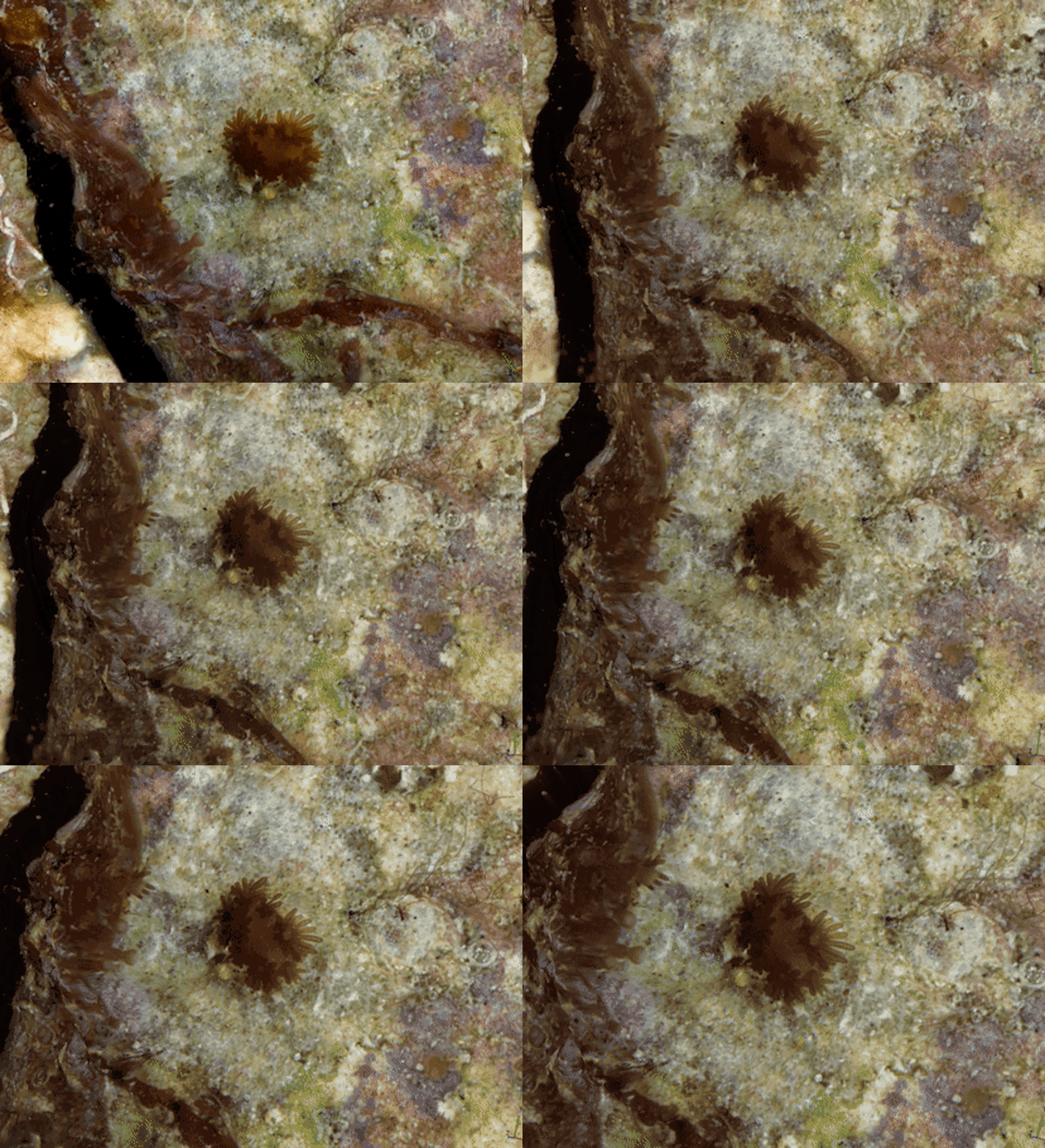
New photographic technology has allowed scientists to dive beneath the ocean’s surface and peer into the hidden world of baby corals, to learn how these tiny organisms survive and grow in their crucial first year of life.
In a study just published, researchers from Southern Cross University and CSIRO describe how advanced imaging techniques offer new ways to monitor baby corals.
Corals provide vital habitat for a large variety of marine life. So it’s useful to better understand how baby corals select and attach to reefs, establish themselves and grow into adult corals.
This knowledge is particularly important if we want to help reefs recover from devastating events such as mass bleaching and cyclones.
The secret life of corals
The life of a coral begins in an annual, synchronised spawning event. Coral colonies release millions of tiny eggs and sperm into the water at the same time. They all rise to the surface where the eggs are fertilised, developing into embryos and then later, into larvae.
Over days or weeks, the millions of larvae disperse with ocean currents. If things go according to nature’s plan, the larvae eventually fall through the water, attach to a reef and grow into adult corals. This process is known as coral “recruitment”.
In healthy coral reefs, this recruitment occurs naturally. But as coral reefs become more degraded – such as through coral bleaching brought on by climate change – fewer coral larvae are produced. This often means recruitment slows down or stops, and natural recovery weakens.
Scientists are working on ways to ensure coral larvae attach to and grow on reefs. This includes collecting coral spawn from the ocean, rearing embryos in floating nurseries and releasing larvae onto damaged reefs.
Coral larvae are less than one millimetre in size, so recruitment occurs on a tiny scale, invisible to the human eye. To better understand the process, researchers traditionally attach artificial plates to the reef. Once corals have established themselves, the plates are taken back to the lab to be inspected under a microscope.
This method can provide valuable insights, but it does not replicate the natural reef environment. That’s where our research comes in. Essentially, we brought the lab to the reef.
Read more: Safe havens for coral reefs will be almost non-existent at 1.5°C of global warming – new study
Capturing the reef in incredible 3D detail
Our new study explores the development and application of an innovative imaging approach known as underwater “macrophotogrammetry”.
The technology combines macrophotography – photographing small objects close-up, at very high resolution – and photogrammetry – taking measurements from photos. In this case, we used photogrammetry to “stitch” photos together to recreate three-dimensional models, such as the one below.
The three round objects in the model are “targets” we placed to help the software stitch the photos together. Look closely, and you’ll see a nail head to the left of each target. To give you an idea of the scale of the model, the nail head is 2.8mm in diameter.
Reef-scale photogrammetry can be a valuable tool to track changes in coral cover and growth over time. However, it does not provide the detailed resolution needed to identify and observe tiny new corals.
Macrophotography provides this incredibly detailed scale. The coupling of the technologies also enables a comprehensive understanding of the entire ecosystem, from the smallest processes to the largest.
We conducted macrophotogrammetry surveys near Lizard Island on the Great Barrier Reef. We marked several 25cm x 25cm locations on the reef. We then captured hundreds of photographs taken at different angles using high-resolution cameras.
Photogrammetry software was used to process the photos, creating precise 3D models that represent the small sections of reef at very high resolution.
The models were examined to find where baby corals settle, to mark their location and measure their size. They reveal the complexity in the reef micro-structure, including tiny crevices, where coral larvae often settle.
The models also reveal diverse micro-organisms such as small turf algae or invertebrates, which interact with corals during the recruitment process.
Macrophotogrammetry surveys can be conducted at the same reef locations over time. This allows us to monitor the survival and growth of baby corals, and observe changes in the organisms living near them.
Looking ahead
Complementary techniques may increase the potential of macrophotogrammetry even further. For example, coral larvae can be dyed various colours before release, making them more visible when they swim to and settle on the reef. This could be captured in 3D models to allow even better tracking of larval restoration efforts.
The use of macrophotogrammetry will deepen our understandings of why some larvae settle and survive on reefs, and others do not. This knowledge can help support our efforts to improve the overall conservation and recovery of coral reefs.
Its application need not be limited to coral reef ecosystems. We are excited about the potential of the technology to drive marine research more broadly.
Authors: Marine Gouezo, Postdoctoral research fellow, Southern Cross University


















