

Olympic swimming in the Seine highlights efforts to clean up city rivers worldwide
- Written by Gary Osmond, Associate Professor of Sport History, The University of Queensland
One year out from the 2024 Summer Olympic and Paralympic games, Paris has announced it will reopen the River Seine for swimming competition and then allow public swimming, ending a century-long ban. This ban was in place to stop people immersing themselves in river waters polluted by stormwater, sewage and chemicals.
But after many years of stormwater management work, three Olympic and Paralympic events will be held in the Seine in 2024 – the swimming marathon and the swimming legs of the Olympic triathlon and Para-triathlon. The Seine will also feature in the opening ceremony when, instead of the traditional athletes’ parade in a stadium, a parade of boats will carry the teams along the river.
The clean waters of the swimmable Seine are being promoted as a positive legacy of these games. But it’s not the first time Olympic swimming events have been held in the famous river. And with growing commitments to swimmable cities around the world, it is unlikely to be the last.
The newly swimmable Seine will have a starring role in the 2024 Olympic Games.Read more: It’s hot, and your local river looks enticing. But is too germy for swimming?
A brief history of river swimming
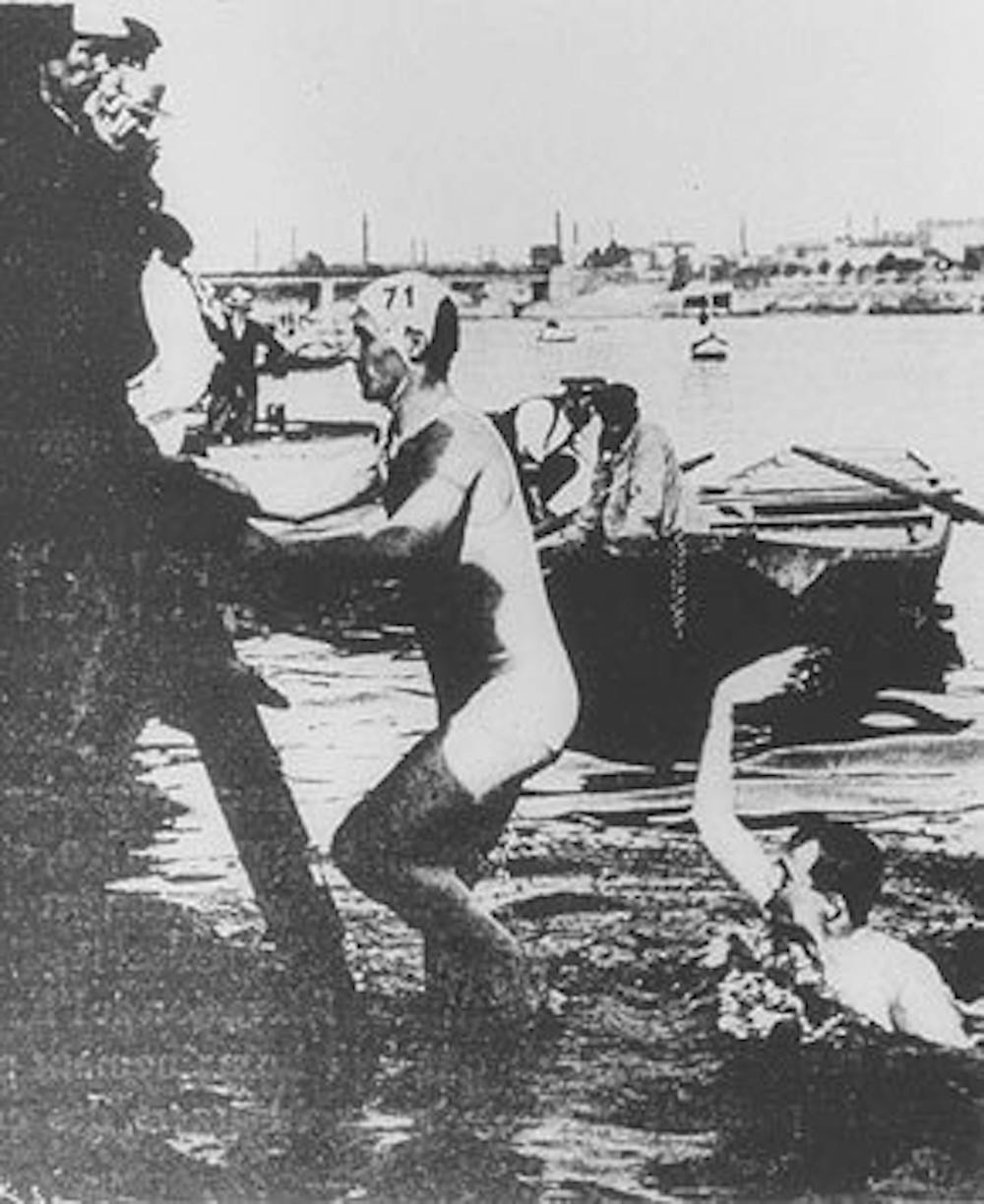
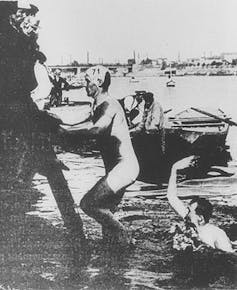
At the 1900 Paris Olympics, Australia’s Freddie Lane won two swimming events in the Seine. These were the 200 metres freestyle and a 200m obstacle race. This unusual event required the 12 athletes from four countries to climb over a pole, scramble over a row of boats and then swim under another row of boats.
Historians Reet and Max Howell quoted Lane describing his winning strategy: “[Knowing] a bit about boats [I] went over the sterns […] unlike the majority of competitors who fought their way over the sides.”
Following the tradition of linking to classical history that was common in the Games at the time, this event referenced Sequana, the Gallo-Roman goddess of the Seine. She is typically represented standing on a boat: clambering over and swimming under the river’s vessels was clearly for mere mortals.
That was the first and only time the Olympics included an obstacle race. But swimming competitions at the time were often held in rivers, harbours, lakes and other natural water bodies. The swimming races at the first modern Olympics, in Athens in 1896, were held in the Bay of Zea on the Piraeus peninsula. It wasn’t until 1908 in London that swimming moved to landlocked pools.
Swimming in rivers has a very long history related to pleasure and politics. Competitive river swimming remained common in the late 19th and early 20th centuries.
Freddie Lane won the New South Wales mile championship in the Murrumbidgee River at Wagga Wagga in January 1899.
“Professor of swimming” Fred Cavill helped pioneer swimming lessons for the masses in Sydney – including girls and women. He gave promotional swims in the Murray River on his arrival from the United Kingdom in 1880. Later that year he had to abandon a much-touted river swim from Parramatta to Sydney due to strong tides. One of Cavill’s sons, Arthur “Tums” Cavill, emigrated from Sydney to the United States where he introduced an annual winter swim in the Willamette River in Portland, Oregon, in 1909.
And while it wasn’t an Olympic feat, in 1918 Alick Wickham made a world record high dive of 205 feet 9 inches (62.7 metres) into the Yarra River in Melbourne.
Read more: Watered down: what happened to Australia's river swimming tradition?
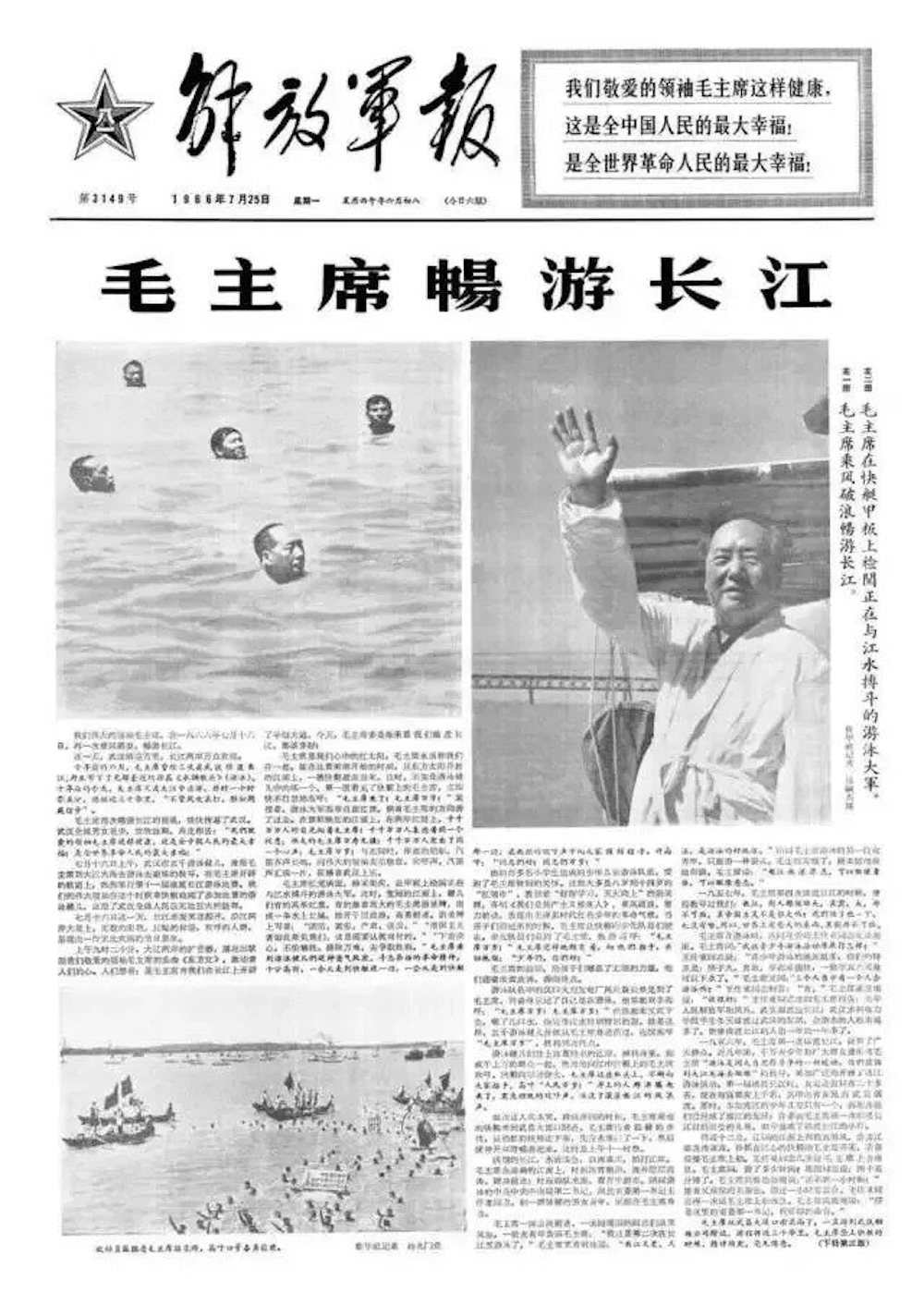 Chairman Mao’s swimming of the Yangtze River was front-page news in the Liberation Army Daily in 1966.
Even Chinese leader Mao Zedong used river swimming to promote his health and political image.
More recently, the swim leg of the triathlon for the 2000 Olympic Games was held in Sydney Harbour, where divers were on shark patrol.
However, like the 1900 obstacle race, organised and informal river swimming in cities became uncommon. In rivers such as the Seine in Paris and parts of the Yarra in Melbourne, it was even illegal.
The rise of built pools contributed to this shift, and for good reason. The novelty and modern design of concrete pools might have been part of the reason people abandoned city rivers and natural waterways. However, these new facilities also offered safety from sharks and stormwater, bacteria, chemicals and pollutants. Admittedly, questions of hygiene have also swirled around pools, especially before chlorine was added.
Ocean baths and pools served a similar purpose. As regulated spaces managed by local governments, pools meant swimmers were safer: lifeguards could watch over them and swimmers had access to more discreet changing facilities.
Read more: A tale of 2 rivers: is it safer to swim in the Yarra in Victoria, or the Nepean in NSW?
The quest for swimmable cities
Pools have remained popular, but river swimming never disappeared. In recent years, a resurgence in interest has been buoyed by the environmental movement’s efforts to rehabilitate waterways and growing research supporting the health benefits of outdoor swimming.
The Seine will reopen for swimming thanks to a €1.4 billion (A$2.3 billion) regeneration project to “reinvent the Seine”. It began in 2017 and includes floating hotels, walkways and other social spaces as well as swimming and diving areas.
The revival of swimming in the Seine is just one example of how outdoor and “wild” swimming is contributing to better caring for rivers. In England, there’s pressure to improve the water of the River Thames in London as well as broader movements to stop sewage outfalls on rivers. In Denmark, Copenhagen harbour has summer swimming sites. In Beijing there is a somewhat subversive outdoor swimming subculture.
Read more: UK waters are too polluted to swim in – but European countries offer answers
In Australia, too, a number of new swimming sites have opened. In Sydney, sites along the Parramatta River and in the harbour – one spot at Barangaroo opened this year – complement established river and harbour swimming areas, including the famous Dawn Fraser Baths. In Melbourne, there are calls for a chain of city swimming spots along the Birrarung/Yarra.
The growth in awareness of the important role that blue spaces – oceans, rivers, lakes, canals and other waterways – play in human health and wellbeing comes alongside a revival of the popularity of outdoor swimming and immersion. While we know this is good for people, public interest in clean, swimmable waterways for our own health, wellbeing and pleasure can also have great benefits for these environments.
Authors: Gary Osmond, Associate Professor of Sport History, The University of Queensland


















