

how floating solar panels near the equator could power future population hotspots
- Written by Andrew Blakers, Professor of Engineering, Australian National University
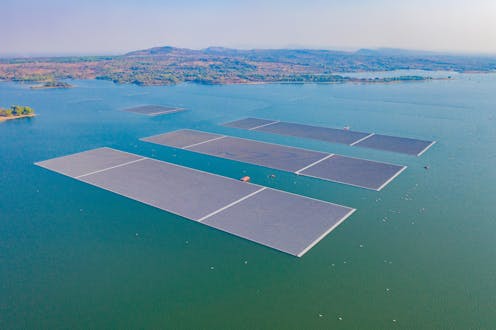
Vast arrays of solar panels floating on calm seas near the Equator could provide effectively unlimited solar energy to densely populated countries in Southeast Asia and West Africa.
Our new research shows offshore solar in Indonesia alone could generate about 35,000 terawatt-hours (TWh) of solar energy a year, which is similar to current global electricity production (30,000TWh per year).
And while most of the world’s oceans experience storms, some regions at the Equator are relatively still and peaceful. So relatively inexpensive engineering structures could suffice to protect offshore floating solar panels.
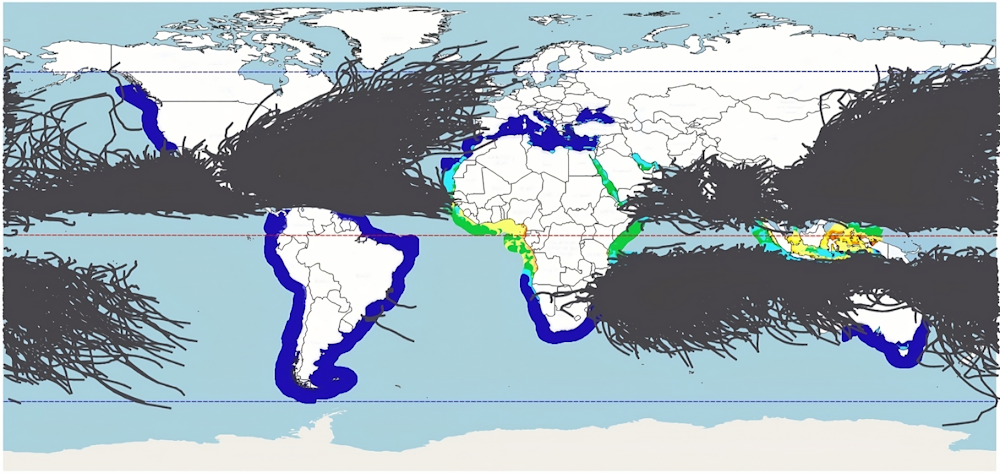
Our high-resolution global heat maps show the Indonesian archipelago and equatorial West Africa near Nigeria have the greatest potential for offshore floating solar arrays.
Solar power rules by mid-century
On current trends, the global economy will be largely decarbonised and electrified by 2050, supported by vast amounts of solar and wind energy.
About 70 square kilometres of solar panels can provide all the energy requirements of a million affluent people in a zero-carbon economy. The panels can be placed on rooftops, in arid areas, colocated with agriculture, or floated on water bodies.
But countries with high population densities, such as Nigeria and Indonesia, will have limited space for solar energy harvesting.
Their tropical location in the so-called “doldrum” latitudes also means wind resources are poor. Fortunately, these countries – and their neighbours – can harvest effectively unlimited energy from solar panels floating on calm equatorial seas.
Floating solar panels can also be placed on inland lakes and reservoirs. Inland floating solar has large potential and is already growing rapidly.
Our recently released paper surveys the global oceans to find regions that didn’t experience large waves or strong winds over the past 40 years. Floating solar panels in such regions do not require strong and expensive engineering defences.
Regions that don’t experience waves larger than 6 metres nor winds stronger than 15m per second could generate up to one million TWh per year. That’s about five times more annual energy than is needed for a fully decarbonised global economy supporting 10 billion affluent people.
Most of the good sites are close to the Equator, in and around Indonesia and equatorial west Africa. These are regions of high population growth and high environmental values. Marine floating solar panels could help resolve land use conflict.
Indonesia has vast solar energy potential
Indonesia is a densely populated country, particularly on the islands of Java, Bali and Sumatra. By mid-century, Indonesia’s population may exceed 315 million people.
Fortunately, Indonesia has vast solar energy potential and also vast pumped hydro energy storage potential to store the solar energy overnight.
About 25,000 square km of solar panels would be required to support an affluent Indonesia after full decarbonisation of the economy using solar power.
Indonesia has the option of floating vast numbers of solar panels on its calm inland seas. The region has about 140,000 square km of seascape that has not experienced waves larger than 4m – nor winds stronger than 10m per second – in the past 40 years.
Indonesia’s maritime area of 6.4 million square km is 200 times larger than required if Indonesia’s entire future energy needs were met from offshore floating solar panels.
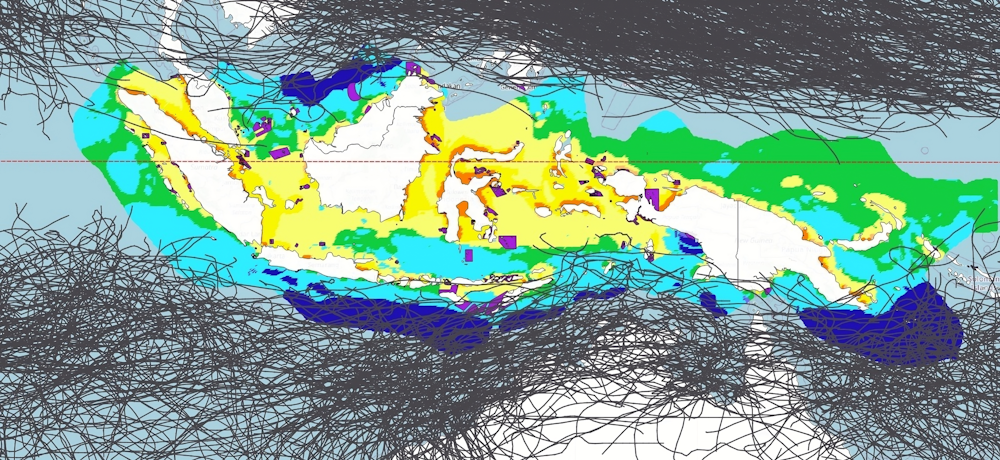 Heatmap for offshore floating solar panels in Indonesia. Red areas are best, followed by yellow, green and dark blue. The grey lines show tropical storm tracks.
Author-supplied, using OpenStreetMap base, CC BY-ND
Heatmap for offshore floating solar panels in Indonesia. Red areas are best, followed by yellow, green and dark blue. The grey lines show tropical storm tracks.
Author-supplied, using OpenStreetMap base, CC BY-ND
The future for offshore floating solar
Most of the global seascape experiences waves larger than 10m and winds stronger than 20m per second. Several companies are working to develop engineering defences so offshore floating panels can tolerate storms. In contrast, benign maritime environments along the equator require much less robust and expensive defences.
We have found the most suitable regions cluster within 5–12 degrees of latitude of the Equator, principally in and around the Indonesian archipelago and in the Gulf of Guinea near Nigeria. These regions have low potential for wind generation, high population density, rapid growth (in both population and energy consumption) and substantial intact ecosystems that should not be cleared for solar farms. Tropical storms rarely impact equatorial regions.
The offshore floating solar industry is in its infancy. Offshore solar panels do have downsides compared with onshore panels, including salt corrosion and marine fouling. Shallow seas are preferred for anchoring the panels to the seabed. And careful attention must be paid to minimising damage to the marine environment and fishing. Global warming may also alter wind and wave patterns. Despite these challenges, we believe offshore floating panels will provide a large component of the energy mix for countries with access to calm equatorial seas. By mid-century, about a billion people in these countries will rely mostly on solar energy, which is causing the fastest energy change in history.
Authors: Andrew Blakers, Professor of Engineering, Australian National University

















