

revealing the wonderful otherworld of owls
- Written by John Woinarski, Professor of Conservation Biology, Charles Darwin University
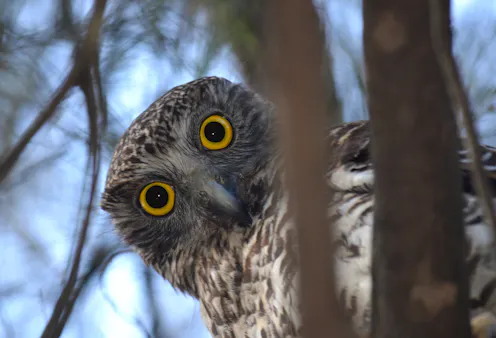
The calls of owls come to me most nights through the open window of my bedroom. Mostly it is the soft, repeated, rhythmic more … pork, more … pork of a pair of boobooks.
Sometimes, more grandly, it is the deeper, slower woo hoo … woo hoo of a powerful owl, hunting for possums in the creek-side forest. Even less common but more unnerving is the truly weird screaming and distinctive whistling (likened to a falling bomb) of a sooty owl.
These calls in the dark invite me into a mysterious world of heightened sensory perceptions beyond the constraints of human experience.
This otherness of owls, and their mastery of the dark – that place in which we are most fearful, most inexpert – has long fascinated and spooked us.
In almost all cultures, owls have been accorded a special significance – sometimes as symbols and talismans of wisdom, sometimes as messengers from the dead, sometimes as an embodiment of evil. They are perhaps the most iconic and intriguing of all birds. As told in a new book, we attach otherworldly significance to owls “because they enchant the environment”.

In What an owl knows: the new science of the world’s most enigmatic birds, American science writer Jennifer Ackerman makes much of this mystery accessible; her explanations accentuate, rather than diminish, the wonder of owls. She weaves in strands of knowledge drawn from recent owl research carried out by an endearing cast of committed scientists and splendidly obsessed volunteers.
Indeed, much of her book is not so much about owls, but rather about the people who choose to venture with them. In some cases, this “owling” is a solace and salve from the pains of normal life; sometimes it is a life-time odyssey born out of and shaped by a wondrous early experience.
Ackerman provides a highly accessible account of all aspects of the lives of owls, a diverse but very distinctive set of birds, numbering about 260 species. Owls occur across all continents other than Antarctica, spanning an environmental gradient from the freezing Arctic (home of the stunningly beautiful snowy owl, of Harry Potter fame) to the hottest deserts (home of elf owls).
 A snowy owl.
Shutterstock
A snowy owl.
Shutterstock
There is much consistency among owl species in behaviour, breeding characteristics and body shape – across a size ranging from the tiny elf owl (weighing about 40 grams) to the seriously large eagle owls and Blakiston’s fish owl (at almost 5 kilograms).
Yet there are intriguing differences among owl species in some aspects of their way of life: for example, some species move across large distances whereas others are highly sedentary; some species eat only a narrow range of prey; others are far less specialist.
 An elf owl weighs just 40 grams.
Shutterstock
An elf owl weighs just 40 grams.
Shutterstock
Owl questions
Ackerman answers some of the most fundamental of owl questions. Firstly, why, alone of all birds, do they have that spooky, human-like characteristic of forward-facing eyes? The answer is partly because the resulting binocular vision gives hunting owls heightened capability for zeroing in on prey. It is also because so much of the owl’s head is crowded with the infrastructure needed to support its acute hearing there is little room in the skull for any other positioning of the eyes.
 Secondly, how do owls hunt in the pitch dark? Mostly, through highly developed hearing, capable of pinpointing noise accompanying the movement of potential prey.
Thirdly, how is owl flight so silent? Ackerman notes it is “a feat of bio-mechanical stealth that still challenges biologists and engineeers”, but is mostly explained by a suite of distinctive physical characteristics of owl feathers. Owls are masterpieces of adaption, having honed their expertise as night predators over millions of years.
But Ackerman’s canvass is broad: her book tells us much about owls’ hunting and diet, breeding habits, movements, habitat requirements, senses and communications methods. Mostly, this is knowledge gained from field research, but there are also fascinating intimate insights into the behaviours of captive owls gained by enthralled bird-keepers.
Beyond ecology alone, Ackerman also ventures into the way owls have infiltrated our minds in mythology and religion. Owl symbology appears in cave paintings, artefacts and stories from ancient cultures, and in many modern societies. Their lasting intrigue is at least partly because of their mastery of the fearsome domain – the dark – and partly because so much strangeness and knowingness can be read into their distinctive faces.
The quest of one researcher
Secondly, how do owls hunt in the pitch dark? Mostly, through highly developed hearing, capable of pinpointing noise accompanying the movement of potential prey.
Thirdly, how is owl flight so silent? Ackerman notes it is “a feat of bio-mechanical stealth that still challenges biologists and engineeers”, but is mostly explained by a suite of distinctive physical characteristics of owl feathers. Owls are masterpieces of adaption, having honed their expertise as night predators over millions of years.
But Ackerman’s canvass is broad: her book tells us much about owls’ hunting and diet, breeding habits, movements, habitat requirements, senses and communications methods. Mostly, this is knowledge gained from field research, but there are also fascinating intimate insights into the behaviours of captive owls gained by enthralled bird-keepers.
Beyond ecology alone, Ackerman also ventures into the way owls have infiltrated our minds in mythology and religion. Owl symbology appears in cave paintings, artefacts and stories from ancient cultures, and in many modern societies. Their lasting intrigue is at least partly because of their mastery of the fearsome domain – the dark – and partly because so much strangeness and knowingness can be read into their distinctive faces.
The quest of one researcher
 Field research on owls can be particularly difficult, for they live largely in the dark, are mostly secretive, and may be scarce. Jonathan Slaght’s epic book Owls of the eastern ice: the quest to find and save the world’s largest owl describes his study of the threatened, fish-eating Blakiston’s fish owl in the wilds of eastern Siberia .
Slaght’s account is an excellent complement to that of Ackerman, providing far more intensive documentation of a single spectacular owl species, living in a place, characterised by copious vodka consumption, where it is increasingly threatened by industrial-scale timber harvesting.
In this comfortless place, Slaght painstakingly pieces together the ecology of this magnificent species, and tries to provide it with some conservation management in a hostile environment. His book is a must-read corrective lesson for anyone who thinks wildlife research is simple and easy.
Field research on owls can be particularly difficult, for they live largely in the dark, are mostly secretive, and may be scarce. Jonathan Slaght’s epic book Owls of the eastern ice: the quest to find and save the world’s largest owl describes his study of the threatened, fish-eating Blakiston’s fish owl in the wilds of eastern Siberia .
Slaght’s account is an excellent complement to that of Ackerman, providing far more intensive documentation of a single spectacular owl species, living in a place, characterised by copious vodka consumption, where it is increasingly threatened by industrial-scale timber harvesting.
In this comfortless place, Slaght painstakingly pieces together the ecology of this magnificent species, and tries to provide it with some conservation management in a hostile environment. His book is a must-read corrective lesson for anyone who thinks wildlife research is simple and easy.
 A Blakiston’s fish owl hunting.
Shutterstock
Threats
Humans have long been interested in and inspired by owls. But of course, this does not mean that we always care for them. Many owls are now threatened, in some cases because of pervasive factors such as habitat destruction and climate change.
But there are also particular conservation problems for owls. As predators, often of rodents, owls are susceptible to the accumulation of persistent pesticides (notably anticoagulant rodenticides such as brodifacoum) that we use to control rats and mice around our houses or more extensively for rodent plagues in crops.
In Australia, we are profligate in our use of such chemicals and lax in our regulation of them. Secondary poisoning of owls is thus common. One study from Western Australia detected anticoagulant rodenticides in 72% of boobook owls found dead or moribund.
A Blakiston’s fish owl hunting.
Shutterstock
Threats
Humans have long been interested in and inspired by owls. But of course, this does not mean that we always care for them. Many owls are now threatened, in some cases because of pervasive factors such as habitat destruction and climate change.
But there are also particular conservation problems for owls. As predators, often of rodents, owls are susceptible to the accumulation of persistent pesticides (notably anticoagulant rodenticides such as brodifacoum) that we use to control rats and mice around our houses or more extensively for rodent plagues in crops.
In Australia, we are profligate in our use of such chemicals and lax in our regulation of them. Secondary poisoning of owls is thus common. One study from Western Australia detected anticoagulant rodenticides in 72% of boobook owls found dead or moribund.
 A southern boobook owl: their poisoning with rodenticides is common.
Shutterstock
During recent Australian mouse plagues, the New South Wales government sought an emergency permit to make available large quantities of the rodenticide bromadiolone. This poison is known to have cumulative impacts across food chains, particularly to predators such as owls. Its proposed use was ultimately quashed by the Commonwealth regulatory agency, largely because of such concerns.
Read more:
Mouse plague: bromadiolone will obliterate mice, but it'll poison eagles, snakes and owls, too
Ironically, the loss of owls and other predators, through unintended poisoning, may exacerbate the problem of hyper-abundant rodents. An alternative approach to rodent control can be seen in parts of Australia where artificial hunting perches and nest boxes have been placed in cropping areas to encourage owls, increasing their density. Ackerman reports a single owl family can kill 8,000 rodents each year.
Like many other Australian birds and mammals, owls are dependent upon tree hollows for nesting, and this resource is rapidly diminishing because of habitat destruction, logging, wildfire and competitive pressure from some birds such as rainbow lorikeets and white cockatoos.
The problem will get worse, given that hollows form so slowly in Australian trees – typically it may take at least 100 years for eucalypts to form hollows big enough for large owls. Such a time span is increasingly out of step with the rapidity with which we are changing, diminishing and degrading our natural environments.
But we are still blessed with owls. Australia’s largest and most impressive owl, the powerful owl, has stealthily re-invaded some of our largest cities. This has brought a fierce wildness to suburbia – and small urban populations have proven remarkably resilient, provided patches of bushland are retained and protected.
A southern boobook owl: their poisoning with rodenticides is common.
Shutterstock
During recent Australian mouse plagues, the New South Wales government sought an emergency permit to make available large quantities of the rodenticide bromadiolone. This poison is known to have cumulative impacts across food chains, particularly to predators such as owls. Its proposed use was ultimately quashed by the Commonwealth regulatory agency, largely because of such concerns.
Read more:
Mouse plague: bromadiolone will obliterate mice, but it'll poison eagles, snakes and owls, too
Ironically, the loss of owls and other predators, through unintended poisoning, may exacerbate the problem of hyper-abundant rodents. An alternative approach to rodent control can be seen in parts of Australia where artificial hunting perches and nest boxes have been placed in cropping areas to encourage owls, increasing their density. Ackerman reports a single owl family can kill 8,000 rodents each year.
Like many other Australian birds and mammals, owls are dependent upon tree hollows for nesting, and this resource is rapidly diminishing because of habitat destruction, logging, wildfire and competitive pressure from some birds such as rainbow lorikeets and white cockatoos.
The problem will get worse, given that hollows form so slowly in Australian trees – typically it may take at least 100 years for eucalypts to form hollows big enough for large owls. Such a time span is increasingly out of step with the rapidity with which we are changing, diminishing and degrading our natural environments.
But we are still blessed with owls. Australia’s largest and most impressive owl, the powerful owl, has stealthily re-invaded some of our largest cities. This has brought a fierce wildness to suburbia – and small urban populations have proven remarkably resilient, provided patches of bushland are retained and protected.
 A powerful owl chick in Kinglake National Park.
Parks Victoria/AAP
In another sign of hope, and of our care for owls, we have also ensured the survival and partial recovery of the population of Norfolk Island moreporks which had been reduced to a lone female in 1986.
These two books guide us expertly into the mystery of owls, allowing us to be further inspired by such wonderful birds.
Authors: John Woinarski, Professor of Conservation Biology, Charles Darwin University
A powerful owl chick in Kinglake National Park.
Parks Victoria/AAP
In another sign of hope, and of our care for owls, we have also ensured the survival and partial recovery of the population of Norfolk Island moreporks which had been reduced to a lone female in 1986.
These two books guide us expertly into the mystery of owls, allowing us to be further inspired by such wonderful birds.
Authors: John Woinarski, Professor of Conservation Biology, Charles Darwin University 
















