

How air travellers can cut their door-to-door emissions right now – by as much as 13% on the Sydney-Melbourne route
- Written by Rico Merkert, Professor in Transport and Supply Chain Management and Deputy Director, Institute of Transport and Logistics Studies (ITLS), University of Sydney Business School, University of Sydney
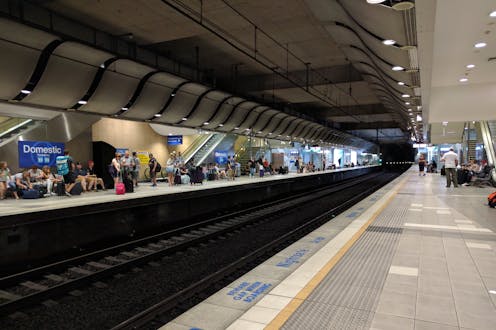
Our climate is changing, and airlines are under pressure to reduce emissions from air travel. For many of us, especially in Australia, flying is an essential form of transport, so how can we reduce its environmental impact? Getting to and from the airport is an overlooked aspect of air travel that offers an immediate way to cut total carbon emissions from the trip by a surprisingly large amount.
Our newly published research shows for an average economy passenger flying from Sydney to Melbourne, the carbon emissions from using a fossil-fuelled car to get to and from the airports make up a staggering 13.5% of the total door-to-door emissions. At a global scale, this number reaches 12.1% for long-haul flights and up to 22.8% for short-haul air journeys.
For comparison, in the International Air Transport Association’s 2050 net-zero emission roadmap, 13% of global airline decarbonisation will come from electric and hydrogen propulsion. A further 65% is to come from mass adoption of sustainable aviation fuel. This is fuel produced from non-petroleum-based renewable sources such as some municipal solid waste, woody biomass, fats, greases and oils.
Each of these big lifters requires a mammoth level of investment and technological breakthroughs, and comes with limitations and risks. Some solutions might make air travel prohibitively expensive. Airlines are moving mountains to decarbonise, but there are increasing concerns their net-zero plans might not stack up.
In contrast, a 13.5% emission reduction on a Sydney-Melbourne door-to-door journey today may sound like a dream. Yet our research shows it’s easily achievable if travellers can be persuaded to change how they get to and from the airport.
Read more: There’s a buzz about ‘sustainable’ fuels – but they cannot solve aviation's colossal climate woes
So how can travellers be convinced to switch?
Research has shown carbon “labelling” helps shift consumer behaviour towards greener choices. It’s a bit like how the nutrition label on the back of our cereal box helps us choose healthier options.
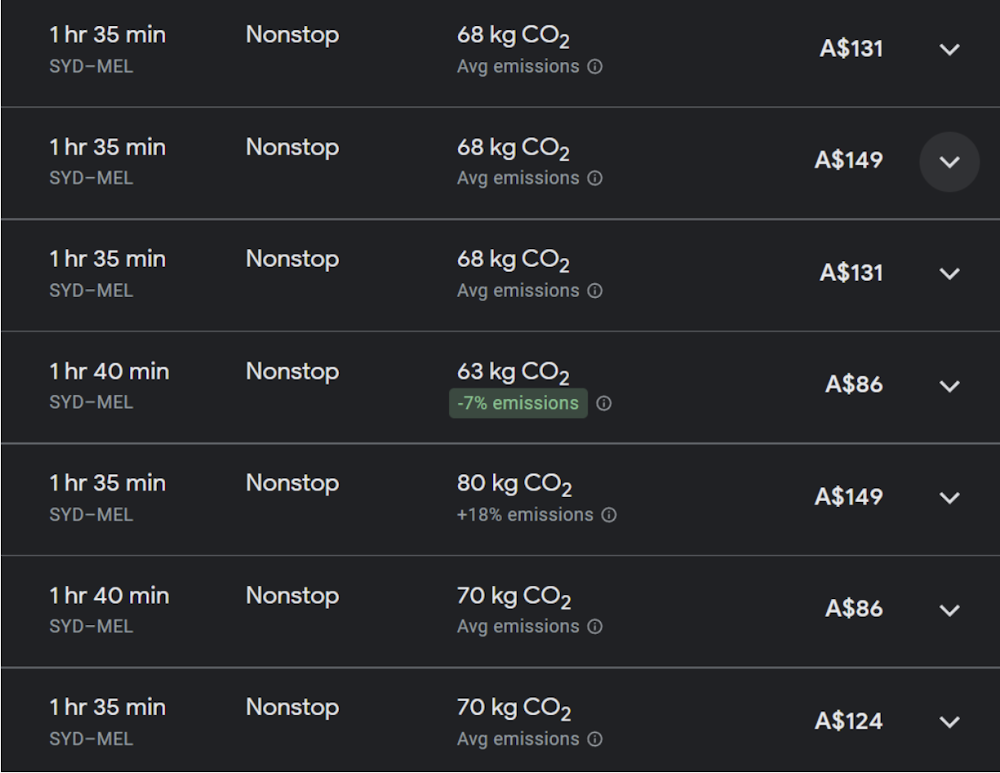
For instance, when searching for a flight on online travel platform Skyscanner, all flight options are displayed with carbon emissions, so consumers can make a more informed choice.
Two recent studies at the University of California, Davis, suggest showing consumers the emission outcomes of different gate-to-gate flight choices, such as aircraft types and transit stops, can prompt them to choose greener flights, reducing emissions by up to 3.8%.
But air journeys don’t start or end at airports. They start at home and end at destinations, or vice versa. Our air-travel carbon emissions are divided into ground and air segments and counted as airport and airline emissions respectively. While airlines focus on gate-to-gate decarbonisation through future technologies, the door-to-door emissions produced by travel to and from airports can be reduced immediately.
Let’s look at an example of a Sydney-to-Melbourne trip. Say you travel from North Sydney to Sydney Airport by car, then fly to Melbourne Airport and catch a taxi to the city centre. That trip emits 82 kilograms of CO₂ door-to-door. But if you use a train, bus or electric vehicle (charged from a renewable source) to travel to and from the airport, the emissions from your trip drop to 71kg: a 13.5% fall door-to-door.
Although travel platforms are increasingly communicating gate-to-gate emissions to consumers, we’re not aware of any that are including door-to-door emissions. Helping climate-conscious consumers understand the door-to-door carbon impact of airport ground connections could drive them to choose greener options such as public transport and electric vehicles.
Read more: Bucking the trend: Is there a future for ultra long-haul flights in a net zero carbon world?
Give airlines an incentive to inform passengers
Governments and airports have long collaborated in driving consumers towards greener ground transit options. For instance, Transport for NSW has set a 50% emission-reduction target for 2030.
However, consumer adoption of these options has remained low. Most airport trips in Australia today are still made by conventional car.
As consumers, we have relationships with airlines that we don’t have with airports. When it comes to flying, we choose our airline carefully. Yet we rarely think about how we get to the airport.
Airlines are experts in customer communication and engagement. They operate some of the largest frequent-flyer programs in the world. Last time we checked, Qantas had 15 million program members and Virgin had 11 million.
Through these channels, airlines learn about us and how we tick when it comes to making flying choices. This puts them in an ideal position to keep us informed about door-to-door travel and drive the transition towards greener airport ground-connection options. To give them an incentive to do so, their efforts should be recognised through emission accounting.
Read more: Blue-sky thinking: net-zero aviation is more than a flight of fantasy
A cost-effective way to cut emissions
Travellers using the Sydney Airport train station must pay an access fee, which adds A$15.74 to the cost of the journey. As our paper highlights, the average customer using the airport train removes 2.7kg of CO₂. Achieving the same amount of decarbonisation during the flight using more sustainable aviation fuel – which is more expensive – would cost the customer about the same: between $10 and $16.
So there is an opportunity for airlines to highlight this decarbonisation outcome as a way to persuade travellers to reconsider driving a car or catching a taxi, and instead take the airport train or bus. Airlines could also consider collaborating with airports to build airport charging facilities for electric vehicles as uptake in Australia approaches a double-digit share of new vehicle sales.
This overlooked opportunity to cut door-to-door emissions from air travel has a substantial upside. It deserves far more attention from airlines, airports and consumers.
Authors: Rico Merkert, Professor in Transport and Supply Chain Management and Deputy Director, Institute of Transport and Logistics Studies (ITLS), University of Sydney Business School, University of Sydney

















