

Unconventional luxury brand collaborations are everywhere. What is the appeal?
- Written by Carlos Diaz Ruiz, Assistant Professor, Hanken School of Economics
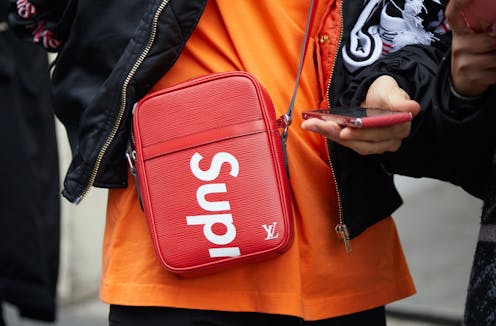
In 2017, Louis Vuitton caused a stir in the luxury industry by partnering with the New York skateboarding brand Supreme.
This collaboration became a milestone in the luxury industry, showcasing the potential of unexpected partnerships between luxury brands and an unconventional partner seemingly at the opposite end of the design spectrum, a street wear brand.
The iconic brand raised interest again when, in 2019, it partnered with the video game franchise League of Legends.
It may appear odd for a renowned French luxury design house and a game developer to team up. After all, their audiences are quite different. Whereas anyone with an internet connection can jump into a “free-to-play” game, few can afford a luxury brand.
So why are luxury brands collaborating with street brands, cartoons and video games? Part of the reason is their success with young Asian consumers, who are driving demand for luxury consumer goods.
Given their growing importance for the luxury industry, we conducted a study of unconventional luxury brand collaborations. We wanted to investigate why this strategy appeals to Chinese luxury consumers of the post-1990s generation.
Read more: Luxury fashion brands are making a splash in the art world
The study reveals potential opportunities for Australian brands, for instance, through partnerships with old-world luxury brands.
The luxury strategy
Luxury typically brings to mind ultra-expensive products such as yachts and private jets that are not within most people’s reach. However, there is another kind of luxury in which products that are not inherently expensive, like cosmetics, perfume or even chocolate, can be luxurious through their brand’s prestige.
Business managers call this approach the luxury strategy. It has specific rules that luxury managers must follow. One of them is that luxury brands must remain above controversy, using aesthetics and tradition to signal exclusivity. Luxury brands are timeless because they resist the whims of fashion and don’t date.
New ways to convey exclusivity and uniqueness in digital and experiential contexts are emerging. For example, consumption experiences can feel like “a moment of luxury” if they convey a pleasurable escape from day-to-day routines.
As a result, new forms of luxury consumption, like second-hand luxury markets, are popping up.
While luxury brands are known to collaborate with artists, they have been pushing the boundaries of the luxury strategy by teaming up with unexpected non-luxury partners. One early example was between the Swedish fast-fashion retail outlet H&M and designer Karl Lagerfeld in 2004.
A partnership between a designer house and a fast-fashion retailer builds upon each other’s strengths, brand prestige and mass distribution. However, luxury brands are growing more creative with their partnerships.
There are renowned luxury pairings like Fendi x Versace but also pairings with streetwear brands including Adidas x Gucci, with celebrities such as Kanye West x Louis Vuitton, anime characters like Doraemon x Gucci, and now video game franchises like Fortnite x Balenciaga.
These collaborations are becoming increasingly popular, especially with Chinese consumers.
Why do young Chinese consumers love luxury collaborations?
Australian designers and producers of high-end goods must keep young adult Chinese consumers top of mind given the growing importance of Asian consumers in the luxury industry.
Reports by consulting agencies Bain & Company and McKinsey predicted that, by 2025, East Asia can become the world’s largest personal luxury goods market. China alone will consume about half the global market value of luxury goods.
In 2019, McKinsey reported that “Chinese consumers are now the engine of worldwide growth in luxury spending,” driven in part by consumers “born between 1980 and 2015 [who] are reshaping global luxury”.
Our study focused on the generational divide that is a uniquely Chinese phenomenon.
The 1990s economic reforms and China’s one-child policy shaped the generation. In 1979, a government program restricted (most) Chinese families to having one child each. The policy was updated to two children per family in 2016 and three in 2021.
During the 1990s, the media called lone children “little emperors” because they became the sole recipient of the family’s attention and financial support.
Analysts often subdivide the cohort into an affluent post-1980s generation consolidating their careers and a post-1990s generation characterised by urban lifestyle and social media savviness.
The post-1990s cohort of Chinese young adults, now in their 20s or early 30s, is characterised by their economic prowess, always-online presence, international mobility, and taste for luxury brands.

We find that Chinese luxury consumers of the post-1990s generation appreciate when luxury brands collaborate with non-luxury partners seemingly at the opposite spectrum of design, image and values. These collaborations are exciting when they are ephemeral, trendy and playful.
Ephemeral collaborations are transitory, existing only for a limited time, and will not reappear. Trendy collaborations help consumers navigate the ebbs and flows of social media to capture novelty and hype. Playful collaborations appeal to a youthful audience by mocking traditions and not being too serious.
In the words of one of our respondents, “Most of my friends in China like these collaborations […] Sometimes they are like: ‘Oh! Wow, your limited edition! Where? How did you get this? Oh my gosh! You must have connections.”
Collaborations are instantly recognisable in social media. When asked why purchase a collaboration, a respondent said: “Selfies (giggles). I mean, I am going to take a selfie with it. You must post it! (giggles). Others will see it and ask me how I got it.”
A rising opportunity for Australian firms
The popularity of unconventional luxury brand collaborations among young adult Chinese consumers opens timely strategic opportunities for Australian designers and producers of high-end goods.
The young adult Chinese segment remains important in Australia because of its purchasing power and influence in redefining luxury. By seeking collaborations that are ephemeral, trendy and playful, Australian brands can meet this segment’s preferences and adapt to the changing rules of luxury.
Read more: Consumers in Asia buy luxuries for different reasons to the West
Australian brands can also position themselves as attractive partners for fresh collaborations. As global luxury brands seek partners who, in the words of one of our study participants, “bring something new to break through old-fashioned limits”, Aussie brands can offer just that.
Upcoming Australian designers are known for their effortless elegance, down-to-earth aesthetics and their values of sustainability and ethics, making them great potential partners for luxury brands.
Aussie brands and consumers are intrepid innovators in outdoor gear and adventure activities, like water sports, offering hype, trendiness and authenticity.
This sets Aussie brands up well to enter the coveted luxury market, gaining a foothold in the fast-growing Chinese market and opening opportunities worldwide.
Authors: Carlos Diaz Ruiz, Assistant Professor, Hanken School of Economics

















