

Beyond Barbie and Oppenheimer, how do cinemas make money? And do we pay too much for movie tickets?
- Written by Peter Martin, Visiting Fellow, Crawford School of Public Policy, Australian National University
I’ve got two questions about blockbuster movies like Barbie and Oppenheimer.
Why aren’t the cinemas charging more for them, given they’re so popular?
Why are they the same price, given Oppenheimer is an hour longer?
The opening weekend for both films saw an avalanche of Australians returning to the cinema. Extra staff had to be put on (although probably not enough) to manage queues, turn away pink-clad fans who couldn’t get in, and clean up mountains of popcorn trampled underfoot.
An obvious solution to such a rush of demand is to push up prices. Airlines do it when they are getting low on seats. When more people want to get a ride share, Uber makes them pay with “surge pricing”.
Even books are sold at different prices, depending on the demand, their length, their quality and how long they’ve been on the shelves.
But not movie tickets, which are nearly always the same price, no matter the movie. Why? And how much has the cost of a trip to the movies risen over the past 20 years?
Why not charge more for blockbusters?
In suburban Melbourne, Hoyts is charging $24.50 for the two-hour Barbie – the same as it is charging for the three-hour Oppenheimer, even though it could fit in far fewer showings of Oppenheimer in a day. It’s also the same price as it is charging for much less popular movies, such as Indiana Jones and the Dial of Destiny.
It’s also how things are in the United States, where James Surowiecki, author of The Wisdom of Crowds blames convention and says
it costs you as much to see a total dog that’s limping its way through its last week of release as it does to see a hugely popular film on opening night.
Australian economists Nicolas de Roos of The University of Sydney and Jordi McKenzie of Macquarie University quote Surowiecki in their 2014 study of whether cinema operators could make more by cutting the price of older and less popular films and raising the price of blockbusters.
By examining what happened to demand on cheap Tuesdays, and developing a model taking into account advertising, reviews and the weather, they discovered Australian cinemas could make a lot more by varying their prices by the movie shown. We turn out to be highly price sensitive. So why don’t cinemas do that?
‘There’s a queue, it must be good’
It’s the sort of thing that puzzled Gary Becker, an economic detective of sorts who won the Nobel Prize for Economics in the early 1990s. A few years earlier, he turned his attention to restaurants and why one particular seafood restaurant in Palo Alto, California, had long queues every night but didn’t raise its prices.
Across the road was a restaurant that charged slightly more, sold food that was about as good, and was mostly empty.
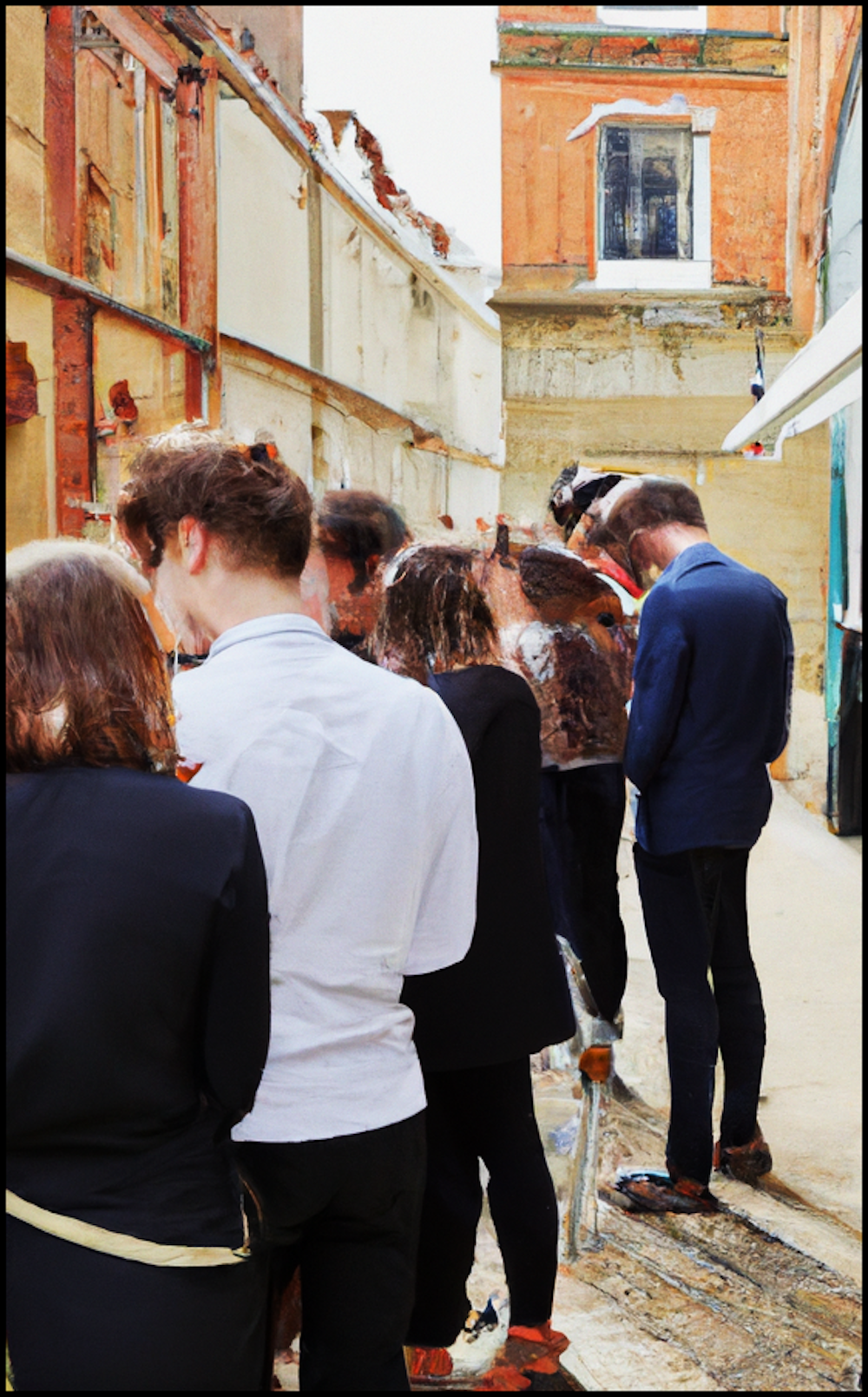
His conclusion, which he used a lot of maths to illustrate, was there are some goods for which a consumer’s demand depends on the demand of other consumers.
Queues for restaurants (or in 2023, long queues and sold out sessions, as crowds were turned away from Barbie) are all signals other consumers want to get in.
This would make queues especially valuable to the providers of such goods, even if the queues meant they didn’t get as much as they could from the customers who got in. The “buzz” such queues create produces a supply of future customers persuaded that what was on offer must be worth trying.
Importantly, Becker’s maths showed that getting things right was fragile. It was much easier for a restaurant to go from being “in” to “out” than the other way around. Once a queue had created a buzz, it was wise not to mess with it.
Cashing in from the snack bar
There are other reasons for cinemas to charge a standard ticket price, rather than vary it movie by movie.
One is that it is hard to tell ahead of time which movies are going to soar and which are going to bomb, even if you spend a fortune on advertising as the makers of Barbie did. In the words of an insider, “nobody knows anything.”
Another is the way cinemas make their money. They have to pay the distributor a share of what they get from ticket sales (typically 35-40%). But they don’t have to pay a share of what they make from high-margin snacks.
This means it can make sense for some cinemas to charge less than what the market will bear – because they’ll sell more snacks – even if it means less money for the distributor.
Rising prices, despite some falling costs
But cinemas still charge a lot. From 2002 to 2022, Australian cinemas jacked up their average (not their highest) prices from $9.13 to $16.26 – an increase of 78%.
In the same 20 year period, overall prices in Australia, as measured by the consumer price index, climbed 65% – less than the rise in movie ticket prices.
A 2015 study found Australian cinemas charge more than cinemas in the US.
Yet some of the cinemas’ costs have gone down. They used to have to employ projectionists to lace up and change reels of film. Digital delivery means much less handling.
A now-dated 1990s report to the Australian Competition and Consumer Commission found the two majors, Hoyts and Greater Union/Village, charged near identical prices except where they were faced with competition from a nearby independent, in which case they discounted.
Whether “by design or circumstance”, the two cinema chains rarely competed with each other, clustering their multiplexes in different geographical locations.
Longer films no longer displace shorter films
I think it might be the multiplex that answers my second question: why cinemas don’t charge more for movies that are longer (and movies are getting longer).
In the days of single screens, a cinema that showed a long movie might only fit in (say) four showings a day instead of six. So it would lose out unless it charged more.
But these days, multiplexes show many, many films on many screens, some of them simultaneously, meaning long films needn’t displace short films.
Although we have fewer cinema seats than we had a decade ago (and at least until the advent of Barbie, we’ve been going less often) we now have far more screens.
Long movies no longer stop the multiplexes from playing standard ones. And because cinemas like to keep things simple, you pay the same price, no matter which movie you chose.
Read more: Hyper-femininity can be subversive and empowering – just ask Barbie
Authors: Peter Martin, Visiting Fellow, Crawford School of Public Policy, Australian National University

















