

Modern Australian
Times Advertising

Efforts to find safe housing for homeless youth have gone backwards. Here's what the new national plan must do differently

  • Written by David MacKenzie, Associate Professor, University of South Australia
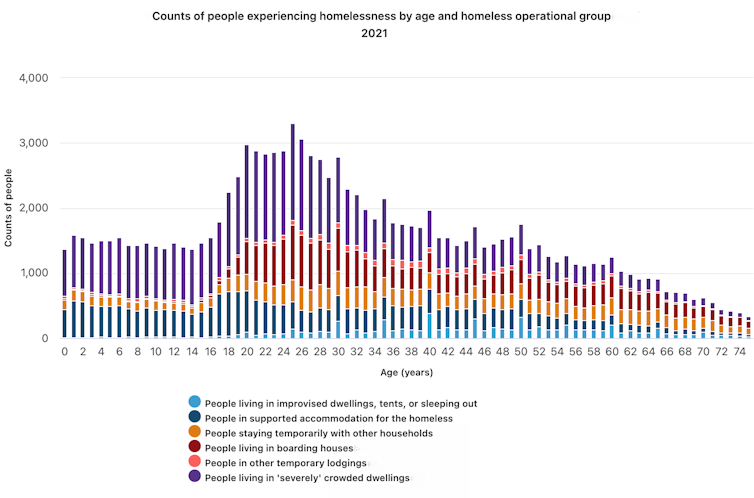
Vertical bar chart showing breakdown of homelessness in Australia by age and category

What needs to change to greatly reduce youth homelessness in Australia? Now is the time to find answers to this question, and not just because it’s National Homelessness Week.

The federal government is developing a National Housing and Homelessness Plan and says public consultations will begin soon. In recent years, there have been two parliamentary inquiries into homelessness in Victoria and across Australia. Then came a Productivity Commission review of the National Housing and Homelessness Agreement, which expired on June 30 this year.

More than a decade ago, the Rudd government made homelessness a national priority. A 2008 white paper, The Road Home, advanced three key strategies:

  1. “turning off the tap” – early intervention and prevention
  2. “improving and expanding services” – the existing service system
  3. “breaking the cycle” – supported housing to prevent homelessness reoccurring.

Yet today more people need help because of homelessness than 15 years ago. The ambitious agenda of 2008 has not been fulfilled.

The forthcoming plan might just be a second chance for Australia to get it right.

Read more: Yes, we see you. Why a national plan for homelessness must make thousands of children on their own a priority

Homelessness is more than ‘sleeping rough’

Homelessness conjures images of someone sleeping in a doorway, alley or city park. “Rough sleeping” is, after all, the visible homelessness that people see. But there are other forms of homelessness that are more hidden.

Some vocal advocates seek to model the Australian homelessness response on that of the United States. In the US, nearly 600,000 people are sleeping rough or in shelters. The rate of homelessness is at least ten times the rate in Australia.

A problem in the US is that homelessness is very narrowly defined. Fortunately, in Australia, homelessness has been understood and defined more broadly as not having a secure and safe home. So the good news is the new homelessness plan is unlikely to make the mistake of adopting the narrow US focus on rough sleeping.
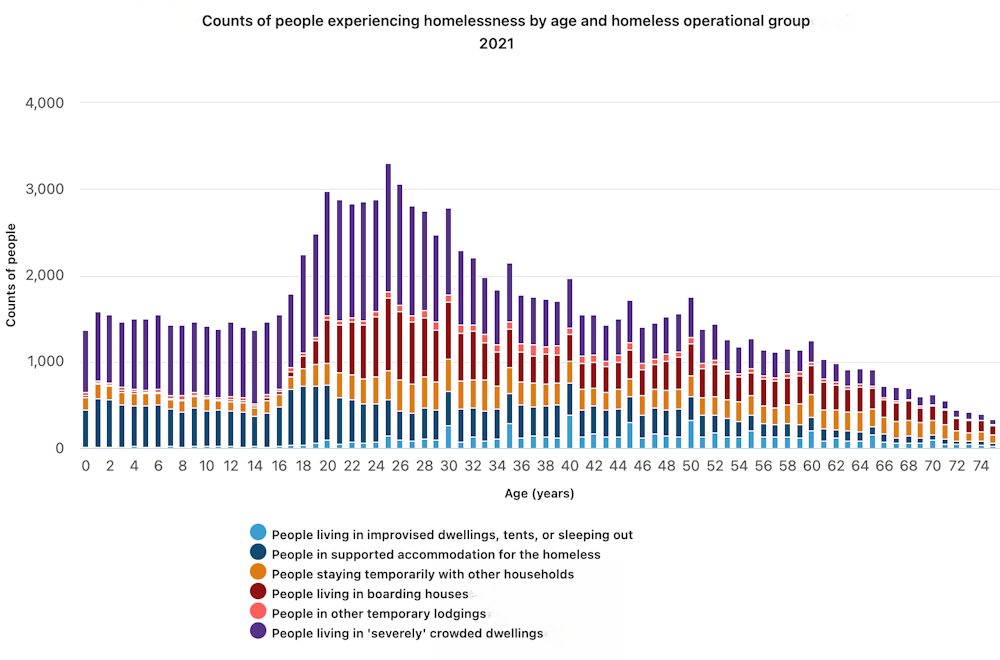

Vertical bar chart showing breakdown of homelessness in Australia by age and category
Source: ABS Census of Population and Housing 2021, CC BY Homelessness funding has largely gone into crisis management – that is, after people become homeless. An expanded role for “prevention” work coupled with supported housing options in each community would be a valuable strategic reform. The Productivity Commission review recommended “prevention and early intervention programs should be a higher priority under the next agreement”, backed by “a separate pool of funding”. The commission even suggested: The nearly $3 billion [annually] given to first home buyers works against improving affordability. This money would be better spent preventing homelessness. Too many young Australians who become homeless and disengage from education then experience long-term disadvantage. The cost to Australia of their lost opportunities amounts to hundreds of millions of dollars a year. Read more: 6 steps towards remaking the homelessness system so it works for young people We have examples of intervention that works There are promising early intervention models for at-risk young people that are ready to be scaled up. Examples include the COSS Model, Kids Under Cover, Ruby’s Reunification and Home Stretch programs. If implemented adequately, programs like these would greatly reduce the flow of young people into homelessness. Housing affordability in Australia has worsened over a long time. For people whose homelessness cannot be averted, the immediate need is access to a crisis service, rapid rehousing and then supported housing options. The Albanese government’s A$10 billion Housing Australia Future Fund could begin to turn the housing crisis around, but it would be only a beginning. All sides of politics need to get behind greater investment in high-quality social housing, shared equity home purchase programs (the government or another investor covers some of the purchase price in return for a share of equity in the home) and increased Commonwealth Rental Assistance. Government subsidies for the private housing sector, such as negative gearing, also need to be reviewed. Read more: To deliver enough affordable housing and end homelessness, what must a national strategy do? Homeless young people have little chance of getting into mainstream social housing when they most need supported housing to get their lives back on track. The social housing business model is not set up to provide supported housing for adolescents and young adults. One notable innovation is the world’s first model of social housing for youth developed by My Foundations Youth Housing. It provides up to five years’ supported residency with rents scaling up annually. Most residents move on to other accommodation when ready to do so. Read more: Homeless numbers set to rise again, but inquiry can be a turning point if we get smarter about housing people Get the plan right and it can be a game-changer Expanding the social housing options for young people would have a significant impact. Should the Senate finally pass the Housing Australia Future Fund legislation, young people (15-24 years) could be guaranteed a specific share of that funding, as has been done for women escaping domestic violence and older women at risk of homelessness. This funding would go into expanding social housing for young people. A key structural reform would be to reorganise support services for at-risk and homeless young Australians on a community-by-community basis. What’s needed is a rigorous approach to needs-based funding for both early intervention and post-homelessness support and supported housing. Will the National Housing and Homelessness Plan be a game-changer for vulnerable young Australians? Well, that remains to be seen. We hope Australia can avoid a rerun of what happened after the 2008 white paper. Authors: David MacKenzie, Associate Professor, University of South Australia

Read more https://theconversation.com/efforts-to-find-safe-housing-for-homeless-youth-have-gone-backwards-heres-what-the-new-national-plan-must-do-differently-210704

7 Benefits of Professional Gutter Cleaning for Australian Homeowners

Gutters aren't exactly glamorous. They sit up there on the edge of your roof, doing their job quietly - until they stop working. Clogged, overflowing ...

Pipe Floats Strengthening Pipeline Performance In Demanding Environments

Pipelines often travel through environments that are anything but predictable, water currents shift, terrain changes, and materials keep moving unde...

Why Ceiling Fans Are Essential For Comfort, Efficiency, And Modern Living

Creating a comfortable indoor environment is not just about temperature; it is about how air moves, how a room feels, and how efficiently energy is ...

Why Duct Cleaning In Melbourne Is A Smart Investment For Healthier Living Spaces

Behind your walls, ceilings, and vents lies a network quietly working every day to keep your home comfortable. Yet over time, this system can become...

Disability Service Providers Supporting Inclusive And Independent Living

Finding the right support system can feel like assembling a puzzle where every piece must fit just right. For individuals and families navigating di...

A Beginner's Guide to Owning a Caravan in Australia

Owning a caravan opens up a style of travel that's hard to match for freedom and flexibility. However, for those just starting out, the process of c...

Preparing Your Air Conditioner for Summer: What Most Homeowners Overlook

As temperatures rise, many homeowners switch on their air conditioning for the first time in months — only to find it’s not performing the way i...

What Actually Adds Value to Properties in Newcastle

Newcastle has seen steady growth over the past few years, with more buyers looking beyond Sydney for lifestyle, space, and long-term value. As dema...

What is Design and Build in Construction?

Imagine you’re about to start a new construction project, maybe it’s a custom home or a commercial building. You’ve got the idea, the land, an...

Commercial roof leak detection: why early action protects your building

Water ingress is one of the most disruptive and costly issues facing commercial properties. For property managers and facilities teams, even a minor...

Custom Photo Frames: Turning Everyday Moments into Lasting Displays

Photos capture moments, but how you display them determines how they’re experienced every day. A meaningful photograph deserves more than a generi...

Managed IT Services: A Smarter, More Predictable Way to Run Your Business Technology

If you’ve ever had your systems go down in the middle of a busy day, you’ll know how quickly things can unravel. Phones stop ringing, emails sto...

Landscaping Geelong — Coastal Elegance Meets Practical Design

A Landscape Shaped by Location Geelong occupies a unique position within Victoria’s broader landscape. It carries the energy of a growing city, y...

Electric Adjustable Beds: A Simpler Way To Sleep Better

Sleep should feel natural. It should come easily, without discomfort, without constant repositioning, and without waking up feeling sore. But for ma...

Healthy Snacking Sorted: Premium Beef Jerky

In today's fast-paced world, finding a snack that's both satisfying and genuinely good for you can feel like a mission. Many readily available optio...

What to Know Before Getting Dental Implants: A Guide for First-Time Patients

Dental implants Perth patients often look for a long-term solution for missing teeth without the hassle of dentures or bridges. If you are thinking ...

Why Protective Packaging Matters More Than Ever In Modern Shipping

In today’s fast-paced world of logistics and eCommerce, ensuring that products reach customers safely is a top priority. This is where a bubble wrap...

Pest Control Albury: Protecting Your Property From Hidden Damage And Health Risks

Pests rarely announce their arrival. They creep into spaces quietly, turning small, unnoticed corners into breeding grounds for bigger problems. Tha...
















