

Oppenheimer has an epic, layered soundtrack – but its real power is in the silence
- Written by Alison Cole, Composer & Lecturer in Screen Composition, Sydney Conservatorium of Music, University of Sydney
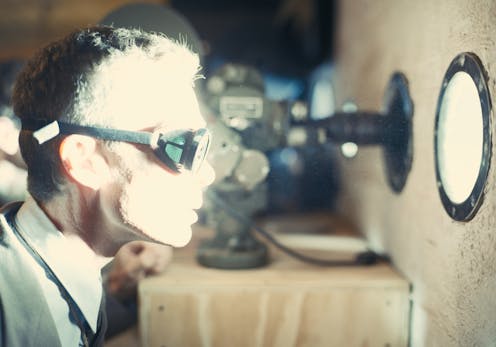
Christopher Nolan’s biopic on the theoretical scientist Robert Oppenheimer, who became known as the “father of the atomic bomb”, has an epic soundtrack.
We follow Oppenheimer’s early work in Europe, establishing the Los Alamos lab, the creation of the atomic bombs released on Hiroshima and Nagasaki, his later activism against nuclear development and its repercussions in his later life.
The music and sound design are integral to telling this dark story.
Ludwig Göransson’s score immerses the audience in the inner emotional dilemma of a man on the brink of unleashing the potential destruction of humanity, while the sound design illustrates flashbacks, physical phenomena and atoms clashing with each other.
Read more: 'Now I am become Death, the destroyer of worlds': who was atom bomb pioneer Robert Oppenheimer?
Drawing on music history
Sound in Nolan’s films is characteristically loud and arresting, accompanied by epic music scores. Oppenheimer’s score moves from the gentle and personal to an imposing sound spectacle that heightens the intensity of the plot.
The violin forms the basis of the score. From the film’s opening track, the violin’s ability to shift from a hauntingly beautiful sound quality (or timbre) to a screeching descending melody to an intimate whispery tone draws us into Oppenheimer’s intense inner dilemma.
The violin is fitting to depict such a complex and intense character.
Göransson’s score draws on performance techniques with a rich cinematic and concert hall legacy.
In Psycho, the short, sharp screech of the violins played in repeated clusters punctuates the rising tension. This is echoed in Oppenheimer: to underscore the visuals of atoms spinning, Göransson layers string harmonics in an escalating crescendo of quivering energy.
In Mozart’s requiem (a mass of the dead) Lacrimosa, the haunting simplicity of the opening melody played by the violins feels raw and immediately draws the listener in. Here, when the scientists learn of the bombing of Japan, the violin plays a two-note melody. This simple composition contains the enormity of the situation.
The tension of the violin
The violin is a fretless instrument, allowing traditional performance techniques including harmonics and vibrato.
Harmonics is an overtone you hear when you place your finger softly on the string and play with the violin bow. By not pushing the string down to the fingerboard, the string vibrates on both sides of your finger to create a whistling sound.
Vibrato is the tiny fluctuations in pitch caused by rocking the finger from the wrist or arm to create warmth and expressiveness in performance.
In this score, Göransson also employs non-traditional techniques such as tapping or hitting the body of the violin with the bow.
When these traditional and non-traditional performance techniques combine, the juxtaposition creates tension between the warm and more brittle sound qualities of the violin.
A scene in the classroom exemplifies the lyrical sound quality of violins that build in numbers. When Oppenheimer is alone one violin plays. As three people join him, three violins join in the composition. As the classroom fills – and as his excitement in talking about quantum physics grows – there is a build to the whole orchestra playing.
The violins shift to tension strings performing various rhythmic patterns and performance techniques. These combine with electronic instruments that musically fluctuate between hope, anxiety and despair.
As the scene progresses, the horns come thundering in as a warning of the destruction to come.
The sound of silence
Göransson’s unrelenting score features in roughly 2.5 hours of the three-hour film. The orchestral blend of piano and harps runs alongside the sounds of Oppenheimer’s world. Feet stomping, synthesisers pulsing, clocks ticking and the electrical static of Geiger counters create a sound world of tension, dread and anticipation.
Göransson uses rhythmic techniques such as triplets – when three notes are played in the space of two – to build the intensity and to create escalating cross-rhythms during the Trinity nuclear test.
The layers of strings playing harmonics and rhythmic patterns build in intensity to create an impression of momentum building. These techniques bring a sense of agitation, heightening the drama and building energy.
The music builds in intensity up to the moment of silence when the button is pushed: there is no turning back.
The score falling silent is as important as the music itself.

When Oppenheimer delivers his speech after the bomb was dropped on Nagasaki and Hiroshima, each jingoistic comment is followed by increasing applause and noise. When the sound suddenly drops out, we are left with his empty words.
When the film only includes the “naked” sound of the world on screen, we feel the gravity of the situation.
When we experience dynamic builds in anticipation in a music score, our dopamine levels naturally increase. Sudden silence creates moments of intense focus. The contrast between the fullness of the orchestra and the silence immerses us in the world. We experience an emotional release.
The silence propels us into a feeling of suspended time: an almost deafening reminder of humanity through the use of close and intimate human sounds. It is one of the most potent features used throughout the three-hour film.
Read more: Music inspires powerful emotions on screen, just like in real life
Authors: Alison Cole, Composer & Lecturer in Screen Composition, Sydney Conservatorium of Music, University of Sydney

















