

Why a Queensland court overturned a ban on religious knives in schools
- Written by Renae Barker, Senior Lecturer, The University of Western Australia
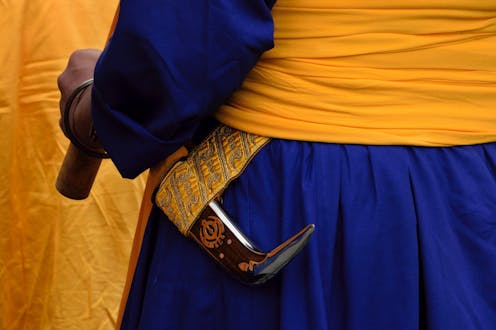
The Supreme Court of Queensland last week overturned a law banning children from bringing “knives” to school for religious reasons. This will allow Sikh students, parents, and teachers to carry a ceremonial dagger known as a “kirpan” at schools in Queensland.
Initiated Sikhs must carry a kirpan as one of five articles of faith. Those preparing for initiation, including school aged children, may also carry the five markers of faith. Many kirpans are blunt and worn stitched inside a sheath under a person’s cloths.
This isn’t the first time the issue of kirpans in schools has been raised. In 2021 the New South Wales government temporarily banned students from wearing kirpans at school following an incident where a 14-year-old boy used one to stab another student. The ban was eventually lifted after consultation with the Sikh community, leading to new guidelines.
In 2006 the Canadian Supreme Court found a ban on wearing kirpans in school was a breach of freedom of religion under the Canadian Charter of Rights.
What made the Queensland law particularly egregious is that not only did it prohibit the freedom of religion of a small and vulnerable minority, it did so deliberately. The only religious or ethnic group in Australia that habitually wears a religious or cultural symbol that resembles a knife are Sikhs. The law was therefore directly targeted at Sikhs.
The Queensland case highlights the needs for Australia’s secular legal system to recognise the adverse impact of law on religious and cultural minorities.
What did the court say?
All states and territories have laws prohibiting people from carrying and using knives in public places and schools. However, knives can be used for a range of legitimate activities such as cutting food or whittling wood. Children can carry knives as part of a scout’s uniform, for example. As a result, all states and territories have exemptions that allow people, including children, to carry and use knives where it’s “reasonably necessary”.
In New South Wales, Victoria, South Australia, Tasmania, and the Australian Capital Territory there are also specific exemptions that allow Sikhs to wear a kirpan for religious purposes. In Western Australia and the Northern Territory, Sikhs rely on the general exemption when wearing a kirpan in public places or at schools.
But Queensland’s laws are a little different. Section 51(1) of Queensland’s Weapons Act 1990 prohibited carrying knives in a public place or school without a reasonable excuse. As in other states and territories, the act also provides a range of reasons, including religion, for carrying a knife in a public place.
However, section 51(5) specifically states that religion is not a reasonable excuse for carrying a knife at a school.
To be clear, children could still bring a knife to school in Queensland for a range of other reasons, such as to cut up food or as part of their studies. However, Sikh children were specifically banned from carrying a knife for religious reasons.
The Supreme Court found the ban on bringing a knife to school specifically for religious reasons was inconsistent with the Racial Discrimination Act.
As per Australia’s constitution, state laws that are inconsistent with Commonwealth laws are void to the extent of the inconsistency. So, the court found that section 51(5) of the Queensland’s Weapons Act 1990 was void.
A religion or ethnicity?
Sikhism originated in the Punjab region in South Asia in the 15th Century. There are around 25-30 million Sikhs worldwide, with about five million living outside the Punjab region.
At the 2021 census there were 210,400 Sikhs in Australia, roughly 0.8% of the population.
While Sikhism is commonly thought of as a religion, the courts have recognised Sikhs have a common ethnic origin. As one of the judges explained in the case:
Nearly all Sikhs originate from the Punjab region. Nearly all Sikhs continue to have a link with family in Punjab, practice elements of Punjabi culture and speak the Punjabi language.
As a result, Sikhs are considered to be an ethno-religious group for the purposes of the Commonwealth Racial Discrimination Act.
A knife or a religious symbol?
The kirpan is one of the five articles of faith worn by initiated Sikhs and those preparing for initiation. The other four are: a kachera (a special undergarment), kanga (a wooden comb), kara (an iron band) and keshas (unshorn hair). If one of the five items is removed, they’re required to undergo a lengthy absolution (or forgiveness) process.
The Queensland Supreme Court found the kirpan was a knife for the purposes of the Weapons Act 1990. It found that a knife remains a knife no matter how blunt or sharp it is, how it’s worn or how easy it is to access.
To Sikhs, a kirpan is fundamentally a religious symbol. It’s a symbol of dignity and of their obligation to stand up for others. Referring to the kirpan as a knife downplays its important religious significance. But in a secular legal system, defining it in any other way would be unworkable.
What happens now?
The Queensland education department is carefully considering the Supreme Court’s decision.
The court did leave the door open for a complete ban on knives in schools, although this would impact other legitimate uses of knives such as preparing food.
Kirpans are currently worn in schools by students, parents and teachers in other states of Australia, often with strict guidelines. The Queensland education system will likely need to develop similar guidelines.
Authors: Renae Barker, Senior Lecturer, The University of Western Australia

















