

The 'number 8 wire' days for NZ's defence force are over – new priorities will demand bigger budgets
- Written by John Moremon, Senior Lecturer in Defence Studies, Massey University
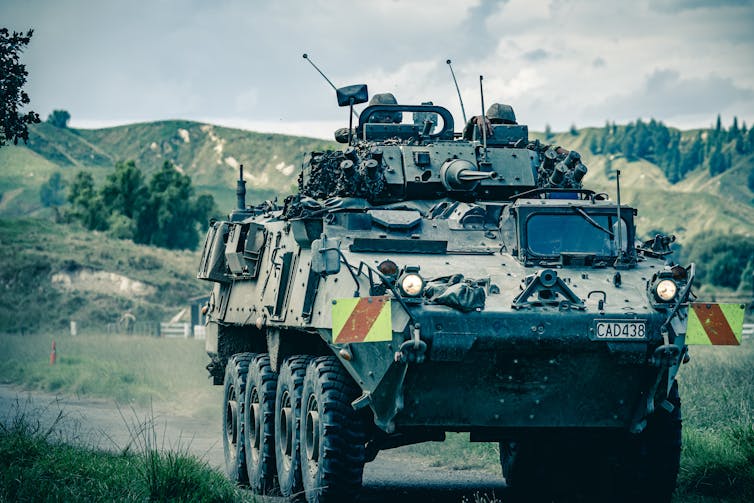
New Zealanders have been put on notice that defence and security are among the bigger challenges the country faces this century.
The assessment earlier this year by the Ministry of Foreign Affairs, Navigating a Shifting World-Te whakatere i tētahi ao hurihuri, warned “the future looks grim” geopolitically. The release last week of a new national security strategy and defence policy strategy statement underscored the urgency of the required response.
Announcing the strategies, Minister of Defence Andrew Little said New Zealand is “facing more geostrategic challenges than we have in decades”, with geographic remoteness no longer affording protection. Possibly the last time this hit home was in 1942 when Japanese forces advanced in the Pacific.
The news is not all bad, however. The defence policy strategy statement emphasises New Zealand can identify and respond to threats by understanding the strategic and operating environments, partnering with other nations for collective security, and acting with “a credible, combat-capable, deployable force”.
Creating and maintaining such a force is central to New Zealand being perceived by its allies as a credible partner. But this will require financial and social investment in the New Zealand Defence Force (NZDF) at a scale not seen for decades.
Underfunding and apathy
Successive governments have underfunded defence. At the end of the Cold War in 1991, defence expenditure was 2.26% of GDP. Many countries imposed a “peace dividend”, reducing defence expenditure. But New Zealand cut more than most, more than half in real terms.
The low point was 2015 when defence spending fell to 0.99% of GDP. It has since climbed to around 1.4%, but the NZDF now needs to recover from those historically low budgets. Such GDP ratios will not be enough to match the rhetoric around the new defence and security strategies.
Read more: NZ’s first national security strategy signals a 'turning point' and the end of old certainties
But Aotearoa New Zealand is a small country with funding challenges in many areas, including housing, health, education, security, conservation and infrastructure. Furthermore, New Zealanders have tended to endorse lower defence spending.
Analysts have previously pointed to a degree of public apathy and negative perception of the NZDF. A poll in 2007 showed a majority of New Zealanders were unwilling to see taxes increase to pay for defence.
The defence policy strategy statement and accompanying future force design principles do not indicate the likely implementation costs. But they do acknowledge it will require “balancing the required resourcing with associated trade-offs on policy outcomes”.
The documents identify several challenges that logic dictates will require increased funding and better public support for defence.
The technology deficit
The strategy statement notes that military technology is “evolving at an exponential rate”. This includes artificial intelligence, robotics, weapons, communications, and warship and aircraft design. The NZDF “needs to be more agile in adopting new technologies, including those that will help protect New Zealand and those that can project force”.
This is emphasised by the cover image of a Boeing P-8A, New Zealand’s newest military aircraft. By contrast, the cover of the design principles document offers a clue to the challenge by featuring a 1980s-designed ANZAC frigate warship.
The Australian navy begins retiring its similarly aged frigates next year, but New Zealand’s will be updated and in service for another decade. This risks the ships passing the point where they can meaningfully contribute to military operations.
Replacement Australian-built frigates cost on average around $5 billion each. New Zealand will likely procure less expensive, off-the-shelf models. But these will need to be equipped for maritime and island operations, as well as war fighting. The NZDF will need new amphibious craft and strategic and tactical drones for sea, air and land.
The next government may well need to revisit past decisions driven by the low priority placed on defence. As one critical assessment in 2020 argued, “The decision to scrap air combat [fighter jet] capability in 2001 appears particularly reckless.”
Skills, people and pay
Another major challenge concerns personnel and skills. The NZDF needs to “adapt to a changing labour force to attract appropriate personnel”. It must compete for science, technology, engineering and mathematics (STEM) graduates.
The NZDF also needs non-STEM recruits for intellectual balance. To sustain capability, it must attract physically fit and educated young people who can understand and utilise modern technologies, and who possess analytical, interpersonal and communication skills. It must then train them for complex, high-risk operations.
The 2022 NZDF annual report noted how the challenges in recruiting and retaining personnel affect operational readiness and resilience. Given the employment market offers “remuneration rates greater than the NZDF currently provides”, a new pay model is needed.
Finally, the NZDF “will be called upon more often” for contingencies that include armed conflict, humanitarian assistance and disaster relief. High-tempo operations and multiple deployments strain personnel and families. To ensure personnel retention, conditions of service and support of families need improving.
The old “number 8 wire” resort to Kiwi ingenuity, imposed on the NZDF by decades of meagre defence budgets, will no longer wash. Identifying and responding to threats in the new geostrategic environment will depend on improved political, financial and societal support for the NZDF.
Of course there will be compromises. New Zealand cannot afford everything the NZDF might desire. In return for what is provided, however, governments and the NZDF itself must better explain to the public how the force contributes to national and collective security.
For New Zealanders to accept a beefed-up, more deployable and more expensive defence force, they will need to understand the threats and be assured the investment is warranted and the money spent wisely.
Authors: John Moremon, Senior Lecturer in Defence Studies, Massey University

















