

Thick ones, pointy ones – how albatross beaks evolved to match their prey
- Written by Jane Younger, Lecturer, Southern Ocean Vertebrate Ecology, University of Tasmania
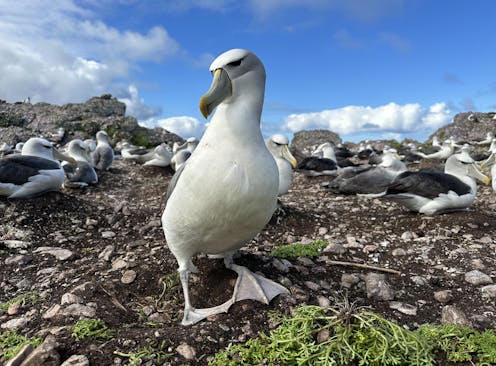
Albatross are among the world’s largest flying birds, with wingspans that can stretch beyond a remarkable three metres. These majestic animals harness ocean winds to travel thousands of kilometres in search of food while barely flapping their wings.
Young albatross, embarking on their first journey, can spend up to five years at sea without ever touching land.
Yet not all albatross are the same. Across the world’s oceans there exist 22 species, with many sharing an overlapping range around the Southern Ocean — a region synonymous with cold, roaring winds and towering waves.
Our new research published today shows how albatross species evolved different beak shapes to make the most of the ocean’s food resources. These species have adapted to different seafood diets.
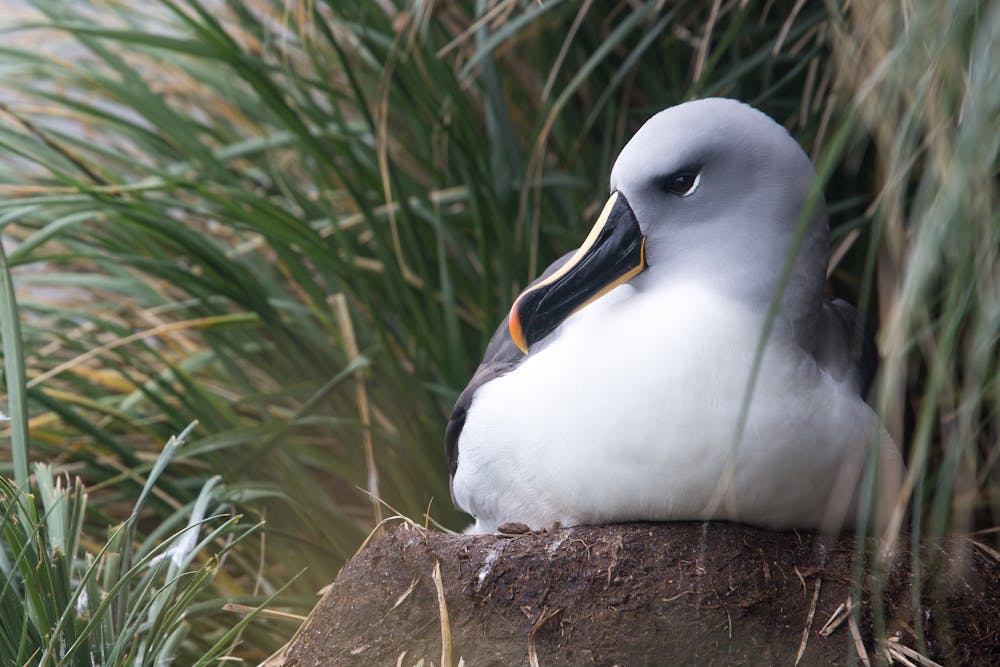
Read more: An ocean like no other: the Southern Ocean's ecological richness and significance for global climate
Move over, Darwin’s finches!
In 1835 Charles Darwin discovered the finches of the Galápagos Islands and noted their beaks varied in shape and size to suit different diets. This observation became a centrepiece for the theory of evolution, showing how species adapt to different ways of life.
From a single common ancestor, Darwin’s finches diversified. Some birds have thick beaks for feeding on seeds and nuts, while others have pointed beaks for eating insects. This variation allows species to specialise, helping them to share available food sources and limit competition.
Albatross have fascinating beaks. Unlike most other birds, they have a “compound” beak made of multiple pieces of keratin. Albatross spend most of their lives at sea, so they have adapted to drink seawater. They use a special gland to remove salt from the seawater and their beaks contain tube-like passages that excrete the salty liquid.
By studying the shape of albatross beaks in three dimensions (3D), our new research shows that, just like Darwin’s finches, albatross beaks vary in size and shape to adapt to different diets.
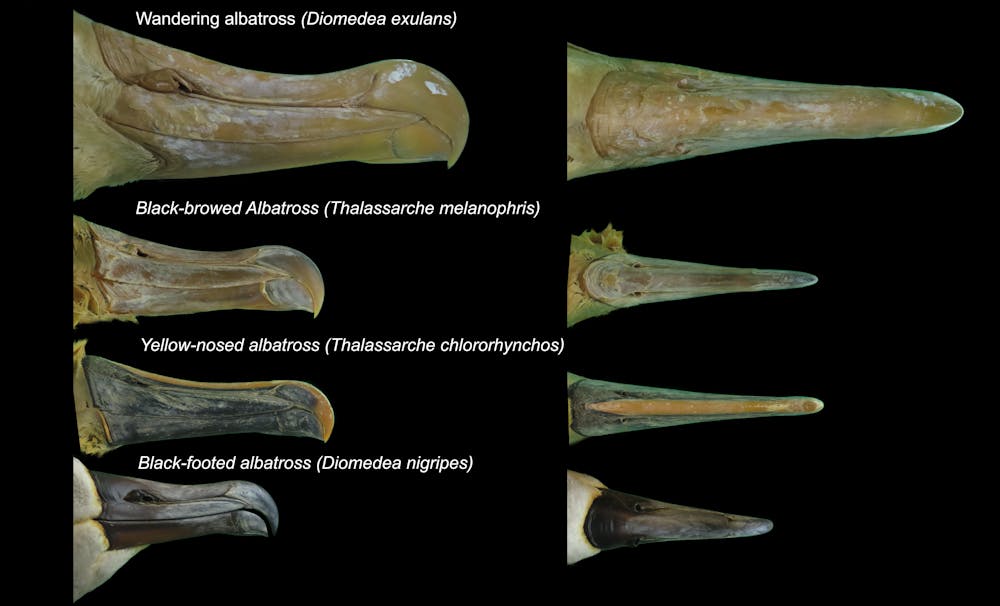 Albatross have compound beaks made of multiple pieces of keratin. These vary in size and shape between the different species.
Josh Tyler, CC BY-ND
Albatross have compound beaks made of multiple pieces of keratin. These vary in size and shape between the different species.
Josh Tyler, CC BY-ND
The 3D scanning revolution
Wildlife research is undergoing a revolution as scientists use new 3D scanning and modelling techniques to compare the anatomy of animals. This gives fresh insights into their ecology and evolution.
Using museum specimens, we made 3D digital models of beaks for 61 birds from 12 different albatross species. We compared the size and shape of different species’ beaks. We tested if closely-related species had similar beaks. Alternatively, beaks might be more alike between species that are distantly related but consume similar food. Such a pattern would be an example of convergent evolution.
We found beak size and shape varied between albatross species, making it a useful tool for identifying species that otherwise look similar.
Beaks also varied between species that eat either invertebrate prey, fish, or a mixture of both. Even in species that have similarly shaped beaks and diets, variations in beak size enable them to focus on prey of different sizes within the same category, such as small versus large fish.
The variation is most obvious in changes in the length and thickness of the beaks, but they can also vary in how the separate keratin pieces come together to make up the whole shape of the beak. These differences help albatross species to avoid competition with each other as they forage together over the open ocean.
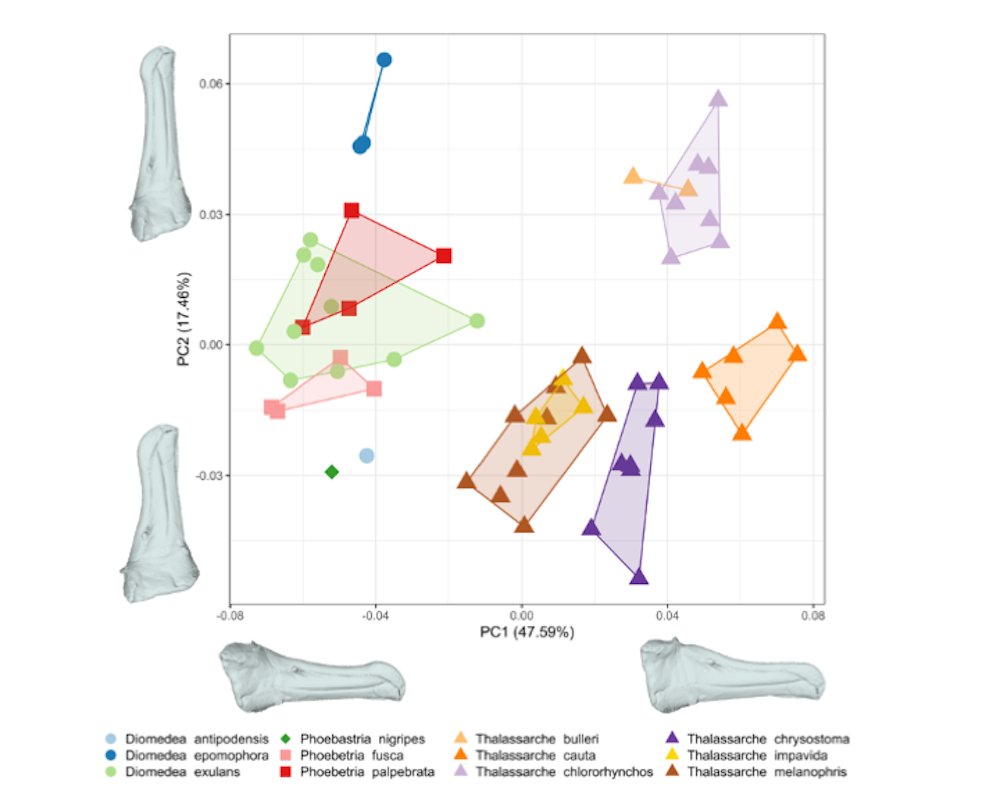 3D analysis shows how albatross species beaks can differ in both size and proportion. They also vary in how the keratin pieces fit together to make the overall shape of the bill.
Josh Tyler, CC BY-ND
3D analysis shows how albatross species beaks can differ in both size and proportion. They also vary in how the keratin pieces fit together to make the overall shape of the bill.
Josh Tyler, CC BY-ND
A future for albatross?
This research was made possible by the large collection of more than 750 albatross specimens preserved at the Tasmanian Museum and Art Gallery.
Almost all of these specimens came to the museum after being caught as bycatch in past longline fisheries, where bird carcasses were collected to identify which species were being captured on hooks.
Fortunately, improved fishing methods have reduced albatross bycatch, but this collection now remains as a valuable resource for new research like this into the biology of these birds.
Sadly, fisheries are not the only threat these extraordinary birds face. The first European record of an albatross from 1593 tells us how the bird was captured, killed and eaten. Today, of the 22 albatross species, two are considered critically endangered, seven species are endangered, and a further six species are considered vulnerable.
Albatross are still frequent victims of fisheries bycatch, plastic pollution, and introduced predators on their breeding islands.
Like most wildlife species, the persistent threat of climate change looms large, as the world’s oceans warm and alter their habitat and the abundance of their prey.
Despite their evolutionary marvels and remarkable adaptations to the harshest ocean on Earth, the albatross serves as a poignant reminder of nature’s fragility. It is our duty to ensure their wings continue to soar above our oceans for generations to come.
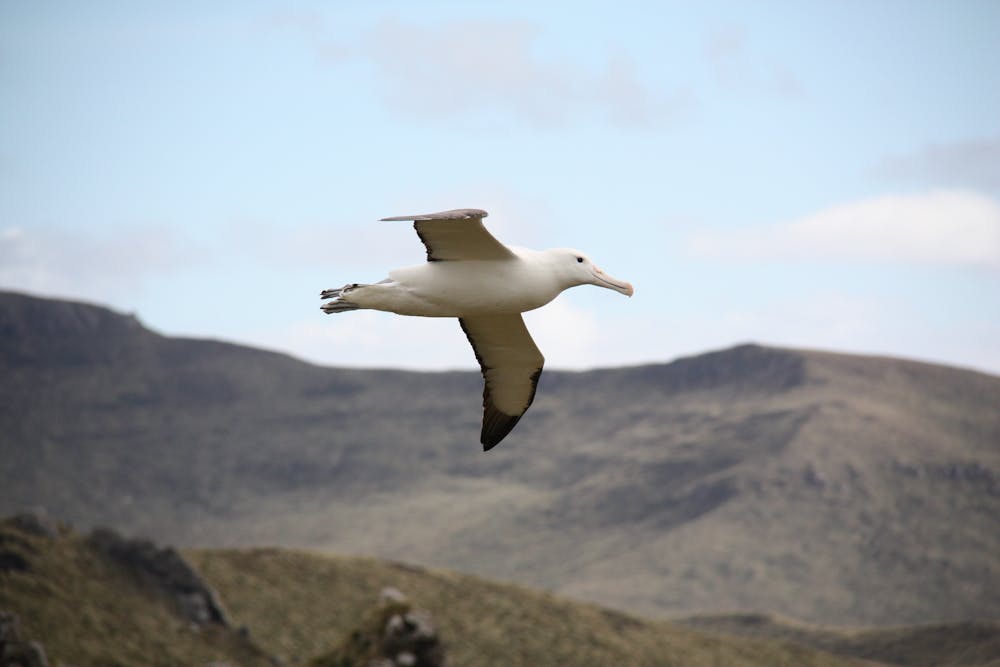 The southern Royal albatross (Diomedea epomophora) in flight.
Julie McInnes, CC BY-ND
The southern Royal albatross (Diomedea epomophora) in flight.
Julie McInnes, CC BY-ND
Read more: Plastic in the ocean kills more threatened albatrosses than we thought
Authors: Jane Younger, Lecturer, Southern Ocean Vertebrate Ecology, University of Tasmania

















