

in a new book, Mark Edele unpacks what's at stake in a bloody war
- Written by Marko Pavlyshyn, Emeritus Professor, Ukrainian Studies, Monash University
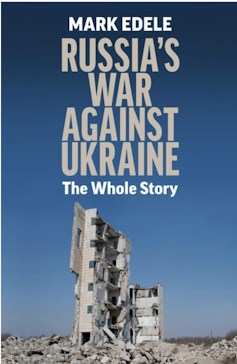
“The whole story” is an unexpected subtitle for a book by a historian. We have long been alert to the fact that, faced with the boundless chaos of empirical facts, historians make selections.
Review: Russia’s War Against Ukraine: The Whole Story – Mark Edele (MUP).
In order to make intelligible narratives, they propose causes and effects. Their accounts imply interpretations and, inevitably, evaluations. The number of potential “stories” about a given topic is infinite.
Historian Mark Edele, author of Stalinism at War: The Soviet Union in World War II, The Soviet Union: A Short History and several other highly regarded books, knows this well. His subtitle is a provocation: it accuses his academic field – call it Soviet and Post-Soviet Studies, or Slavic and East European Studies, or Eurasian Studies – of telling us what is patently not the whole story of the Russia-Ukraine relationship.
Edele, along with historian Rebecca Friedman, has begun editing a new series of short books for Cambridge University Press dedicated to “decolonising Soviet history”. By decentralising this history away from Moscow, they write,
contributions will both decolonize Soviet history and provincialize the former metropole: Russia.[…] Why is this worth doing? Russia’s war of aggression against Ukraine has further amplified voices in our field who have called for a ‘decolonization’ of our thinking, writing, and teaching about the former Soviet space. This is an urgent matter.
These words were addressed to scholars. Edele’s new book Russia’s War Against Ukraine, by contrast, is chiefly written for non-specialists. The book makes its argument of decolonisation by implication, treating Ukrainian realia as things-in-themselves rather than peripheral parts of an essentially Russian whole.

 Ukrainian rescuers at the scene of rocket debris falling on a hypermarket in Odesa, Ukraine, 14 August. Odesa was attacked with eight rockets and 15 shock drones.
Igor Tkachenko/EPA
He rejects the notion, favoured by some scholars and commentators in the West, that Russia’s aggression is both understandable and justifiable as a response to alleged encroachments by NATO and the EU upon the sphere of influence to which a "great power” such as Russia is entitled.
Indeed he disputes the application of the 19th century term “great power” to Russia, given its actual economic and military heft in the contemporary world.
Thirdly, Edele contextualises the war as
one moment in a larger conflict over empire and decolonisation in the lands once dominated by the Muscovite state and then the Russian Empire.
This conflict began with the independence struggles of the submerged nations of the Russian Empire at the end of the first world war, resuming in the years of the Soviet Union’s decay and collapse (1989-1991).
Read more:
5 must-read books about Russia and Ukraine: our expert picks
A decolonial flavour
In Edele’s view, the conflict – manifested not only in the war in Ukraine, but also in recent protests and confrontations in Belarus, Kazakhstan, Armenia and Azerbaijan – combines “domestic and international aspects, struggles over independence and empire with contests between dictatorship and democracy”.
The first chapter of his book, “Ukraine: A Short History to 1991,” is followed by the analogously named second chapter, “Russia: A Short History to 1991”. Edele commences the Ukrainian narrative with the late 19th century polity of Kyivan Rus, centred on Kyiv; he begins the corresponding history of Russia in 1300 with the rise of Muscovy (Moscow).
Edele does not position Kyivan Rus within the “heritage” of either Ukraine or Russia, as historians of the two countries are apt to do; but there is a certain decolonial flavour to the gesture of dedicating equal space to the two stories and placing the Ukrainian one first.
Read more:
How Moscow has long used the historic Kyivan Rus state to justify expansionism
Edele’s telling of the Ukrainian story emphasises the evolution of the modern national project through its tribulations in the Russian Empire and the USSR. The lead themes of the Russian chapter include Russia’s centuries-long habit of territorial expansion and its efforts (from the 19th century onward and throughout the Soviet period) to reconfigure a multi-ethnic empire into a monochrome, Russianised, nation-state.
The arguments of the next two chapters are announced in their subtitles: “Ukraine since 1991: The Struggle for Democracy” and “Russia since 1991: Failed Decolonisation.”
Edele shows Ukraine to have evolved, albeit with falterings and false steps along the way, into a modern nation state. Its citizens, regardless of ethnic or cultural differences, share a civic dedication to their country as a sovereign territory where the democratic political process can embody their will.
On the other hand, Russians under the leadership of Putin (“Vladimir the Great,” as Edele ironically calls him in the title of the book’s fifth chapter), have re-embraced an imperial identity, conceding authoritarianism is a price that must be paid for membership of a powerful and expanding state.
Ukrainian rescuers at the scene of rocket debris falling on a hypermarket in Odesa, Ukraine, 14 August. Odesa was attacked with eight rockets and 15 shock drones.
Igor Tkachenko/EPA
He rejects the notion, favoured by some scholars and commentators in the West, that Russia’s aggression is both understandable and justifiable as a response to alleged encroachments by NATO and the EU upon the sphere of influence to which a "great power” such as Russia is entitled.
Indeed he disputes the application of the 19th century term “great power” to Russia, given its actual economic and military heft in the contemporary world.
Thirdly, Edele contextualises the war as
one moment in a larger conflict over empire and decolonisation in the lands once dominated by the Muscovite state and then the Russian Empire.
This conflict began with the independence struggles of the submerged nations of the Russian Empire at the end of the first world war, resuming in the years of the Soviet Union’s decay and collapse (1989-1991).
Read more:
5 must-read books about Russia and Ukraine: our expert picks
A decolonial flavour
In Edele’s view, the conflict – manifested not only in the war in Ukraine, but also in recent protests and confrontations in Belarus, Kazakhstan, Armenia and Azerbaijan – combines “domestic and international aspects, struggles over independence and empire with contests between dictatorship and democracy”.
The first chapter of his book, “Ukraine: A Short History to 1991,” is followed by the analogously named second chapter, “Russia: A Short History to 1991”. Edele commences the Ukrainian narrative with the late 19th century polity of Kyivan Rus, centred on Kyiv; he begins the corresponding history of Russia in 1300 with the rise of Muscovy (Moscow).
Edele does not position Kyivan Rus within the “heritage” of either Ukraine or Russia, as historians of the two countries are apt to do; but there is a certain decolonial flavour to the gesture of dedicating equal space to the two stories and placing the Ukrainian one first.
Read more:
How Moscow has long used the historic Kyivan Rus state to justify expansionism
Edele’s telling of the Ukrainian story emphasises the evolution of the modern national project through its tribulations in the Russian Empire and the USSR. The lead themes of the Russian chapter include Russia’s centuries-long habit of territorial expansion and its efforts (from the 19th century onward and throughout the Soviet period) to reconfigure a multi-ethnic empire into a monochrome, Russianised, nation-state.
The arguments of the next two chapters are announced in their subtitles: “Ukraine since 1991: The Struggle for Democracy” and “Russia since 1991: Failed Decolonisation.”
Edele shows Ukraine to have evolved, albeit with falterings and false steps along the way, into a modern nation state. Its citizens, regardless of ethnic or cultural differences, share a civic dedication to their country as a sovereign territory where the democratic political process can embody their will.
On the other hand, Russians under the leadership of Putin (“Vladimir the Great,” as Edele ironically calls him in the title of the book’s fifth chapter), have re-embraced an imperial identity, conceding authoritarianism is a price that must be paid for membership of a powerful and expanding state.
 ‘Vladimir the Great’ at his desk.
Alexander Kazakov/Sputnik/Kremlin Pool/EPA
Read more:
More corrupt, fractured and ostracised: how Vladimir Putin has changed Russia in over two decades on top
The future?
The final and shortest chapter of the book is titled “The Future.” Given the notorious dangers of prediction, Edele reports on trends already manifest: in Ukraine, a shift in orientation, accelerated by the war, away from Russia and toward the European Union and NATO; in Russia, an intensification of authoritarianism on the part of the regime and chauvinism in the public sphere.
On the question of how the war might end, Edele lists some of the alternatives and their possible consequences, without picking any as the most likely. They are the “nightmare scenarios” of a Russian victory, a nuclear holocaust, or a Russian “face-saving” retreat after maximum destruction of Ukraine; a Ukrainian victory; a battlefront stalemate with continued missile strikes on Ukraine; or a negotiated peace – unlikely, given that the aims of the warring sides are irreconcilable.
One conclusion, however, Edele is prepared to offer with a modicum of certainty:
Ukraine is unlikely ever to return to the Russian Empire. The empire itself is a thing of the past. It remains to be seen how much blood will need to flow until this reality is accepted by Moscow.
Edele has written an excellent book. It presents two complex histories briefly, lucidly and in a manner that illuminates what is at stake, and for whom, in the current war. It also critically examines some widely circulated, but misleading, commonplaces about the two countries.
Without making explicit value judgements, Edele is clear about who the aggressor is in the war, which of the two countries is on a democratic trajectory and which is descending deeper into autocracy. He also emphasises what will be lost – to Ukraine, but also to Western countries and the world at large – should Russia win.
Not the least of the book’s virtues is that it is written in a lively and engaging style. It assists the reader with informative maps and graphs, as well as generous advice about further reading on the topic in English.
Authors: Marko Pavlyshyn, Emeritus Professor, Ukrainian Studies, Monash University
‘Vladimir the Great’ at his desk.
Alexander Kazakov/Sputnik/Kremlin Pool/EPA
Read more:
More corrupt, fractured and ostracised: how Vladimir Putin has changed Russia in over two decades on top
The future?
The final and shortest chapter of the book is titled “The Future.” Given the notorious dangers of prediction, Edele reports on trends already manifest: in Ukraine, a shift in orientation, accelerated by the war, away from Russia and toward the European Union and NATO; in Russia, an intensification of authoritarianism on the part of the regime and chauvinism in the public sphere.
On the question of how the war might end, Edele lists some of the alternatives and their possible consequences, without picking any as the most likely. They are the “nightmare scenarios” of a Russian victory, a nuclear holocaust, or a Russian “face-saving” retreat after maximum destruction of Ukraine; a Ukrainian victory; a battlefront stalemate with continued missile strikes on Ukraine; or a negotiated peace – unlikely, given that the aims of the warring sides are irreconcilable.
One conclusion, however, Edele is prepared to offer with a modicum of certainty:
Ukraine is unlikely ever to return to the Russian Empire. The empire itself is a thing of the past. It remains to be seen how much blood will need to flow until this reality is accepted by Moscow.
Edele has written an excellent book. It presents two complex histories briefly, lucidly and in a manner that illuminates what is at stake, and for whom, in the current war. It also critically examines some widely circulated, but misleading, commonplaces about the two countries.
Without making explicit value judgements, Edele is clear about who the aggressor is in the war, which of the two countries is on a democratic trajectory and which is descending deeper into autocracy. He also emphasises what will be lost – to Ukraine, but also to Western countries and the world at large – should Russia win.
Not the least of the book’s virtues is that it is written in a lively and engaging style. It assists the reader with informative maps and graphs, as well as generous advice about further reading on the topic in English.
Authors: Marko Pavlyshyn, Emeritus Professor, Ukrainian Studies, Monash University 
















