

how do we know the energy content of food, and how accurate are the labels?
- Written by Lauren Ball, Professor of Community Health and Wellbeing, The University of Queensland
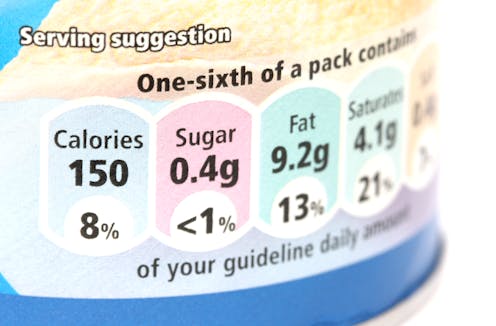
Everything we consume contains energy our bodies use to move, grow and maintain health. To work out how much energy is in different foods and drinks, we need to first look at a few core concepts.
Firstly, you’ve probably heard of the units of measurement for energy – calories – as well as the metric equivalent, which is joules. One calorie is defined as the amount of energy required to raise the temperature of 1 gram of water by 1℃.
In human nutrition, the amounts of energy needed to maintain health, and to fuel a body, are much larger than the tiny singular calories used to heat up a gram of water. So, the term “calorie” in nutrition commonly refers to a kilocalorie (or kcal), which is 1,000 calories. When you see the word “calories” on a nutrition label, it’s likely referring to kcals.
The energy stored in food and drinks is released when the body breaks down one or more of the four macronutrients inside the food (carbohydrates, proteins, fats, alcohol). The body then uses that energy for activities such as keeping our heart beating, our lungs breathing and our muscles moving.
When energy in food is estimated, it is the amount of energy food and drinks provide for these bodily processes. The four macronutrients provide different amounts of energy:
- 1 gram of carbohydrate provides about 4 kcal of energy
- 1 gram of fat provides about 9 kcal of energy
- 1 gram of protein provides about 4 kcal of energy
- 1 gram of alcohol provides about 7 kcal of energy.
How are calories estimated?
There are two ways to estimate the amount of energy in food and drinks.
The first is called “bomb calorimetry”. This gold-standard method involves placing a small sample of food or drink inside a device known as a bomb calorimeter. The food is burned in the presence of oxygen, releasing heat.
The amount of heat released is directly related to the amount of energy in the food, allowing a calculation to be made. This method is most commonly used for foods rich in fats and is considered the most reliable (but expensive) method.
The second method, the Altwater system, is a much less expensive method for estimating energy content. It is more commonly used when calculating energy of most food and drinks sold in supermarkets. Named after legendary food researcher Wilbur Altwater, this system uses a standard conversion factor for each macronutrient found in food and drinks. By estimating the amount of each of the four macronutrients, an approximate calculation of the total energy can be made.
However, this method requires detailed knowledge of the ingredients within composite foods (such as muesli bars or hamburgers) – which may reduce accuracy. There is also a margin of error to expect with the Altwater system, because it assumes each ingredient is always the same in composition.
For example, a cup of oats grown in one part of the country won’t necessarily have the exact same nutritional content as another cup of oats grown elsewhere, due to climate and soil differences. So, this system is an estimation based on an average.
Importantly, both methods estimate the amount of energy in food and drinks. But the actual energy our bodies extract from these foods and drinks can vary due to factors such as individual differences in digestion and absorption, as well as food processing and cooking methods.
Why do foods have calories written on them?
In Australia, it’s a legal requirement for packaged food items to have a nutrition information panel that displays the number of kcal it contains.
However, homemade food items sold at places like a fresh market may not be required to provide a nutrition information panel. This will depend on the type of food being sold and the scale of the business operation.
Fresh foods such as fruit, vegetables and meat also don’t require a nutrition information panel. To find out the number of kcal in them, you can either run an experiment with a bomb calorimeter or look up an estimated value in an online nutrition database.
Food composition databases such as CalorieKing compile information about the energy and nutrient content of various foods. Dietitians and other health professionals often use these databases to estimate the energy content of foods to inform dietary recommendations.
Different international standards
Both kJ and kcal refer to energy – they are just two different units of measurements (such as how inches and centimetres are two different units for measuring length). Kilojoules (kJ) is part of the International System of Units (SI).
Australia, New Zealand and some parts of Europe use kJ. The United States and the United Kingdom use kcal. To convert between calories and kilojoules you use the conversion factors:
- 1 kcal = 4.184 kJ
- 1 kJ = 0.24 kcal (about ¼).
For example, if you have a packet of chips with an energy content of 200 kcal, you can convert it to kJ as follows: 200 kcal × 4.184 = 836.8 kJ.
As for how many calories are acceptable to eat, the Australian Guidelines for Healthy Eating estimate the average adult requires about 7,000kJ or 1,670Kcal every day. However, differences in age, gender, size, health and physical activity will influence how much energy a person needs.
To estimate your personal energy requirements, you can use this nutrients and dietary energy calculator.
Read more: It's time to bust the 'calories in, calories out' weight-loss myth
Authors: Lauren Ball, Professor of Community Health and Wellbeing, The University of Queensland

















