

Modern Australian
The Times

only a genuine shift to rail will put NZ on track to reduce emissions

  • Written by Philip Laird, Honorary Principal Fellow, University of Wollongong
only a genuine shift to rail will put NZ on track to reduce emissions

Both the Labour government and the opposition National Party have now released major transport polices that put the emphasis on maintaining and expanding roads.

The cost and priority of various projects will clearly be an election issue. But at the heart of the debate lies an inconvenient truth about climate change: encouraging road transport while needing to reduce carbon emissions simply does not add up.

We can see this tension in transport agency Waka Kotahi’s own policy statements: road safety and better travel options on the one hand, addressing sustainability on the other. But transport is responsible for 17% of New Zealand’s total greenhouse gas emissions.

Furthermore, road vehicle use has been increasing, as has the popularity of larger cars and SUVs that create more emissions per kilometre. Road congestion has become worse, with the popular response being to expand road capacity.

Hence the present government’s recently announced plans for a second harbour crossing in Auckland involving two road tunnels. And the main thrust of National’s Transport for the Future policy is on more urban and intercity roads. Both Labour and National favour a second Mount Victoria tunnel in Wellington.

In the background sits the government’s Rail Plan, which sets out the “vision and priorities for rail over the next decade and beyond”. But given the clear need for New Zealand’s transport policies to change, the planned improvements need to be on a fast track.

Light rail right next door

Cars and planes are convenient, but both have low energy efficiency compared to rail.
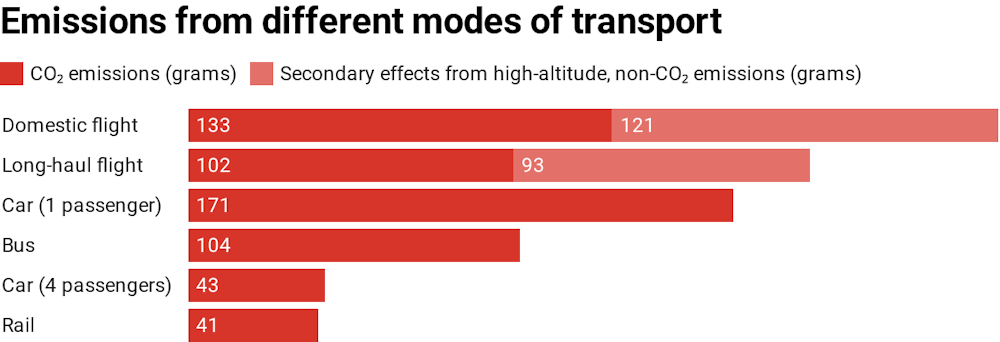
Data source: Greenhouse gas reporting: conversion factors 2019 A car’s carbon emissions per passenger kilometre can be around four times that of domestic rail (as shown by the graph above, based on UK data). The government’s transport plans for Auckland do include light rail, but National has promised to scrap the scheme if elected. Looking across the Tasman, however, there is good evidence that light rail should not be this contentious. Few might have predicted that Queensland’s Gold Coast light rail network – G:link, which opened in July 2014 – would see six million riders in its first 12 months of operation. Work started on a second stage within 24 months, with construction of a third stage now under way. Read more: 70 years of road-based policies created today's problems – does National’s transport plan add up? The system has now seen more than 73 million paid passenger trips since it opened, with upwards of ten million trips likely in the 2022-23 year. In 2019, three other new light rail systems opened in Australia: a short section in Newcastle, another in Canberra (where post-COVID patronage is recovering), and Sydney’s CBD and south-east line (where patronage is also bouncing back). Adelaide’s single line was also extended during the 2010s. However, the combined patronage of all of these new light rail systems is far exceeded by Melbourne’s trams, now building back to pre-COVID levels of 205 million rides in 2018-19. This is all part of a remarkable renaissance of light rail around the world. New Zealand could be part of this – if the will was there. Light rail success: Melbourne’s trams have seen more than 200 million rides per year. Getty Images The freight factor New Zealand’s historical shift from rail to road as the primary mode of freight transport has seen an ever-increasing dependence on trucks. While road freight grew steadily in the first two decades of this century, rail freight in 2021-2022 was the same as it was in 1999-2000. Road freight does have some advantages, including point-to-point delivery and flexibility. But for many freight movements, using trucks rather than rail increases emissions by a factor of three. If reducing freight emissions is the goal, shifting some from road to rail is a logical solution. Read more: New Zealand must get over its obsession with big cars and go smaller or electric to cut emissions Rail will therefore have to increase its own energy efficiency, including through more electrification of rail routes such as the Auckland-Hamilton-Tauranga and Palmerston North-Waikanae links. While this was hinted at in the government’s 2023 budget, it doesn’t appear in the recently released draft government statement on land transport. Increasing the allowable axle loading for freight wagons across the rail network would also allow trains to carry heavier loads, improve efficiency and reduce emissions. Finally, the North Island main trunk needs upgrading to make the track straighter and allow trains to go faster. In turn this will make rail more attractive and help reduce emissions. Read more: To get New Zealanders out of their cars we'll need to start charging the true cost of driving When’s the next train? Clearly, roads need to be maintained, and New Zealand’s road network has to be made more resilient to adverse weather impacts. But expanding road capacity at the expense of a more efficient rail system and improved public transport is a recipe for increasing emissions. While road congestion in major cities is a problem, overseas experience tells us that more road capacity only increases vehicle use. The net result is more, not fewer, transport emissions. Read more: Why restoring long-distance passenger rail makes sense in New Zealand – for people and the climate It would make more sense to upgrade the rail network to move more freight and transport more urban and intercity passengers. In fact, the Transport and Infrastructure Select Committee has recently recommended that the Ministry of Transport investigate how the Rail Plan could better incorporate inter-regional passenger rail. But New Zealand needs to move beyond recommendations. As the International Energy Agency has noted: “Rail transport is the most energy-efficient and least carbon-intensive way to move people and second only to shipping for carrying goods.” Whichever parties form the next government have an opportunity to put New Zealand transport on the right track. On the evidence so far, however, it could be a slow train coming. Authors: Philip Laird, Honorary Principal Fellow, University of Wollongong

Read more https://theconversation.com/slow-train-coming-only-a-genuine-shift-to-rail-will-put-nz-on-track-to-reduce-emissions-211662

Why Regular Skills Updates Are Essential for Licensed Security Officers

A guard at a Brisbane shopping centre gets a call about a shoplifter who's turned aggressive.  They’ve done the job for six years. But their de-...

10 Benefits of Choosing Professional Tutoring Penrith Services

Every student has unique learning strengths, challenges, and academic goals. While classroom teaching provides essential knowledge and structure, so...

Sunshine Coast Baby Classes Prove Big Hit Among First-Time Mums

There's a movement gaining traction on the Sunshine Coast, providing a village of support, socialisation and relief for first-time mothers and babie...

Father's Day Gift Ideas for Men Who Are Hard to Buy For

Some dads are easy to buy for. Others do not want anything, already have everything, or give you the classic "don't worry about me" answer every yea...

Top 5 Mistakes That Wear Out Your Brakes Faster

Brakes don't need frequent replacements like oil changes do.   But a lot of the wear happens quietly, over months, because of habits most drivers...

Plantation Shutters vs Curtains: Which Is Better for Your New Home?

Moving into a new home is an exciting opportunity to personalise your space and make it your own. While many homeowners focus on furniture, flooring...

Celebration of Life vs Traditional Funeral: What's the Difference?

When saying goodbye to someone you love, there is no single way to honour their life. Every family has different traditions, beliefs, and preference...

Building Approval for Roofing Projects: What Homeowners Need to Know

Roofing projects are an important part of maintaining and protecting your home. Whether you're repairing storm damage, replacing an ageing roof, or ...

Chatswood Tutoring And Its Role In Academic Achievement

Academic success often requires more than classroom attendance alone. Students face increasing expectations as they progress through school, particu...

Why Laser Hair Removal Treatments Continue Growing In Popularity

Managing unwanted hair can become time-consuming and frustrating for many people, especially when shaving, waxing, and other temporary methods requi...

Choosing the Right Devices for a Flexible Workplace

For IT leaders managing large fleets, the device layer is where workforce productivity and security policy meet. The shift towards flexible and hybrid...

How Business Advisory Services Help Companies Achieve Sustainable Growth

Every business owner aims to build a profitable and sustainable organisation. While dedication, innovation, and hard work are important, achieving l...

Why Body Contouring Has Become A Popular Cosmetic Treatment

Many people maintain healthy lifestyles through regular exercise and balanced eating habits but still struggle with stubborn areas of fat that are d...

How to Choose the Right POS Hardware for Your Business in Australia

A lot of Australian business owners spend weeks researching POS software but buy hardware almost as an afterthought. That's a mistake. The wrong har...

Why Material Handling Hose Is Critical for Industrial Efficiency

A high-performance material handling hose is an essential component in industries that transport abrasive, dry, or bulk materials on a daily basis...

How to Choose the Right Lawyer in Melbourne for Your Situation

Choosing legal support can feel difficult, especially when the stakes are personal or business-related. The right lawyer in Melbourne should underst...

Hoteliers Look to Clever Value Adds to Increase Revenue

The Australian hospitality industry is still in recovery mode after a notoriously rough patch in recent years. While there has been a post-COVID tra...

Moving to Queensland? Here’s How to Prep Your Car for the Big Move North

There’s no sign of the northern migration slowing down, with thousands of southerners fleeing from chaotic lifestyles and cooler climates for a brig...
















