

taking selfies in nature has a cost
- Written by Samuel Cornell, PhD Candidate, School of Population Health, UNSW Sydney
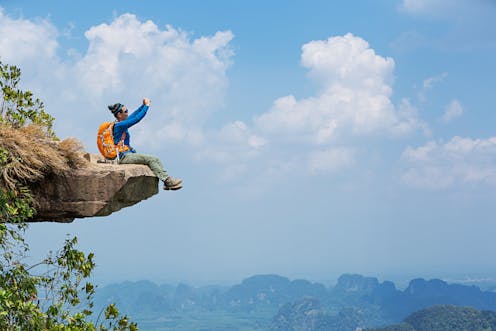
In the age of the selfie taking photos of yourself has become an everyday occurrence. Half of all teenagers regularly post selfies. Driven by social media algorithms, many of us now flock to natural places for the best selfie background.
But what happens when our pursuit of the perfect selfie starts damaging nature – or even ourselves? Many people have been severely injured or killed by taking risky selfies and photos in dangerous locations. Indian researchers catalogued 259 selfie-related deaths worldwide as of 2018.
And the search for the perfect selfie can injure animals like quokkas, crayfish and glow-worms, protected plants and even First Nations rock art. Selfies have even become a biosecurity threat.
Spare a thought for our land managers, tasked with caring for the natural places sometimes despoiled for a photo and emergency workers entrusted with rescuing selfie-seekers. As our new research has found, Australia’s land managers are often at their wit’s end trying to keep people safe in nature.
The problem? Fences and warning signs don’t work well. Hardcore selfie-seekers jump the fence and perch on the edge of the cliff to get the shot. We may well need selfie educational campaigns.
Read more: Instagram is making you a worse tourist – here's how to travel respectfully
Selfies make a new brand of tourist
Social media tourism is drastically changing who and how many of us go to places such as Figure Eight Pools in Sydney’s Royal National Park or Josephine Falls not far from Cairns.
As one land manager told us:
We noticed a massive increase in the number of people, and the kind of visitor that we were getting. We’re getting a lot more people who are maybe urban based, didn’t spend a lot of time in national parks, weren’t particularly familiar with the concept of bushwalking
Land managers told us these new kinds of tourist were motivated to seek out photos and selfies. The problem was, many were willing to ignore warning signs or bans on drones to get their photos.
You know, it’s all just to get that photo, really. That’s it. People definitely, more so now than ever, I think, are coming for the photo. They’re not coming for a bushwalk and to look around at the trees and to experience nature.
Drone use is common, even when it is banned.
They break the Civil Aviation Safety Authority (CASA) rules [on drones], every flipping day, they annoy the people, the guests, the wildlife […] I’ve got eight crashed drones in the park currently [risking] environmental harm to the park if they catch fire or the batteries leak in the World Heritage area, in the creeks where the rare crayfish are.
For other land managers, the challenge is the damage to the environment. Plants get trampled, wildlife disturbed, and in some cases, delicate ecosystems suffer long-term damage.
Someone goes swimming, puts it on social media and suddenly there’s 100 people a day coming to go wild swimming where the platypus and the glow-worms live. And in a wet year, suddenly all the vegetation around the rock pool is trampled, it turns into a muddy mess
Mainstream tourism bodies can make the problem worse by promoting social media hotspot locations.
I was horrified the other day noticing promotions for these Figure Eight pools. I just thought, “You’ve gotta be kidding me. How many times have we told the tourism industry to stop it?”
Safe selfies?
Perhaps the thorniest challenge for land managers is accommodating increased interest while keeping people safe. That’s because selfie-seekers sometimes deliberately avoid safety measures like fences. As one land manager told us:
They want to get a photo without a fence in it. Look at me with my toes over the edge of the crumbly sandstone cliff.
Other land managers are working to assist this new demand by reshaping nature to make better scenery – and keep visitors safer. At Moran Falls in Queensland’s Lamington National Park, a famous view across the gorge had been obscured by vegetation. That drove some visitors to jump the fence at the viewing platform and stand directly on top of a very tall cliff.
As a solution, land managers got an arborist to trim the trees blocking the view and then use the fallen limbs to hide the goat track made by selfie-seekers.
Once we improved the view and the photo shot, people were happy to take the photo from the platform. But when the view was impeded from the platform, they would undertake risky behaviour and stand on top of a 300ft cliff, right on the edge, to get the photo.
Why do traditional measures like signs and warnings often prove ineffective? The answer may lie in social validation. For many, the risk seems worth the reward if it means garnering admiration on social media.
Nature-based content on platforms like Instagram and TikTok often performs very well, giving other would-be influencers the incentive to seek out new locations.
What can we do?
Land managers have repeatedly told us signs aren’t working for these new tourists. As a result, there’s an urgent need to communicate risk and safety information in novel ways which resonate.
The tools land managers have are often preventive – barriers, boardwalks and signs, coupled with punitive measures such as fines. But this isn’t working.
Better risk communication, as New South Wales authorities are doing with time-sensitive risk warnings for Figure Eight Pools, may help.
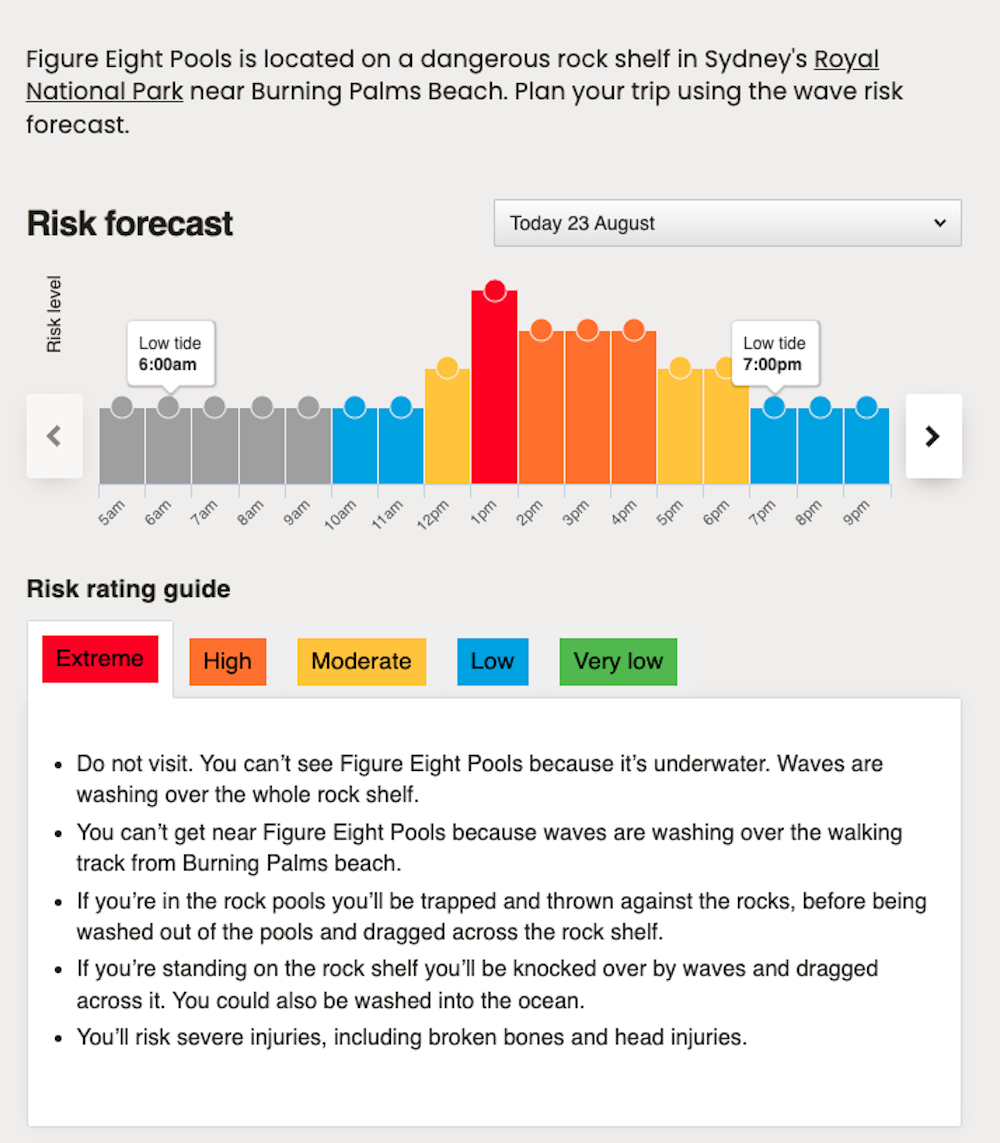
Our research points to the need for fresh strategies to tackle social media hotspots and selfie-seeking by understanding what drives social-media tourists, improving risk communication and developing partnerships.
This problem has been created by the confluence of social media and human psychology. It may well be that the solution lies in the same intersection.
Responsible selfie and tourism campaigns on platforms like TikTok and Instagram could be a start.
After all, it’s not that national parks shouldn’t have visitors. It’s finding ways to deal with this spurt of interest which doesn’t harm people - or nature.
Authors: Samuel Cornell, PhD Candidate, School of Population Health, UNSW Sydney

















