

Almost half of Moon missions fail. Why is space still so hard?
- Written by Gail Iles, Senior Lecturer in Physics, RMIT University
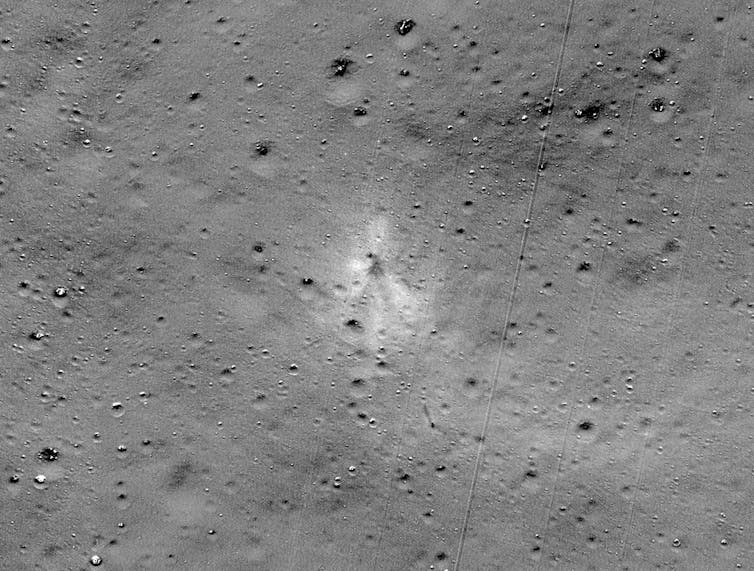
In 2019, India attempted to land a spacecraft on the Moon – and ended up painting a kilometres-long streak of debris on its barren surface. Now the Indian Space Research Organisation has returned in triumph, with the Chandrayaan-3 lander successfully touching down near the south pole of Earth’s rocky neighbour.
India’s success came just days after a spectacular Russian failure, when the Luna 25 mission tried to land nearby and “ceased to exist as a result of a collision with the lunar surface”.
These twin missions remind us that, close to 60 years after the first successful “soft landing” on the Moon, spaceflight is still difficult and dangerous. Moon missions in particular are still a coin flip, and we have seen several high-profile failures in recent years.
Why were these missions unsuccessful and why did they fail? Is there a secret to the success of countries and agencies who have achieved a space mission triumph?
An exclusive club
The Moon is the only celestial location humans have visited (so far). It makes sense to go there first: it’s the closest planetary body to us, at a distance of around 400,000 kilometres.
Yet only four countries have achieved successful “soft landings” – landings which the spacecraft survives – on the lunar surface.
The USSR was the first. The Luna 9 mission safely touched down on the Moon almost 60 years ago, in February 1966. The United States followed suit a few months later, in June 1966, with the Surveyor 1 mission.
China was the next country to join the club, with the Chang'e 3 mission in 2013. And now India too has arrived, with Chandrayaan-3.
Missions from Japan, the United Arab Emirates, Israel, Russia, the European Space Agency, Luxembourg, South Korea and Italy have also had some measure of lunar success with fly-bys, orbiters and impacts (whether intentional or not).
Crashes are not uncommon
On August 19 2023, the Russian space agency Roscosmos announced that “communication with the Luna 25 spacecraft was interrupted”, after an impulse command was sent to the spacecraft to lower its orbit around the Moon. Attempts to contact the spacecraft on August 20 were unsuccessful, leading Roscosmos to determine Luna 25 had crashed.
Despite more than 60 years of spaceflight experience extending from the USSR to modern Russia, this mission failed. We don’t know exactly what happened – but the current situation in Russia, where resources are stretched thin and tensions are high due to the ongoing war in Ukraine, may well have been a factor.
Read more: Russia has declared a new space race, hoping to join forces with China. Here's why that's unlikely
The Luna 25 failure recalled two high-profile lunar crashes in 2019.
In April that year, the Israeli Beresheet lander crash-landed after a gyroscope failed during the braking procedure, and the ground control crew was unable to reset the component due to a loss of communications. It was later reported a capsule containing microscopic creatures called tardigrades, in a dormant “cryptobiotic” state, may have survived the crash.
And in September, India sent its own Vikram lander down to the surface of the Moon – but it did not survive the landing. NASA later released an image taken by its Lunar Reconnaissance Orbiter showing the site of the Vikram lander’s impact. Debris was scattered over almost two dozen locations spanning several kilometres.
Space is still risky
Space missions are a risky business. Just over 50% of lunar missions succeed. Even small satellite missions to Earth’s orbit don’t have a perfect track record, with a success rate somewhere between 40% and 70%.
We could compare uncrewed with crewed missions: around 98% of the latter are successful, because people are more invested in people. Ground staff working to support a crewed mission will be more focused, management will invest more resources, and delays will be accepted to prioritise the safety of the crew.
Read more: I'm training to become Australia's first woman astronaut. Here's what it takes
We could talk about the details of why so many uncrewed missions fail. We could talk about technological difficulties, lack of experience, and even the political landscapes of individual countries.
But perhaps it’s better to step back from the details of individual missions and look at averages, to see the overall picture more clearly.
The big picture
Rocket launches and space launches are not very common in the scheme of things. There are around 1.5 billion cars in the world, and perhaps 40,000 aeroplanes. By contrast, there have been fewer than 20,000 space launches in all of history.
Plenty of things still go wrong with cars, and problems occur even in the better-regulated world of planes, from loose rivets to computers overriding pilot inputs. And we have more than a century of experience with these vehicles, in every country on the planet.
So perhaps it’s unrealistic to expect spaceflight – whether it’s the launch stage of rockets, or the even rarer stage of trying to land on an alien world – to have ironed out all its problems.
We are still very much in the early, pioneering days of space exploration.
Monumental challenges remain
If humanity is ever to create a fully fledged space-faring civilisation, we must overcome monumental challenges.
To make long-duration, long-distance space travel possible, there are a huge number of problems to be solved. Some of them seem within the realm of the possible, such as better radiation shielding, self-sustaining ecosystems, autonomous robots, extracting air and water from raw resources, and zero-gravity manufacturing. Others are still speculative hopes, such as faster-than-light travel, instantaneous communication, and artificial gravity.
Read more: New warp drive research dashes faster than light travel dreams – but reveals stranger possibilities
Progress will be little by little, small step by slightly larger step. Engineers and space enthusiasts will keep putting their brainpower, time and energy into space missions, and they will gradually become more reliable.
And maybe one day we’ll see a time when going for a ride in your spacecraft is as safe as getting in your car.
Correction: a typing error in the original version of this article put the Surveyor 1 mission in 1996, rather than its actual year of 1966.
Authors: Gail Iles, Senior Lecturer in Physics, RMIT University
Read more https://theconversation.com/almost-half-of-moon-missions-fail-why-is-space-still-so-hard-211914

















