

How to use critical thinking to spot false climate claims
- Written by: Peter Ellerton, Lecturer in Critical Thinking, Director of the UQ Critical Thinking Project, The University of Queensland
Much of the public discussion about climate science consists of a stream of assertions. The climate is changing or it isn’t; carbon dioxide causes global warming or it doesn’t; humans are partly responsible or they are not; scientists have a rigorous process of peer review or they don’t, and so on.
Despite scientists’ best efforts at communicating with the public, not everyone knows enough about the underlying science to make a call one way or the other. Not only is climate science very complex, but it has also been targeted by deliberate obfuscation campaigns.
Read more: A brief history of fossil-fuelled climate denial
If we lack the expertise to evaluate the detail behind a claim, we typically substitute judgment about something complex (like climate science) with judgment about something simple (the character of people who speak about climate science).
But there are ways to analyse the strength of an argument without needing specialist knowledge. My colleagues, Dave Kinkead from the University of Queensland Critical Thinking Project and John Cook from George Mason University in the US, and I published a paper yesterday in Environmental Research Letters on a critical thinking approach to climate change denial.
We applied this simple method to 42 common climate-contrarian arguments, and found that all of them contained errors in reasoning that are independent of the science itself.
In the video abstract for the paper, we outline an example of our approach, which can be described in six simple steps.
The authors discuss the myth that climate change is natural.Identify the claim: First, identify as simply as possible what the actual claim is. In this case, the argument is:
The climate is currently changing as a result of natural processes.
Construct the supporting argument: An argument requires premises (those things we take to be true for the purposes of the argument) and a conclusion (effectively the claim being made). The premises together give us reason to accept the conclusion. The argument structure is something like this:
- Premise one: The climate has changed in the past through natural processes
- Premise two: The climate is currently changing
- Conclusion: The climate is currently changing through natural processes.
Determine the intended strength of the claim: Determining the exact kind of argument requires a quick detour into the difference between deductive and inductive reasoning. Bear with me!
In our paper we examined arguments against climate change that are framed as definitive claims. A claim is definitive when it says something is definitely the case, rather than being probable or possible.
Definitive claims must be supported by deductive reasoning. Essentially, this means that if the premises are true, the conclusion is inevitably true.
Read more: How I came to know that I am a closet climate denier
This might sound like an obvious point, but many of our arguments are not like this. In inductive reasoning, the premises might support a conclusion but the conclusion need not be inevitable.
An example of inductive reasoning is:
- Premise one: Every time I’ve had a chocolate-covered oyster I’ve been sick
- Premise two: I’ve just had a chocolate-covered oyster
- Conclusion: I’m going to be sick.
This is not a bad argument – I’ll probably get sick – but it’s not inevitable. It’s possible that every time I’ve had a chocolate-covered oyster I’ve coincidentally got sick from something else. Perhaps previous oysters have been kept in the cupboard, but the most recent one was kept in the fridge.
Because climate-contrarian arguments are often definitive, the reasoning used to support them must be deductive. That is, the premises must inevitably lead to the conclusion.
Check the logical structure: We can see that in the argument from step two – that the climate change is changing because of natural processes – the truth of the conclusion is not guaranteed by the truth of the premises.
In the spirit of honesty and charity, we take this invalid argument and attempt to make it valid through the addition of another (previously hidden) premise.
- Premise one: The climate has changed in the past through natural processes
- Premise two: The climate is currently changing
- Premise three: If something was the cause of an event in the past, it must be the cause of the event now
- Conclusion: The climate is currently changing through natural processes.
Adding the third premise makes the argument valid, but validity is not the same thing as truth. Validity is a necessary condition for accepting the conclusion, but it is not sufficient. There are a couple of hurdles that still need to be cleared.
Check for ambiguity: The argument mentions climate change in its premises and conclusion. But the climate can change in many ways, and the phrase itself can have a variety of meanings. The problem with this argument is that the phrase is used to describe two different kinds of change.
Current climate change is much more rapid than previous climate change – they are not the same phenomenon. The syntax conveys the impression that the argument is valid, but it is not. To clear up the ambiguity, the argument can be presented more accurately by changing the second premise:
- Premise one: The climate has changed in the past through natural processes
- Premise two: The climate is currently changing at a more rapid rate than can be explained by natural processes
- Conclusion: The climate is currently changing through natural processes.
This correction for ambiguity has resulted in a conclusion that clearly does not follow from the premises. The argument has become invalid once again.
We can restore validity by considering what conclusion would follow from the premises. This leads us to the conclusion:
- Conclusion: Human (non-natural) activity is necessary to explain current climate change.
Importantly, this conclusion has not been reached arbitrarily. It has become necessary as a result of restoring validity.
Note also that in the process of correcting for ambiguity and the consequent restoring of validity, the attempted refutation of human-induced climate science has demonstrably failed.
Check premises for truth or plausibility: Even if there were no ambiguity about the term “climate change”, the argument would still fail when the premises were tested. In step four, the third premise, “If something was the cause of an event in the past, it must be the cause of the event now”, is clearly false.
Applying the same logic to another context, we would arrive at conclusions like: people have died of natural causes in the past; therefore any particular death must be from natural causes.
Restoring validity by identifying the “hidden” premises often produces such glaringly false claims. Recognising this as a false premise does not always require knowledge of climate science.
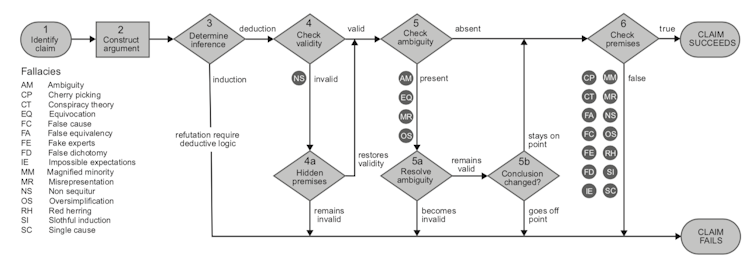 Flow chart for argument analysis and evaluation.
When determining the truth of a premise does require deep knowledge in a particular area of science, we may defer to experts. But there are many arguments that do not, and in these circumstances this method has optimal value.
Previous work by Cook and others has focused on the ability to inoculate people against climate science misinformation. By pre-emptively exposing people to misinformation with explanation they become “vaccinated” against it, showing “resistance” to developing beliefs based on misinformation.
Read more: Busting myths: a practical guide to countering science denial
This reason-based approach extends inoculation theory to argument analysis, providing a practical and transferable method of evaluating claims that does not require expertise in climate science.
Fake news may be hard to spot, but fake arguments don’t have to be.
Authors: Peter Ellerton, Lecturer in Critical Thinking, Director of the UQ Critical Thinking Project, The University of Queensland
Read more http://theconversation.com/how-to-use-critical-thinking-to-spot-false-climate-claims-91314


















