

Explainer: the symbolism of The Lady and the Unicorn tapestry cycle
- Written by: Mark De Vitis, Lecturer in Art History , University of Sydney
The arrival of The Lady and the Unicorn tapestry cycle at the Art Gallery of New South Wales from February 10 presents a rare opportunity to see a work of art revered by specialists and enthusiasts alike. It has been called everything from the “Mona Lisa of the Middle Ages”, to “a national treasure of France”. Comprising six individual pieces and made around the year 1500, tapestries of such quality are rare, and few examples survive.
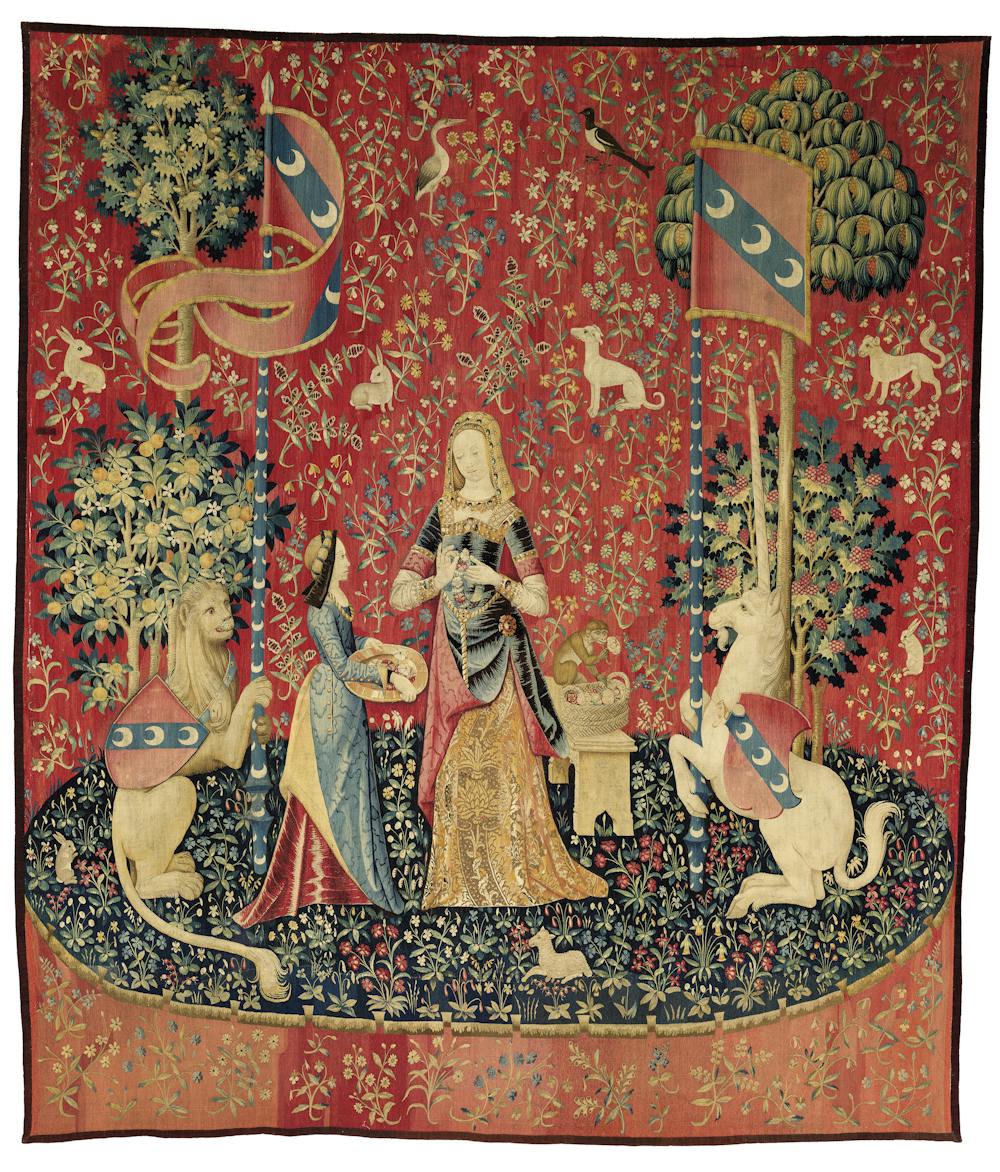 ‘Smell’ c1500, from The lady and the unicorn series.
wool and silk, 368 x 322 cm
Musée de Cluny – Musée national du Moyen Âge, Paris
Photo © RMN-GP / M Urtado
‘Smell’ c1500, from The lady and the unicorn series.
wool and silk, 368 x 322 cm
Musée de Cluny – Musée national du Moyen Âge, Paris
Photo © RMN-GP / M Urtado
Materially, they are breathtaking. Their elaborate millefleur (“thousand flowers”) backgrounds form hypnotic patterns. The sumptuous stuff from which they are woven – wool and silk, dyed with rich, natural dyes – insulate the beholder (literally part of their original function.) They muffle sound, creating an atmosphere of quiet mediation. The air is stilled, and light is enriched by their surfaces, generating a transcendental aura that draws the beholder into their complex internal universe.
The cycle first came to public attention in the middle of the 19th century, discovered languishing in the decaying château de Boussac, located in central France. Gnawed at by rats and threatened by the dank conditions, they were rescued by the musée de Cluny in 1882, bought for the princely sum of 25,500 francs.
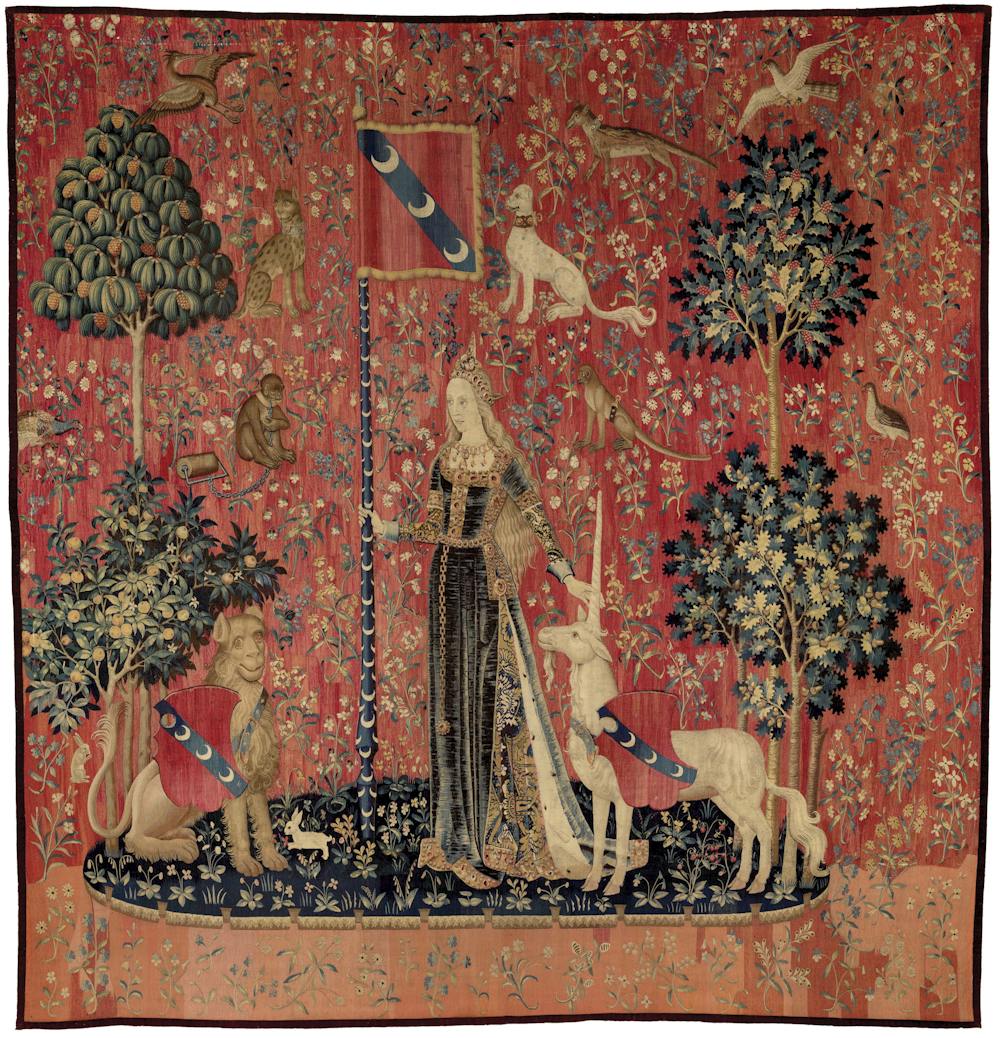 ‘Touch’ c1500, from The lady and the unicorn series.
wool and silk, 373 x 358 cm
Musée de Cluny – Musée national du Moyen Âge, Paris
Photo © RMN-GP / M Urtado
‘Touch’ c1500, from The lady and the unicorn series.
wool and silk, 373 x 358 cm
Musée de Cluny – Musée national du Moyen Âge, Paris
Photo © RMN-GP / M Urtado
The amount paid by the Cluny museum would have represented just a fraction of the original cost of their production, however. Tapestries of such quality would have commanded more than the annual income of all but the richest members of the nobility. More than a battleship. Far more than Michelangelo was paid to paint the Sistine ceiling.
Unsurprisingly then, the patron of the cycle came from a noble family with close ties to the French monarchy – the Le Viste. This is made clear from the heraldic symbols shown in the tapestries themselves. They were most likely designed by the “Master of Anne of Brittany” (so called because he designed a book of hours for the French queen, Anne of Brittany), a preeminent artist of the day.
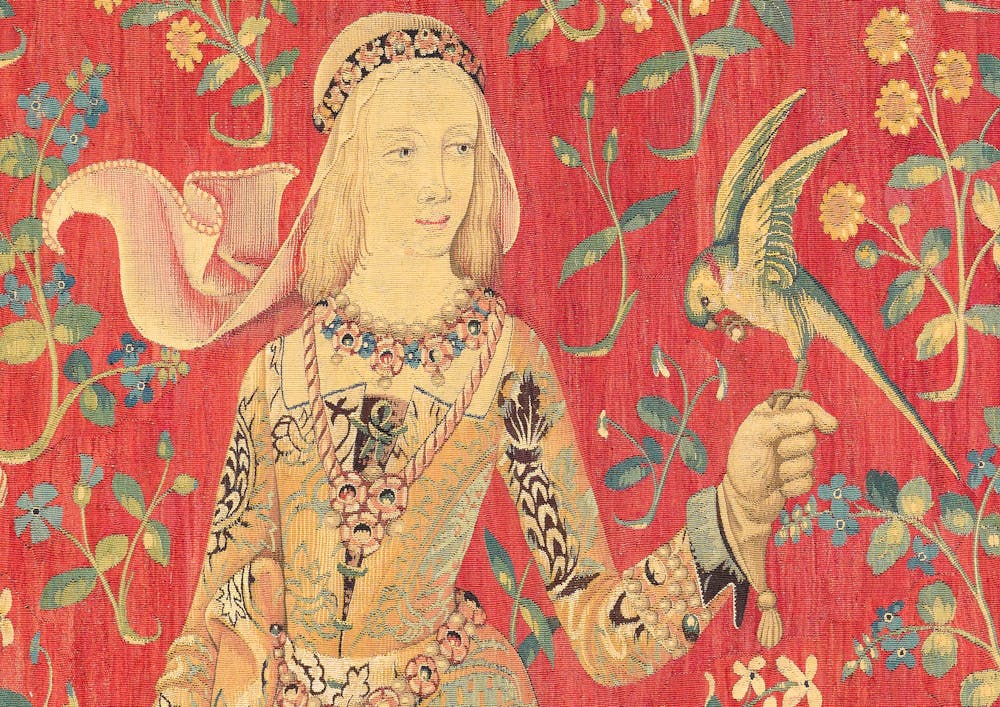 Detail of ‘Taste’ c1500, from The lady and the unicorn series.
wool and silk, 377 x 466 cm
Musée de Cluny – Musée national du Moyen Âge, Paris
Photo © RMN-GP / M Urtado
Detail of ‘Taste’ c1500, from The lady and the unicorn series.
wool and silk, 377 x 466 cm
Musée de Cluny – Musée national du Moyen Âge, Paris
Photo © RMN-GP / M Urtado
Though we might fixate on the artist who designed the composition, tapestries were made collaboratively, and the Lady and the Unicorn cycle was probably woven in the Southern Netherlands, not France, for the standard of weaving was higher there.
Given the effort and investment required to produce them, it is little surprise that the subject of the tapestries is complex – something worthy of more than a mere glance. The meaning of the cycle has been much debated. Experts now (generally) agree that they present a meditation on earthly pleasures and courtly culture, offered through an allegory of the senses.
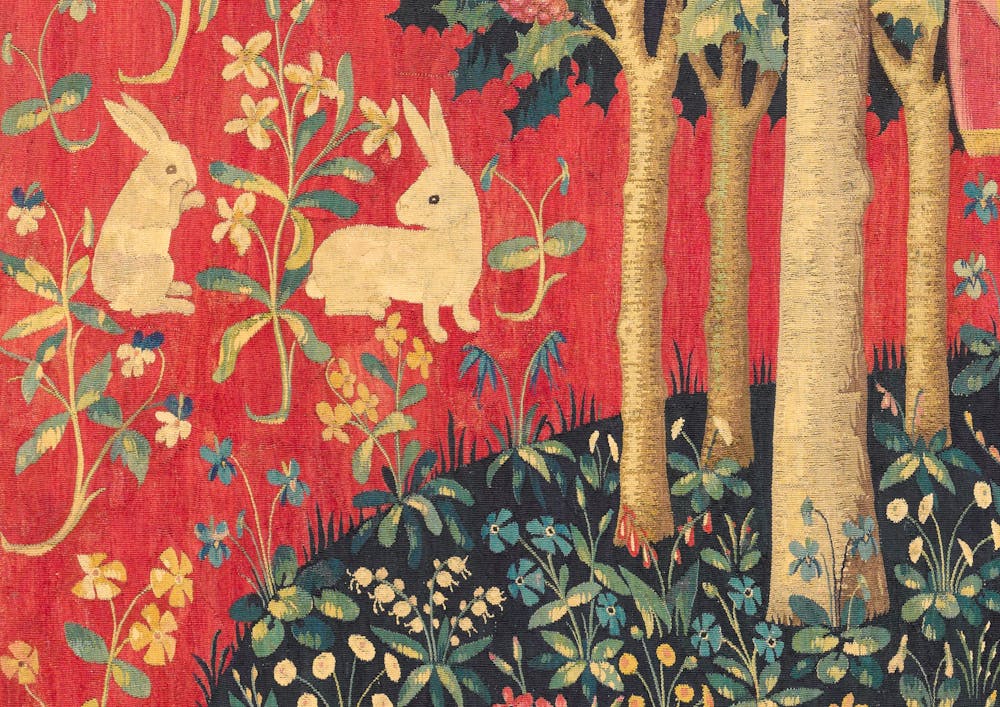 Detail of ‘Taste’ c1500, from The lady and the unicorn series.
wool and silk, 377 x 466 cm
Musée de Cluny – Musée national du Moyen Âge, Paris
Photo © RMN-GP / M Urtado
Detail of ‘Taste’ c1500, from The lady and the unicorn series.
wool and silk, 377 x 466 cm
Musée de Cluny – Musée national du Moyen Âge, Paris
Photo © RMN-GP / M Urtado
Five of the tapestries each depict one of the senses (Touch, Taste, Smell, Hearing and Sight.) Each shows a woman (the “Lady” of the title) performing some action intended to exemplify the sense in question. In “Smell” the Lady is presented with a dish of carnations. In ‘Hearing’ she plays at an organ. In “Sight”, she holds a mirror, which reflects the image of a unicorn that rests in her lap.
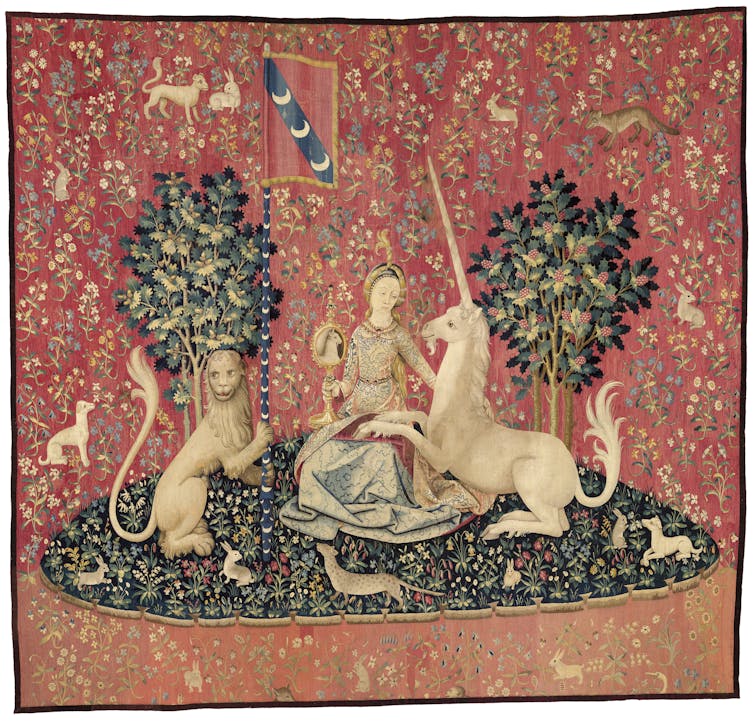 ‘Sight’ c1500, from The lady and the unicorn series.
wool and silk, 312 x 330 cm
Musée de Cluny – Musée national du Moyen Âge, Paris
Photo © RMN-GP / M Urtado
‘Sight’ c1500, from The lady and the unicorn series.
wool and silk, 312 x 330 cm
Musée de Cluny – Musée national du Moyen Âge, Paris
Photo © RMN-GP / M Urtado
Each of these gestures is presented with much charm and grace, conveyed through gently curving lines that show no sharp transitions. Yet, all is not as peaceful as it may seem. For there is a sixth tapestry. Though it is clear that all six are meant to form a unit, as each displays the same basic format and figures, the sixth work breaks the pattern of the other five.
Here, the Lady is depicted returning jewels (worn in the other tapestries) to a casket. She stands before a tent emblazoned with the words Mon Seul Désir (“my only desire”.) Her action does not connect with sensory or empirical experience, as with the other five, but is instead driven by some alternate force – cognition, moral reasoning, or emotion.
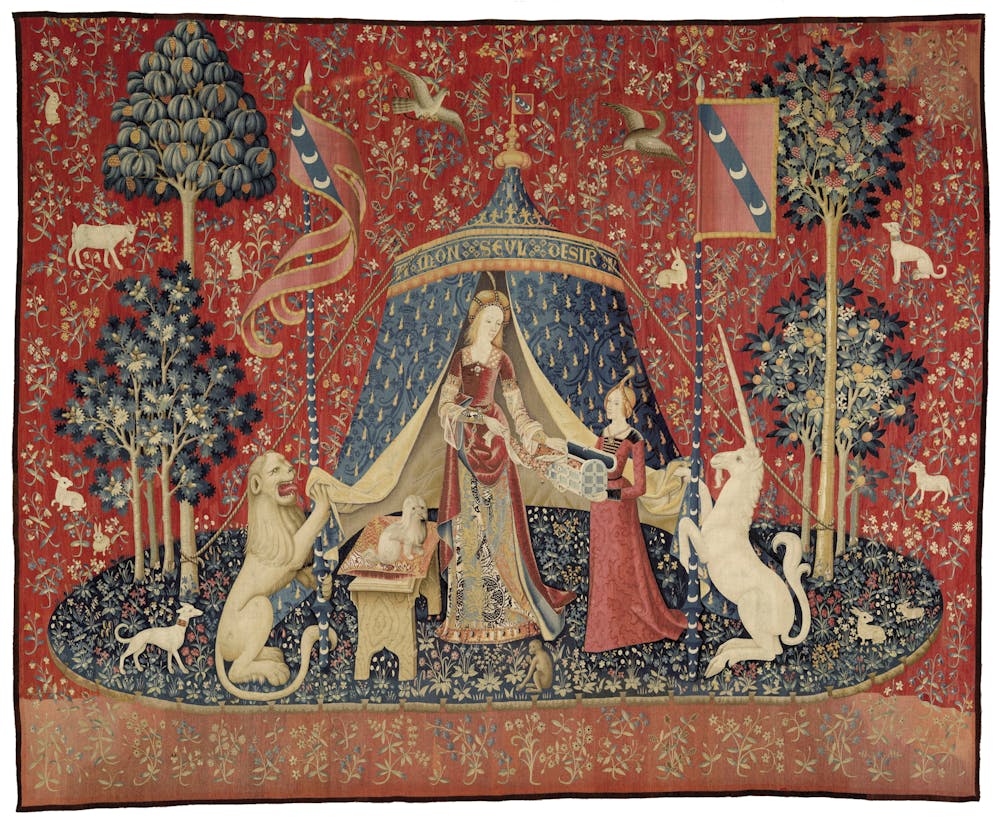 ‘Mon Seul Desir’ c1500, from The lady and the unicorn series.
wool and silk, 377 x 473 cm. Musée de Cluny – Musée national du Moyen Âge, Paris
Photo © RMN-GP / M Urtado
‘Mon Seul Desir’ c1500, from The lady and the unicorn series.
wool and silk, 377 x 473 cm. Musée de Cluny – Musée national du Moyen Âge, Paris
Photo © RMN-GP / M Urtado
A sixth sense is represented in this sixth tapestry, which presents a further way of knowing the world. This sense seems to have not one, but multiple dimensions. Intellectually, it may be thought of as common sense, or “internal” sense. Morally, it may be understood to encapsulate neo-platonic philosophy’s emphasis on the soul as the source of beauty (read the “good”.) In terms of courtly rhetoric, the sixth sense may be thought of as the heart, the source of courtly love and the home of complex or competing forces – free will, carnal passion, desire.
It is this sixth sense that leads the Lady to return her jewels to her casket. The gesture may be read as a sign of her virtue, an expression of the dominance of her reason over the physical sensations she experiences in the other tapestries, or, of the will as the centre of being. In this interpretation, the phrase Mon Seul Désir could be read not as “my sole desire” but “by my own free will”.
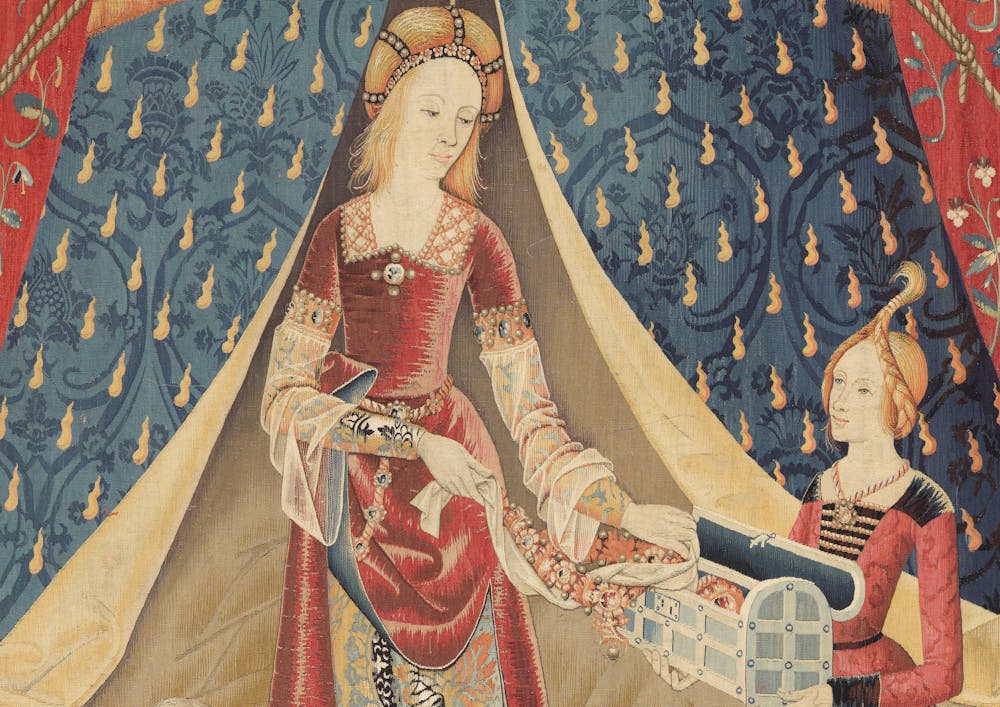 Detail of ‘Mon Seul Desir’ c1500, from The lady and the unicorn series.
wool and silk, 377 x 473 cm
Musée de Cluny – Musée national du Moyen Âge, Paris
Photo © RMN-GP / M Urtado
Detail of ‘Mon Seul Desir’ c1500, from The lady and the unicorn series.
wool and silk, 377 x 473 cm
Musée de Cluny – Musée national du Moyen Âge, Paris
Photo © RMN-GP / M Urtado
This multi-layered approach to interpreting the tapestries is echoed in other, localised features. For instance, the unicorn, which is represented in all six tapestries, embodies various, overlapping meanings. Unicorns were common heraldic animals, and frequently appear in courtly literature. Since the second century they were understood to represent chastity or purity. Certainly, this meaning connects with the reading of the Mon Seul Désir tapestry offered above.
The unicorn also acts as a canting emblem – that is, a pun on the name of the patron. Le Viste may be pronounced more like “Le Vite” in French, meaning fast. Fast, like a unicorn.
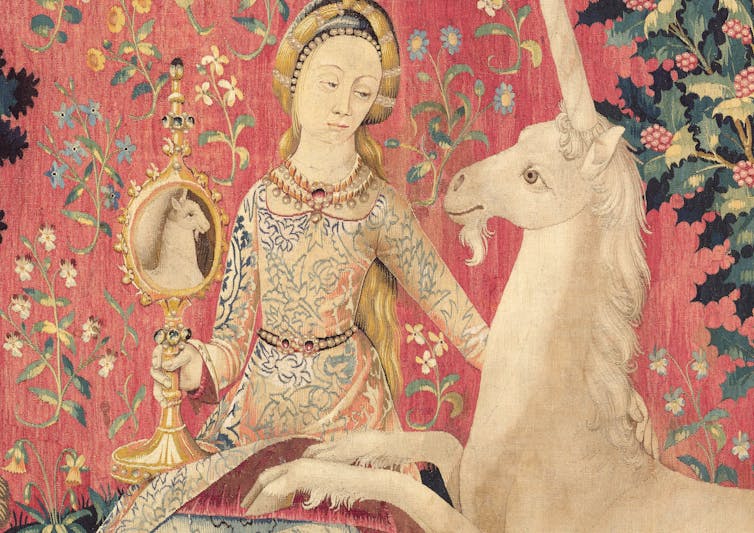 Detail of ‘Sight’ c1500, from The lady and the unicorn series.
wool and silk, 312 x 330 cm
Musée de Cluny – Musée national du Moyen Âge, Paris
Photo © RMN-GP / M Urtado
Detail of ‘Sight’ c1500, from The lady and the unicorn series.
wool and silk, 312 x 330 cm
Musée de Cluny – Musée national du Moyen Âge, Paris
Photo © RMN-GP / M Urtado
The inclusion of the unicorn also contributes to the sense that the tapestries intentionally encourage a viewer to evaluate types of knowledge or understanding. Representations of unicorns (both past and present, it could be argued) raise questions regarding how we come to know, and how empirical knowledge exists alongside tradition, culture, imagination, and creative expression.
More than a series of objects with remarkable aesthetic, historical and economic significance, the Lady and The Unicorn tapestries offer an opportunity to confront how different forms of understanding and experience overlap to form beliefs, shape perspectives, and precipitate action.
The Lady and the Unicorn tapestries will be at the Art Gallery of NSW from February 10 to 24 June. The gallery is mounting a series of programs around the tapestries.
Authors: Mark De Vitis, Lecturer in Art History , University of Sydney
Read more http://theconversation.com/explainer-the-symbolism-of-the-lady-and-the-unicorn-tapestry-cycle-91325


















