

Do we want a wind farm outside our window? What Australians think about the net zero transition
- Written by: Lucy Richardson, Post Doctoral Research Fellow, Monash Climate Change Communication Research Hub, Monash University
A paradox lies at the heart of Australian public opinion about climate change. While there is clear general support for substantial government action to achieve net zero emissions by 2050, there is also strong concern about the local impacts of new renewable energy infrastructure.
The rise of protest groups in regional Australia objecting to the installation of wind farms and transmission lines, in particular, presents a serious challenge to the Albanese government in communicating the importance of the net zero transition to the public.
In principle it seems that Australians strongly support this transition. In a poll for the Australia Institute’s Climate of the Nation report last year, two in three respondents went as far as to say our country should be a world leader in climate action.
Similarly, a 2020 Monash University study found eight out of ten Australians think the shift to renewable energy is inevitable, and two-thirds think we should be exporting renewable energy.
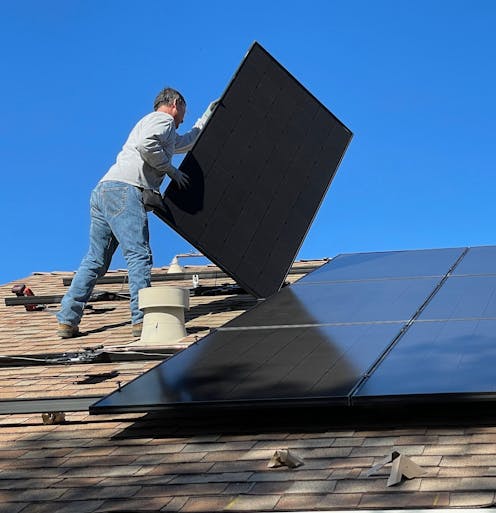
Studies also show strong support for renewable energy production through solar farms, with 90% of Australians prepared to live within ten kilometres of one, according to a 2021 CSIRO study. And a Guardian Essential poll from October last year found about 70% of respondents supported solar farms and 60% supported both offshore and onshore wind farms.
Local opposition to the net zero transition
But at the same time the installation of these same wind farms has attracted strong local protests, especially in NSW and Victoria. There has also been significant community pushback to the Australian Energy Market Operator’s plan to install 10,000 kilometres of overground transmission lines, which are key to carrying renewable energy to the electricity grid. Only 35% of respondents in the Guardian Essential poll supported them.
Read more: Australian homes can be made climate-ready, reducing bills and emissions – a new report shows how
In an equally serious challenge for the net zero transition, 70% of respondents felt renewable energy should not be developed “at the expense of local communities”.
In a bid to address these concerns, the Australian Energy Market Commission has drafted new community engagement rules to ensure communities are involved early in the process of designing the routes of transmission lines.
The changes seek to ensure all stakeholders get information about a project in a clear and timely fashion (including advice on how they can best play a role) and have opportunities to be regularly involved throughout the planning of projects.
NH: Would be good to have some analysis here from the authors on overcoming the problem and whether the AEMC action is enough
A more nuanced look at public opinion
There might be an even bigger issue that helps to explain the tension between apparent general support for acting to arrest global warming and local opposition to specific renewable energy projects. Segmentation studies, first undertaken in 2008 by researchers at Yale and George Mason Universities in the United States, and replicated in many countries, including Australia, are valuable for explaining this apparent paradox.
Read more: From laggard to leader? Why Australia must phase out fossil fuel exports, starting now
These studies break down views on climate change into segments of the population with different levels of concern. The original research divided American popular opinion into six groups: Alarmed, Concerned, Cautious, Disengaged, Doubtful and Dismissive.
The spectrum ranges from those most worried about climate change and who tend to take the most action, both in their personal lives and politically, to those who either don’t accept climate change is happening, or feel it isn’t something we need to address.
A range of segmentation studies conducted in 2011, 2016, 2020 and 2022 by researchers from both Australia and the US show Australians have become more worried over time. The Alarmed segment more than doubled between 2011 and 2022.
However, the studies show different segments of the population have different views of when we need to act to arrest climate change.
For example, the 2022 Climate Compass report highlights that people in the Concerned segment — the largest group, comprising one in four Australians — feel climate change is a serious problem but that its impacts will be most felt by future generations. These Australians see cost of living as a much more urgent problem.
While the polling data do not show whether many protesters against renewable energy projects belong to the Concerned segment of the population, it remains essential to explore communication strategies that might move the large numbers of Australians who identify as Concerned into the Alarmed camp. One way to do this might be on the nightly TV news.
Looking more closely at the weather
From flooding to heat, many Australian extreme weather records have been broken in recent years. Some people feel that is part and parcel of living in Australia, and remain unaware of the connection between climate change and the increasing frequency and intensity of extreme weather. And it can be difficult to translate complex climate phenomena into terms the public can easily understand.
Read more: How to beat 'rollout rage': the environment-versus-climate battle dividing regional Australia
Yet while the research is not conclusive, there is good evidence that floods, fires and heat waves increase popular concern about global warming by exposing the connection between extreme weather and climate change. Research from our centre argues that weather presenters can play a greater role in making this connection clearer. Australians see weather presenters, along with climate scientists, farmers and fire fighters, as the most trusted sources of information about climate change.
Looking ahead
Whether or not we fully understand the ways climate change is impacting our society, most Australians realise it’s only going to get worse unless we do something about it. We’ve now moved into the implementation phase of the net zero transition, but many doubt that we’ll achieve it in time. The Guardian Essential poll showed just 31% of respondents felt it was “very” or “quite” likely Australia would achieve its net zero target.
Therefore, it is crucial that we ramp up action towards transforming our energy sector, but it’s equally important that communities be part of deciding how this is achieved. In doing so, we can improve public support, and bring net zero within reach.
Authors: Lucy Richardson, Post Doctoral Research Fellow, Monash Climate Change Communication Research Hub, Monash University


















