

How and why do magnets stick together?
- Written by: Stephen Bosi, Senior Lecturer in Physics, University of New England
This is an article from Curious Kids, a series for children. The Conversation is asking kids to send in questions they’d like an expert to answer. All questions are welcome – serious, weird or wacky! You might also like the podcast Imagine This, a co-production between ABC KIDS listen and The Conversation, based on Curious Kids.
Hi my name is Dean and I am 7 years old. My question is: How and why do magnets stick together? – Dean, age 7, Vermont Sth.
Hi Dean!
This is a good question and a bit tricky to answer, but I’ll try my best.
Every magnet has two sides: a north pole and a south pole. We use these names because if you hang a magnet from a thread, the magnet’s north pole points (almost) towards the north direction.
This is because the Earth’s core (its centre) is a large, weak magnet. Your little, strong magnet lines up with Earth’s magnetic core, so it points north. That’s how a magnetic compass works.
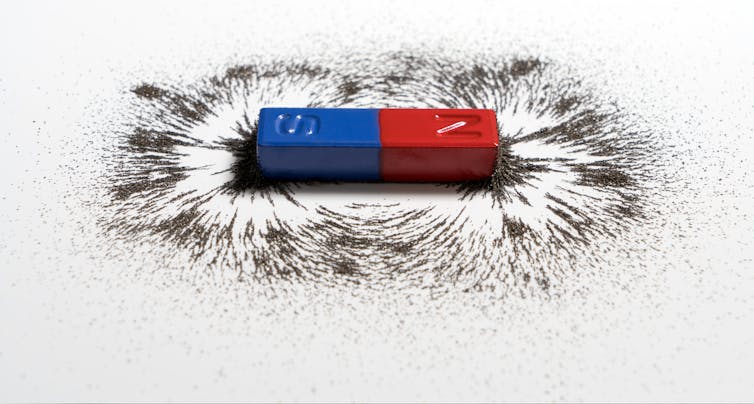 If you sprinkle iron filings (a fine powder of iron) around a magnet, you can see an image of the magnetic field.
from www.shutterstock.com
If you sprinkle iron filings (a fine powder of iron) around a magnet, you can see an image of the magnetic field.
from www.shutterstock.com
Magnets don’t always stick together.
If you hold two magnets the wrong way around, they push apart - they repel! In other words, if you hold two magnets together so that like-poles are close together (two norths OR two souths), they repel. Try it! It feels like the magnets are surrounded by an invisible rubber layer pushing them apart. That invisible layer is called a magnetic field.
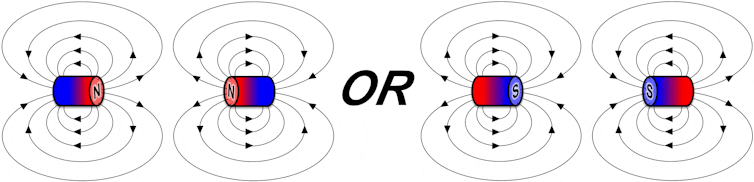 Like-poles repel: We can use curvy arrows (called field lines) to draw the shape of the magnetic field around magnets. The arrows always start at the magnet’s north pole and point towards its south pole. When two like-poles point together, the arrows from the two magnets point in OPPOSITE directions and the field lines cannot join up. So the magnets will push apart (repel). Image credit: Author provided.
It’s only when you hold unlike-poles together (a north pointing to a south) that magnets stick together (they are attracted). Now, the magnetic field acts like a stretched rubber band pulling the magnets together. (Be careful; two strong magnets can pinch your skin).
 Unlike-poles attract: When a north pole and south pole point together, the arrows point in the SAME direction so the field lines can join up and the magnets pull together (attract). Image credit: Author provided.
So, why do magnets attract or repel?
You have probably heard of energy. Energy is needed to create movement.
A car that’s sitting still will start to move when the petrol inside it burns. That’s because petrol contains stored-up energy which is released when it burns.
When this stored-up energy is released, some of it changes into movement energy. Scientists call this stored-up energy “potential energy” and call movement energy “kinetic energy”.
When you start running, it’s because energy stored in your food is released and some of it changes into movement energy.
What’s this got to do with magnets? Well, the magnetic field that surrounds all magnets contains stored-up energy. But there’s a way to change the amount of stored-up energy surrounding the magnet. And the way you change it will tell you which way the magnet will move.
A rule to remember
Everything in the universe follows a rule. I will tell you the rule in a moment, but first I have to say that it’s not easy to explain why the universe follows this rule without complicated mathematics. The best I can say is “that’s just how the universe behaves”. (I’m sorry. I don’t like answers like that either).
The rule is: wherever there is stored-up energy in an object (and the object is not tied down or stuck in place), then the object will be pushed in the direction that causes the stored-up energy to decrease. The stored-up energy will be reduced and replaced by movement energy.
So if two magnets are pointing with unlike-poles together (north pole to a south pole), then bringing them closer together decreases the energy stored up in the magnetic field. They will be pushed in the direction that decreases the amount of stored-up energy. That is, they are forced together (this is called attraction).
If two magnets are pointing with like-poles together (a south pole to a south pole OR north to north), then stored-up energy will decrease if they move apart.
So our rule says the magnets will be pushed in the direction that decreases the amount of stored-up energy. That is, they are forced apart (repelled).
I should also say that when dropped objects are attracted to Earth and fall down, it’s NOT because of magnetism. It’s because of gravity. Earth is also surrounded by a gravitational field which also contains stored up energy.
Unlike magnetism, gravity never repels because gravity only points one way. There are no north and south poles for gravity.
Read more: Earth's magnetic heartbeat, a thinner past and new alien worlds
Can I keep taking stored-up energy from the magnetic field forever?
No.
Once two magnets stick together, you’ll need to put some stored-up energy back into the field by pulling the magnets apart again. You can’t get energy for nothing.
The energy needed to pull the magnets apart comes from you, and you get it from the food you eat. And the plants or animals you eat get their energy from other plants and animals, or from the Sun. All energy comes from somewhere.
Hello, curious kids! Have you got a question you’d like an expert to answer? Ask an adult to send your question to us. They can:
* Email your question to curiouskids@theconversation.edu.au * Tell us on Twitter
 CC BY-ND
Please tell us your name, age and which city you live in. You can send an audio recording of your question too, if you want. Send as many questions as you like! We won’t be able to answer every question but we will do our best.
CC BY-ND
Please tell us your name, age and which city you live in. You can send an audio recording of your question too, if you want. Send as many questions as you like! We won’t be able to answer every question but we will do our best.
Authors: Stephen Bosi, Senior Lecturer in Physics, University of New England
Read more http://theconversation.com/curious-kids-how-and-why-do-magnets-stick-together-101899


















