

Five active volcanoes on my Asia Pacific 'Ring of Fire' watch-list right now
- Written by: Heather Handley, Associate Professor in Volcanology and Geochemistry, Macquarie University
In Indonesia, more than 197 million people live within 100km of a volcano, including more than 8.6 million inside a 10km radius.
The country has a record of some of the most deadly volcanic eruptions in history, and right now there are ongoing eruptions at the Agung, Sinabung and Dukono volcanoes. But other volcanoes in the region are active too, including Kadovar in Papua New Guinea, Mayon in the Philippines, and Kusatsu-Shiranesan in Japan.
Although it all seems to be happening at once, it’s normal for the Asia-Pacific region to have frequent earthquake and volcanic activity.
But we still need to keep a close eye on things, and local volcanic authorities are monitoring activity to manage risks and evacuations adequately.
Read more: Curious Kids: Do most volcanologists die from getting too close to volcanoes?
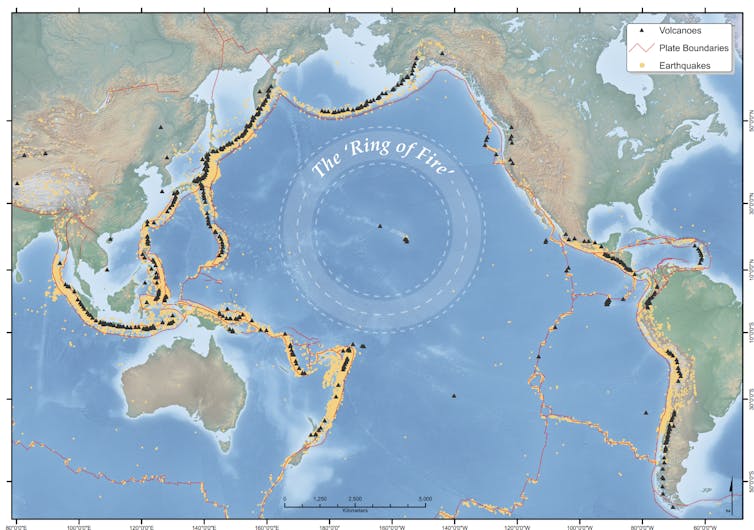 The Ring of Fire extends around the Pacific Rim in a horseshoe shape.
Earth Observatory of Singapore
The Ring of Fire extends around the Pacific Rim in a horseshoe shape.
Earth Observatory of Singapore
These volcanoes are part of the Pacific “Ring of Fire”, a horseshoe-shaped belt of earthquakes and volcanoes that runs for some 40,000km, roughly around the edge of the Pacific Ocean. The Ring stretches from South America, up to North America and across the Bering straight, and down through Japan, the Philippines, Papua New Guinea, Vanuatu and New Zealand. It generates around 90% of the world’s earthquakes and contains 75% of its active volcanoes.
Here are the volcanoes on my Asia-Pacific watch list this week.
Agung, Bali, Indonesia
Mount Agung in Bali has been highly scrutinised for the past few months, largely because of Bali’s popularity as a tourist destination.
After a series of volcanic earthquakes (more than 1,000 per day at its peak), eruptions began on November 21, 2017.
Read more: Mount Agung continues to rumble with warnings the volcano could still erupt
Since then we’ve seen frequent explosive eruptions emitting gas, steam and volcanic ash reaching thousands of metres above the volcano.
Drones used by the Indonesian Centre for Volcanology and Geological Hazard Mitigation (CVGHM) show an estimated 20 million cubic metres of new lava in the crater, filling roughly one-third of it.
In the evening of January 19 an explosion of fire (known as a “strombolian” eruption) ejected glowing rocks up to 1km from the crater. The alert level remains at the highest level, with an exclusion zone in place.
There have been very few issues for tourists visiting Bali so far, apart from a temporary closure of Denpasar airport in late November 2017. However, thousands of Agung’s local residents are still displaced from their homes, with many still stationed in evacuation centres. It remains uncertain when those living closest will be able to return home.
Many evacuated pregnant women have given birth to babies since leaving their homes in places such as the Bumi Sehat’s community health center and birthing clinic in Ubud, which relies on donations to keep running. As a mother of a one-year-old and a three-year-old, I can’t imagine having a newborn baby and not being in the comfort of my own home.
Read more: Tourists are stuck at the airport, but erupting Mt Agung has a deeper significance for the Balinese
Sinabung, Sumatra, Indonesia
Sinabung volcano awoke in 2010 after a 400-year sleep, and is currently one of the most active volcanoes in Indonesia. It has been pretty much in constant eruption since September 2013, and there are still frequent volcanic earthquakes.
Eruptions have produced ash plumes reaching as high as 11km into the atmosphere, as well as ash fall and lava flows. There have also been volcanic mudflows (“lahars”) and fast-moving, hot flows of gas, ash and rock fragments (“pyroclastic flows”), which have killed 25 people.
The initial activity in 2010 saw around 30,000 people evacuated. In August last year the Indonesian National Disaster Management Authority (BNPB) reported that there were 7,214 people displaced, and a further 2,863 living in refugee camps. For the locals, life seemingly goes on in the midst of eruptions.
The alert level currently remains at 4 (on a scale of 1-4), with exclusion zones of 3-7km around the volcano.
Read more: Why do people still live next to an active volcano?
Mayon, Luzon, Philippines
Mayon, around 330km southeast of Manila, is a picture-perfect volcano with its steep-sided conical cone, typical of stratovolcanoes. It is one of the most active volcanoes in the Philippines, with 24 confirmed eruptive periods in the past 100 years. Mayon’s most violent eruption in 1814 killed more than 1,200 people and destroyed several towns.
The recent eruption began on January 13, 2018, and is continuing, with several episodes of dramatic lava fountaining, one lasting 74 minutes.
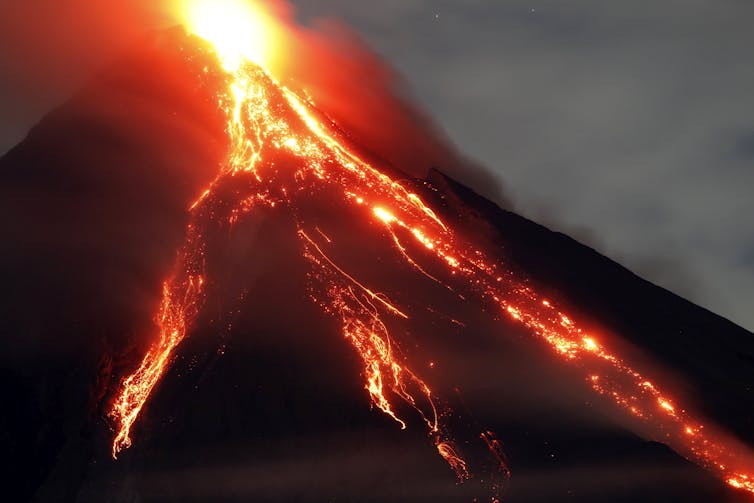 Mayon volcano spews ash and lava on January 26 2018.
Francis. R. Malasig/AAP
Mayon volcano spews ash and lava on January 26 2018.
Francis. R. Malasig/AAP
Eruptions during January 23-29 generated 3-5km-high ash plumes and multiple pyroclastic flows, which travelled more than 5km down drainage channels. The alert is at level 4 (on a scale of 1 to 5) and an 8km danger zone is in place.
Lava flows have currently made their way up to 4.5km down river valleys from the summit crater.
The Philippine Institute of Volcanology and Seismology (PHIVOLCS) estimated on January 27 that the total volume of material deposited from ash fall and pyroclastic flows amounted to 10.5 million cubic metres. Remobilisation of this loose volcanic material by rainfall to form volcanic mudflows is a major concern.
According to news articles, more than 75,000 people have been evacuated, along with the temporary closure of Legazpi airport around 15km away.
Kadovar, Papua New Guinea
Until January 2018, when it began erupting, I hadn’t heard of Kadovar. It’s a 2km-wide, 365m-high emergent summit of a stratovolcano off the coast of Papua New Guinea.
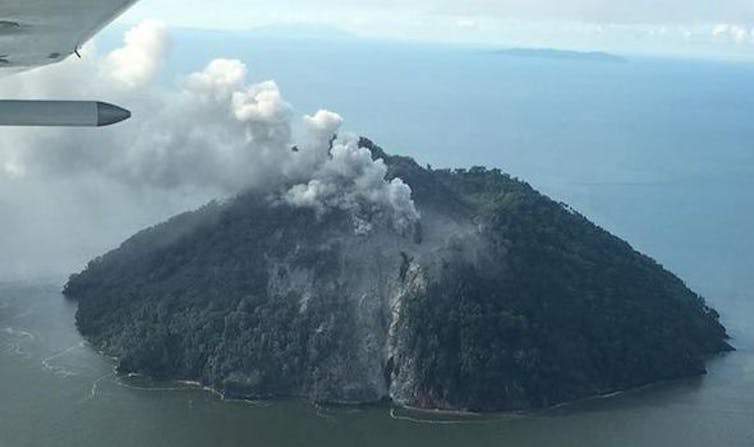 Kadovar island off the coast of PNG is currently an active volcano.
Samaritan Aviation
Kadovar island off the coast of PNG is currently an active volcano.
Samaritan Aviation
The volcano had no confirmed historic eruptions before 2018. However, it is possible that William Dampier, a 17th-century pirate and later maritime adventurer, witnessed an eruption at Kadovar during a voyage in search of Terra Australis.
Activity began on January 5, 2018, with rising plumes of ash and steam from the volcano. The island’s inhabitants, some literally living on the crater rim, began evacuating at that time. People were initially taken by boat to neighbouring Blup Blup island but then to the mainland along with other nearby islanders, due to the close proximity of the eruption and logistics of providing people with supplies.
The Rabaul Volcano Observatory reported that activity significantly escalated on January 12, with a large explosive eruption and volcanic rocks ejected to the south. Large amounts of sulfur dioxide have been detected since January 8, and continue to be released along with ash and steam plumes. A lava “dome” has been observed glowing at night.
The impact from the eruption is not just confined to those on Kadovar and nearby islands, with satellite imagery tracking an ash plume from Kadovar travelling over tens of kilometres.
Identified volcanic risks at Kadovar include further potential explosive activity, landslides, and resulting possible tsunamis.
Kusatsu-Shirane, Honshu Japan
On January 23, 2018, an eruption occurred at Kusatsu-Shirane volcano without any prior warning, catching Japan’s Meteorological Agency and volcanic experts, not to mention the skiers on the volcano, by surprise.
According to agency’s volcanology division, there had been no volcanic activity at the apparent site of the eruption (Kagamiike crater), for about 3,000 years.
The eruption ejected a black plume of ash and larger volcanic material that damaged a gondola and the roof of a mountain lodge.
The ejected volcanic rocks, which landed up to 1km away from the vent, injured several people. A member of the Ground Self-Defence Force who was skiing in a training exercise was killed.
The Japan Meteorological Agency has since analysed the deposits of the eruption and state that there was no new magma erupted on January 23.
Volcanic rocks were ejected from the Kusatsu-Shirane volcano.Japan has more than 100 active volcanoes, with many monitored 24/7 by Japan’s Meteorological Agency.
Living near volcanoes
Indonesia, the Philippines and Japan have the greatest numbers of people living within 100km of their volcanoes. The populations of small volcanic island nations, such as Tonga and Samoa, almost all live within 100km.
 The top 10 countries for population within 100 km of a volcano (left) and the top ten countries (area over 31,415 km²) for percentage of the total population (right).
Sarah Brown and co-authors.
The top 10 countries for population within 100 km of a volcano (left) and the top ten countries (area over 31,415 km²) for percentage of the total population (right).
Sarah Brown and co-authors.
Indonesia has the greatest total population located within 10km (more than 8.6 million), 30km (more than 68 million) and 100km (more than 179 million), and a record of some of the most deadly volcanic eruptions in history.
The eruption of Tambora in 1812-15, was the largest eruption in the last 10,000 years and killed around 100,000 Indonesians (due to the eruption and the ensuing famine). The infamous eruption of Krakatau (Krakatoa) killed an estimated 35,000 people, almost all due to volcanic-generated tsunamis. Volcanic mudflows (lahars) generated by the eruptions of 1586 and 1919 at Kelut (Kelud) in Java took the lives of 10,000 and 5,000 people, respectively.
Keeping watch on the world’s volcanoes is a big job for the local volcanic agencies. This is particularly true when volcanoes erupt for the first time in history (Kadovar is a good example) or there were no warning signals before eruption, as at Kusatsu-Shirane.
Authors: Heather Handley, Associate Professor in Volcanology and Geochemistry, Macquarie University


















