

Even as the fusion era dawns, we’re still in the Steam Age
- Written by: Andreas Helwig, Associate Professor, Electro-Mechanical Engineering, University of Southern Queensland
Steam locomotives clattering along railway tracks. Paddle steamers churning down the Murray. Dreadnought battleships powered by steam engines.
Many of us think the age of steam has ended. But while the steam engine has been superseded by internal combustion engines and now electric motors, the modern world still relies on steam. All thermal power plants, from coal to nuclear, must have steam to function.
But why? It’s because of something we discovered millennia ago. In the first century CE, the ancient Greeks invented the aeolipile – a steam turbine. Heat turned water into steam, and steam has a very useful property: it’s an easy-to-make gas that can push.
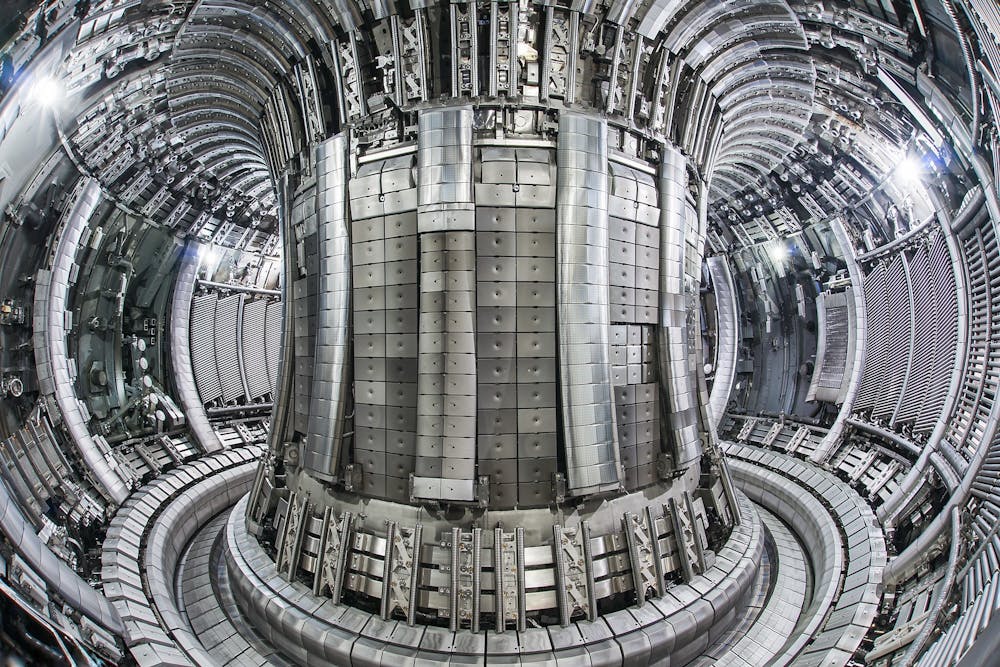
This simple fact means that even as the dream of fusion power creeps closer, we will still be in the Steam Age. The first commercial fusion plant will rely on cutting-edge technology able to contain plasma far hotter than the sun’s core – but it will still be wedded to a humble steam turbine converting heat to movement to electricity.
Why are we still reliant on steam?
Boiling water takes a significant amount of energy, the highest by far of the common liquids we’re familiar with. Water takes about 2.5 times more energy to evaporate than ethanol does, and 60% more than ammonia liquids.
Why do we use steam rather than other gases? Water is cheap, nontoxic and easy to transform from liquid to energetic gas before condensing back to liquid for use again and again.
Steam has lasted this long because we have an abundance of water, covering 71% of Earth’s surface, and water is a useful way to convert thermal energy (heat) to mechanical energy (movement) to electrical energy (electricity). We seek electricity because it can be easily transmitted and can be used to do work for us in many areas.
When water is turned to steam inside a closed container, it expands hugely and increases the pressure. High pressure steam can store huge amounts of heat, as can any gas. If given an outlet, the steam will surge through it with high flow rates. Put a turbine in its exit path and the force of the escaping steam will spin the turbine’s blades. Electromagnets convert this mechanical movement to electricity. The steam condenses back to water and the process starts again.
Steam engines used coal to heat water to create steam to drive the engine. Nuclear fission splits atoms to make heat to boil water. Nuclear fusion will force heavy isotopes of hydrogen (deuterium and tritium) to fuse into helium-3 atoms and create even more heat – to boil water to make steam to drive turbines to make electricity.
If you looked only at the end process in any thermal power plant – coal, gas, diesel, nuclear fission or even nuclear fusion – you would see the old technology of steam taken as far as it can be taken.
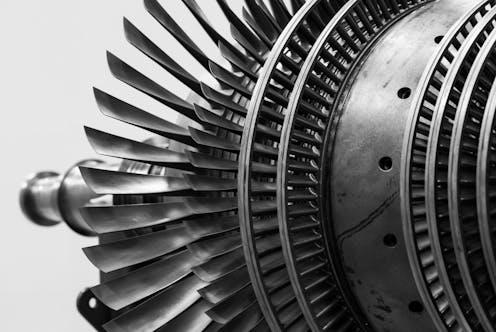
The steam turbines driving the large electrical alternators which produce 60% of the world’s electricity are things of beauty. Hundreds of years of metallurgical technology, design and intricate manufacturing has all but perfected the steam turbine.
 Under high pressure, superheated steam pushes turbine blades.
aappp/Shutterstock
Under high pressure, superheated steam pushes turbine blades.
aappp/Shutterstock
Will we keep using steam? New technologies produce electricity without using steam at all. Solar panels rely on incoming photons hitting electrons in silicon and creating a charge, while wind turbines operate like steam turbines except with wind blowing the turbine, not steam. Some forms of energy storage, such as pumped hydro, use turbines but for liquid water, not steam, while batteries use no steam at all.
These technologies are rapidly becoming important sources of energy and storage. But steam isn’t going away. If we use thermal power plants in any form, we’ll still be using steam.
 Thermal power plants rely on giant steam turbines.
rtem/Shutterstock
Thermal power plants rely on giant steam turbines.
rtem/Shutterstock
Why can’t we just convert heat to electricity?
You might wonder why we need so many steps. Why can’t we convert heat directly to electricity?
It is possible. Thermo-electric devices are already in use in satellites and space probes.
Built from special alloys such as lead-tellurium, these devices rely on a temperature gap between hot and cold junctions between these materials. The greater the temperature difference, the greater voltage they can generate.
The reason these devices aren’t everywhere is they only produce direct current (DC) at low voltages and are between 16–22% efficient at converting heat to electricity. By contrast, state of the art thermal power plants are up to 46% efficient.
If we wanted to run a society on these heat-conversion engines, we’d need large arrays of these devices to produce high enough DC current and then use inverters and transformers to convert it to the alternating current we’re used to. So while you might avoid steam, you end up having to add new conversions to make the electricity useful.
There are other ways to turn heat into electricity. High temperature solid-oxide fuel cells have been under development for decades. These run hot, at between 500–1,000°C, and can burn hydrogen or methanol (without an actual flame) to produce DC electricity.
These fuel cells are up to 60% efficient and potentially even higher. While promising, these fuel cells are not yet ready for prime time. They have expensive catalysts and short lifespans due to the intense heat. But progress is being made.
Until technologies like these mature, we’re stuck with steam as a way to convert heat to electricity. That’s not so bad – steam works.
When you see a steam locomotive rattle past, you might think it’s a quaint technology of the past. But our civilisation still relies very heavily on steam. If fusion power arrives, steam will help power the future too. The Steam Age never really ended.
Authors: Andreas Helwig, Associate Professor, Electro-Mechanical Engineering, University of Southern Queensland
Read more https://theconversation.com/even-as-the-fusion-era-dawns-were-still-in-the-steam-age-217273



















