

Grant Robertson is swapping cabinet for academia – but should ex-politicians lead universities?
- Written by Tom Baker, Associate Professor in Human Geography, University of Auckland, Waipapa Taumata Rau
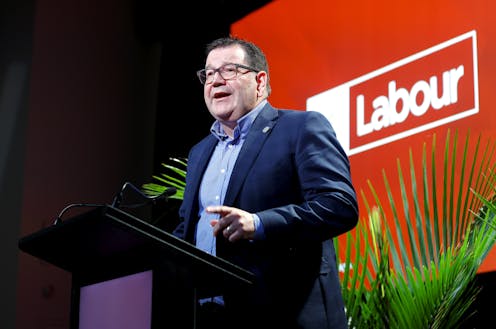
The appointment of former Labour finance minister Grant Robertson as vice-chancellor is a first for Otago University, which has never had a non-academic in the role. But it’s not hard to see why the university’s governing body made the decision.
Universities are navigating a difficult funding environment. The current government has commissioned a sector-wide review, but its instincts for thrift mean the challenges will likely continue for some time.
Combine this national predicament with Otago’s own specific financial problems, and the choice of new vice-chancellor makes strategic sense. Robertson’s public profile and political networks may be useful assets at this critical moment. Cometh the hour, cometh the former finance minister.
However, the appointment also raises a larger question, barely mentioned in the ensuing public coverage: should former politicians lead universities at all?
Read more: Starved of funds and vision, struggling universities put NZ’s entire research strategy at risk
Wider debate needed
For a sector that trades in independent opinion, analysis and debate, it’s surprising the announcement of a senior politician to lead New Zealand’s oldest university produced so little public discussion.
Was this akin to a collective sigh of relief? After all, Robertson has a sympathetic stance towards his old university and towards the potential of public institutions in general.
Let’s consider a parallel universe, though, where a politician of a different stripe was appointed to lead a university after their parliamentary career. Were a former National or ACT Party minister to be hired, for example, would there be so little debate?
This hypothetical suggests we need principles that transcend individual cases in order to better assess appointments to executive roles within universities.
Competence and corporatisation
The first area of principle is competence. Universities were traditionally led by academics. This was a product of their historical guild-like training and collegial governance.
While vice-chancellors are still mostly academics, in recent decades the appointment of business and public sector leaders has eroded that tradition internationally.
This openness to appointing non-academics to executive roles has proceeded in step with New Zealand’s “corporatisation” of universities and their governing bodies.
For example, in 2015, legislative provisions were changed to reduce staff representation and give ministerial appointees greater weight on the governing bodies of New Zealand universities.
In 2021, the University of Sydney hired Mark Scott as its first non-academic vice-chancellor. Scott is a former director-general of the New South Wales Department of Education and former managing director of the Australian Broadcasting Corporation. Many universities around the world are breaking similar ground.
This is familiar territory in New Zealand. John Hood, for example, was a director of Fonterra and Fletcher Chellenge before starting his university leadership career in 1999. He served as vice-chancellor at the University of Auckland and later the University of Oxford.
Read more: Bailout, Band-Aid or back to basics? 3 questions NZ's university funding review must ask
Critic and conscience
Critics of non-academic appointments have pointed to a variety of potential problems, including a lack of knowledge about academic pursuits, academic work and the particularities of the university.
They also point to a growing separation between the careers of those “at the coalface” and those “in leadership”, and to a narrowing of the university’s civic mission by corporate and managerial mindsets.
History tells us, however, that non-academics can be at least as capable of leading universities as those trained as academics.
An academic vice-chancellor draws on deep experience within universities. They ought to know how these unusual institutions are run – and how they “tick” in a less formal sense.
Read more: NZ universities are not normal Crown institutions – they shouldn't be 'Tiriti-led’
But many of the skills required of a vice-chancellor — strategic thinking, diplomacy, stringent governance — have much in common with the role of a commercial CEO or director-general.
When it comes to competence, Grant Robertson clearly satisfied the University of Otago’s governing council. This might not be the case for every politician.
But the discussion should not be limited to issues of competence alone. It should also consider how the appointment of politicians to university leadership roles affects perceived and actual independence.
Universities began as elite institutions with a degree of separation from society. Shielded from commercial temptation, academics were able to pursue knowledge for its own sake. And shielded from political loyalties, they could ask questions of our social, political and economic systems, and those who create and benefit from them.
The university’s role as “critic and conscience of society” became seen as central to democracy. New Zealand went one step further than most countries by enshrining this in legislation.
Perceived independence
Robertson, of course, is not the first to move from politics to academic leadership. Former Labour education and social development minister Steve Maharey was vice-chancellor at Massey University from 2008 to 2016.
While that appointment was also met with little discussion at the time, Maharey had some claim to experience within universities, having previously taught at Massey.
Internationally, universities are increasingly hiring politicians and other non-academics for non-executive staff roles. There are legitimate concerns about these appointments, too.
Read more: Are New Zealand’s universities doing enough to define the limits of academic freedom?
But they are less acute than those associated with having politicians lead universities. Being seen as another state sector agency, or aligned to certain political parties, would seriously compromise the democratic function of the university.
In the United States, the university sector is extremely varied and there is a strong tradition of movement between careers in universities, business and government. Yet even there the appointment of politicians to lead universities is fairly rare.
Elsewhere, it’s rarer still. There is a recognition, at least implicitly, that the potential risk to the independence and distinctive societal role of universities requires frank discussion.
Authors: Tom Baker, Associate Professor in Human Geography, University of Auckland, Waipapa Taumata Rau

















