

Australia and the question of Palestinian statehood
- Written by Micaela Sahhar, Lecturer, History of Ideas, Trinity College, The University of Melbourne
What is the significance of the Australian government signalling this week that it may finally recognise Palestinian statehood?
Though not universally popular, Foreign Minister Penny Wong’s diplomatic gesture towards Palestinian statehood has been welcomed in some quarters as a departure from Australia’s longstanding bipartisan consensus on the Middle East.
Formerly reluctant to interfere in the affairs of other nations, many countries have become frustrated by the lack of progress on a resolution to the decades-old question of Palestine and are moving to unilateral recognition of its statehood.
Yet, it is hard not to associate the timing of Wong’s speech with public outrage over the killing of Australian aid worker Zomi Frankcom and concern over the impact that Labor’s position on Palestine is having on its electoral prospects.
Why has this issue been so contentious for so long in Australia, and what could its recognition of Palestinian statehood mean?
Australia’s role in the creation of Israel
Australia played a key role in preparing the groundwork for Israeli statehood in the early 20th century.
As a loyal servant of the British empire, the Australian army actively participated in the destruction of the Ottoman empire during the first world war. Battles in which Australian troops played a decisive role – such as the 1917 Charge of the Light Horse Brigade in Beersheba and the Allied capturing of Damascus in 1918 – are remembered in Australian and Israeli history as milestones in the achievement of Israeli statehood.
“Self-determination” was a watchword coined by Leon Trotsky and popularised by US President Woodrow Wilson towards the end of the first world war. However, in the postwar settlement, self-determination was unequally applied.
Zionist claims to self-determination were endorsed by the British government’s Balfour Declaration of 1917. But under the terms of the mandate of Palestine administered by Britain under the new League of Nations charter, indigenous Palestinian Arabs were catalogued among the “peoples not yet able to stand by themselves under the strenuous conditions of the modern world”.
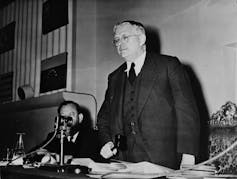
Two decades later, Australia played a key role in the recognition of Israeli statehood at the United Nations. It is now well known that Australian Herbert Vere “Doc” Evatt, who presided over the UN Special Committee on Palestine, was instrumental in garnering international support for the proposed partition of Palestine. Australia was one of the first countries to recognise Israel in 1948.
In contrast, Britain initially maintained a policy of non-recognition of Israel, a position still held by some 30 countries.
The creation of Israel was also inextricably linked to the Palestinian Nakba, when an estimated 750,000 people were expelled during the 1948 Arab-Israeli war. As former Knesset member Haneen Zoabi has observed, the Nakba is therefore indivisibly a part of the Jewish history of the land, as much as it is Palestinian history.
Read more: 10 books to help you understand Israel and Palestine, recommended by experts
A long history of bipartisan support for Israel
So, why has it been so difficult for Australia to recognise Palestinian aspirations for statehood?
The emergence of the Palestine Liberation Organisation (PLO) in the 1960s under the leadership of Yasser Arafat thrust the Palestine question back into the spotlight. For mainstream Australian politicians, the PLO was akin to the African National Congress in South Africa, seen at the time as an irredeemable terrorist organisation.
Yet, unlike the bipartisan position later adopted against South African apartheid in Australia during the 1980s, no such revision has come with regard to Israel’s treatment of Palestinians, which many observers in Israel and internationally also consider to be apartheid.
One South African observer, Andrew Feinstein, the son of a Holocaust survivor and former colleague of Nelson Mandela, has described Israeli apartheid as “far more brutal than anything we saw in South Africa”.
Read more: Gareth Evans: the case for recognising Palestine
In recent years, Australian politicians on both sides have recommitted to their unwavering support of Israel. This is part of a broader phenomenon that US historian Ussama Makdisi has described as “philozionism” (or love of Zionism).
While the Rudd-Gillard government repositioned Australia’s relationship with Israel in a more critical light, the country’s politicians soon returned to the former bipartisan consensus around Israel. Prime Minister Anthony Albanese was a cofounder of the Australian Parliamentary Friends of Palestine, though many have observed that his government has resiled from that affiliation. Prime ministers from both sides of the aisle have also had parks in Israel named in their honour.
The Palestine question has been a particularly tortured one for the Labor Party, as illustrated by Australia’s abstention in the 2012 vote at the United Nations to grant Palestinian observer status.
Labor’s shifting policy
The gradual move towards recognition of Palestinian statehood has followed Labor’s attempts to return to the fold of international consensus on the Israel-Palestinian issue after a decade of Coalition leadership. This has included reversing the Coalition stance on Israel’s West Bank settlements, recognising them as illegal under international law.
Though hubristic to imagine Australian diplomatic recognition will have any impact on Palestinian lives, the change in position of one of Israel’s historically staunch allies does coincide with a broader shift in the Western consensus.
Following Israel’s bombardment of Gaza during the 2014 Operation Protective Edge, lawmakers in Sweden and the United Kingdom voted to recognise the state of Palestine. These moves had little material impact but carried symbolic value.
Read more: Explainer: what is the two-state solution to the Israeli-Palestinian conflict?
It is important to recall that UN Resolution 194, recognising Israeli statehood, did so on the condition that Palestinians ethnically cleansed from their ancestral lands would be given the right of return, or be appropriately compensated. This resolution has been reaffirmed annually since 1949 and is fundamental to the question of a just peace.
Australia’s belated recognition of Palestinian statehood would be a welcome first step. It is the result of decades of grassroots activism by Palestinians and their allies in Australia. However, much work remains to be done if Australia is to be a constructive partner in the meaningful achievement of Palestinian self-determination.
Authors: Micaela Sahhar, Lecturer, History of Ideas, Trinity College, The University of Melbourne

















