

Australia is playing catch-up with the Future Made in Australia Act. Will it be enough?
- Written by Naoise McDonagh, Senior Lecturer, School of Business and Law, Edith Cowan University
Australia is a trading nation. Its economy relies on a strong and open global trade environment.
Australian governments have historically rejected protectionist industrial policies that undermine fair competition, and Canberra has long been a staunch advocate of the World Trade Organization, whose rules help “promote and protect the open global trading system”.
Yet Labor has just announced a major new industrial policy – the Future Made in Australia Act – that will break with Canberra’s historical aversion to large-scale economic intervention. It will also cost taxpayers billions to fund.
Prime Minister Anthony Albanese’s rationale for doing so is as succinct as it is paradoxical:
This is not old-fashioned protectionism or isolationism – it is the new competition … we must recognise that the partners we seek are moving to the beat of a new economic reality.
What is this “new reality”, and what does it mean for Australia’s economic future?
Australia joins the “geoeconomic game”
With this announcement, Australia has joined the great “geoeconomic game” currently transforming the world economy.
In a geoeconomic world economy, nations use economic relations as tools to achieve their strategic goals.
This could include coercing a country to change its policies by blocking their imports, as China has done to Australia. Or using export controls to prevent advanced technology reaching a strategic geopolitical rival, as the United States has applied to China to limit the flow of advanced semiconductors.
Read more: Anthony Albanese puts interventionist industry policy at the centre of his budget agenda
Under these conditions, relations between countries shift from win-win to zero-sum. The resulting risks and vulnerabilities can be leveraged by geopolitical foes. Growing concern over this shift is driving economic “ghettoisation” – countries that were already on friendly terms are trading more between themselves, and with those on less friendly terms, trading less.
Australia has already been participating in “friend-shoring” – the relocation of crucial supply chains to diplomatically friendlier countries.
New policies for a new business reality
Some countries have already established policies in recognition of the new realities of international business, speeding up the formation of these blocs.
Two major recent policies by the US – the Inflation Reduction Act and the CHIPS Act – aim to boost US electric vehicle and semiconductor manufacturing, respectively, with hundreds of billions of dollars in new government spending.
Japan is also spending big to bring more semiconductor production onshore.
These policies have also attracted vast sums of new private investment in relevant “strategic sectors” – totalling more than half a trillion dollars in the US alone.
Levelling the playing field or distorting the market?
This new economic approach by Washington and Tokyo almost certainly breaches the World Trade Organization’s rules, because it discriminates in determining who can access funds and where things have to be made.
China has already launched a dispute against the US Inflation Reduction Act on these very grounds. But China itself is also the biggest user of industrial policy by far.
On one hand, the new US and Japanese industrial policies will distort global markets, but – returning to Albanese’s “new competition” paradox – level the playing field on the other.
Consider Indonesia’s rise to become a nickel exporting powerhouse.
Jakarta applied an export ban – illegal under World Trade Organization rules – on unprocessed nickel in 2020, while attracting investment from China, where state-owned enterprises can access subsidised financing.
Combined with poor environmental and labour standards during production, the effect was extremely low-cost Indonesian nickel, which undercut global prices. As a result, some Australian mines could face closure.
This situation was not the product of free markets, but rather of state intervention. Canberra needs its own plan to counter such policies.
How should business leaders respond?
We still don’t know the full details of Labor’s strategy. But if the act is anything like Washington’s policies, it will aim to boost Australian firms with protectionist and discriminatory provisions. Awkwardly, this could well be in breach of the international trade rules Canberra has staunchly defended for so long.
Levelling the playing field implies sweeping changes in the dynamics of international commerce, with implications for Australian businesses, consumers and government.
In formulating strategy, Australian business leaders will increasingly need to think geopolitically. The world is no longer one big open economy.
Australian industries will certainly get a shot in the arm from Labor’s new policy.
There will be more downstream value-add processing in areas of existing strength, such as critical minerals.
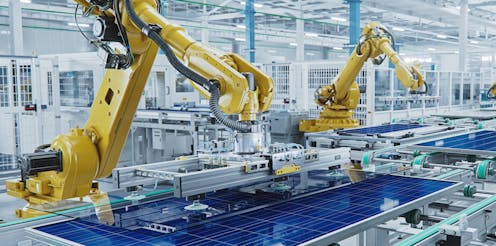
Major investments in solar manufacturing will benefit regional Australia. These and other strategic sectors will enjoy higher levels of government support. But many non-strategic sectors could be left behind, facing new geoeconomic costs without extra funding.
A new, smaller world
For consumers, the era of getting the most competitively priced goods on the global market is coming to a close.
As the global economy fragments, Australians will have to pay more for the duplication of global supply chains, and additional costs of subsidised production.
However, they may also see better supply chain security, and a domestic jobs boom in advanced manufacturing. Governments and businesses can work to reduce the risk of any economic coercion effects.
Much like the Old Testament principle of an “eye for an eye”, the principle of a “tariff for a tariff” is foundational in international trade. As Australia joins the geoeconomic game, pressure will mount on countries not yet playing to join in, simply to stay competitive. Trade and industry measures will continue to proliferate globally, reinforcing the new dynamics of geoeconomic competition.
The Albanese government faces great risks in implementing its new industrial strategy. Yet in taking action, it may have avoided a much greater risk – doing nothing at all in the face of a historic global economic change.
Authors: Naoise McDonagh, Senior Lecturer, School of Business and Law, Edith Cowan University

















