

forests and shrublands are dying in parched Western Australia
- Written by Joe Fontaine, Lecturer, Environmental and Conservation Science, Murdoch University
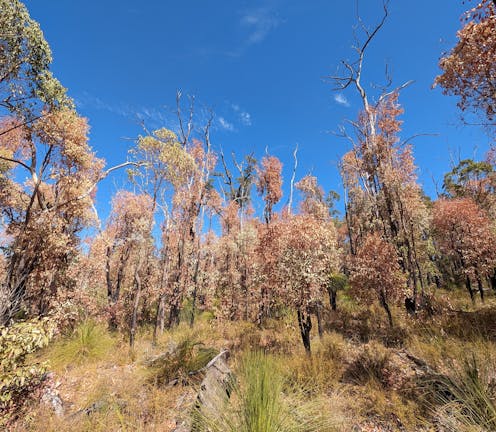
Perth has just had its driest six months on record, while Western Australia sweltered through its hottest summer on record. Those records are remarkable in their own right. But these records are having real consequences.
Unlike us, trees and shrubs can’t escape the heat and aridity. While we turn up the air conditioning, they bear the full brunt of the changing climate. Our previous research has shown plants are more vulnerable to heatwaves than we had thought.
Beginning in February 2024, large areas of vegetation started to turn brown and die off. With no real relief in sight, we unfortunately expect this mass plant death event to intensify and expand.
Just like a coral bleaching event, WA’s plants are responding to the cumulative stress of the unusually long, hot and dry summer. And just like bleaching, global heating is likely to cause more regular mass plant deaths. The last time this happened in 2010-11, almost 20% of trees and shrubs in affected areas died.
This is in line with climate change models, which pinpoint south-western Australia as a warming and drying hotspot.
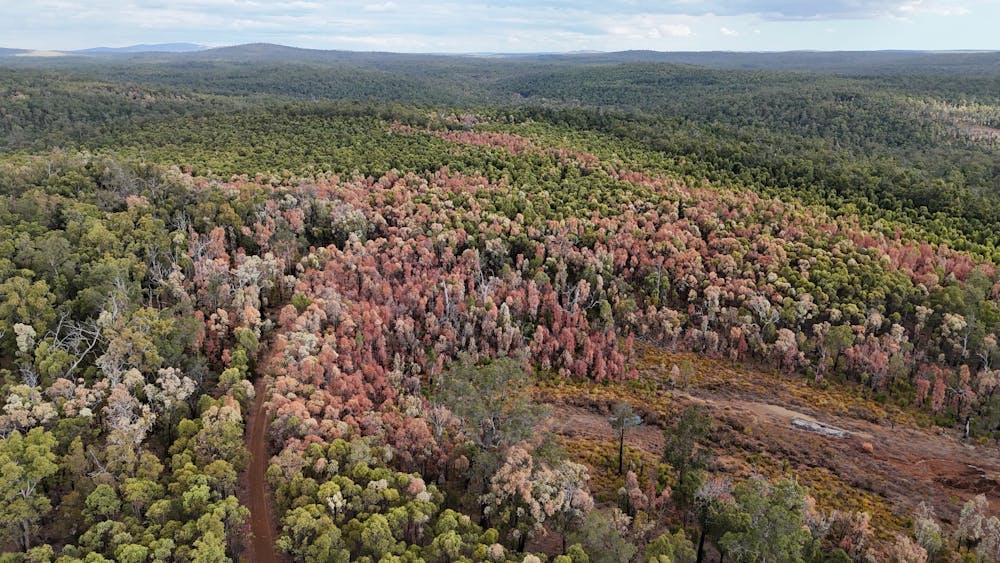
Which trees and shrubs are dying and where?
We have received reports from community members, colleagues, and authorities of dead and dying shrubs and trees spanning approximately 1,000 km from the Zuytdorp Cliffs near Shark Bay down to Albany on the southern coast.
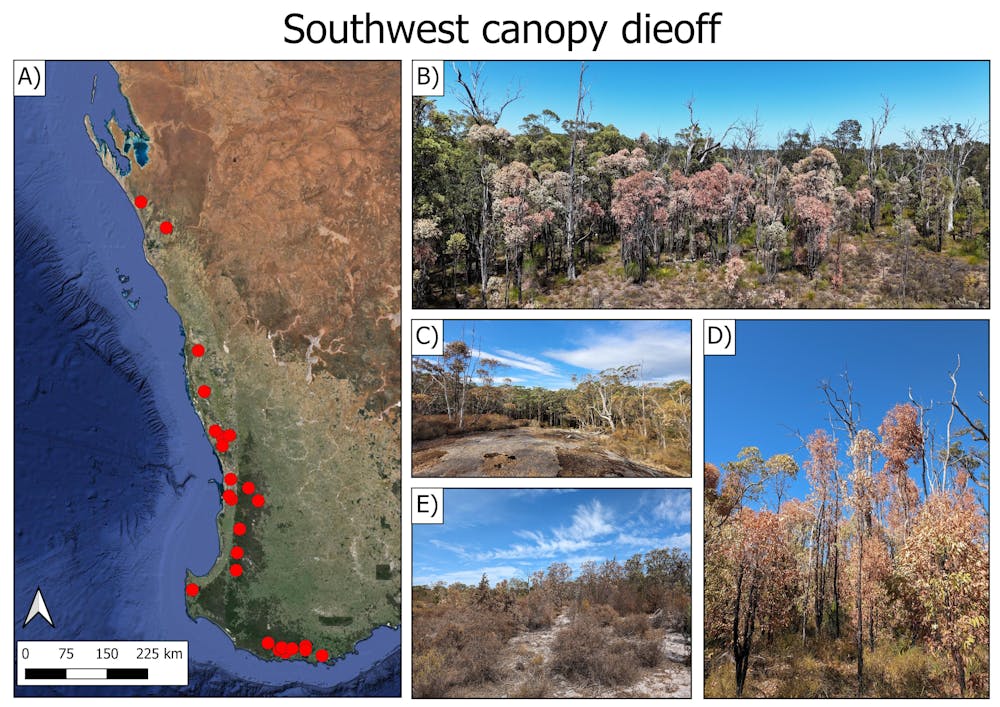 This year’s die-off is wide ranging, from Shark Bay to Albany (a) and across many types of plant, from jarrah forest (b,d), southern wet forests near granites (c), and shrublands and woodlands north of Perth (e)
Joe Fontaine, CC BY-NC-ND
This year’s die-off is wide ranging, from Shark Bay to Albany (a) and across many types of plant, from jarrah forest (b,d), southern wet forests near granites (c), and shrublands and woodlands north of Perth (e)
Joe Fontaine, CC BY-NC-ND
In areas along the west coast where it was hottest, dead or dying patches are larger while further south in the forests, the damage is so far limited to pockets of dead trees and shrinking tree canopies.
Read more: Drying land and heating seas: why nature in Australia's southwest is on the climate frontline
At present, the die-off seems to have affected plants on and around shallow soils, including trees near granite outcrops and coastal heath.
While February heatwaves directly killed some plants, it is likely the long, dry period finished the job. Despite some patchy rain last week, no substantial rain is forecast until May. It’s likely more areas will be hit, including our iconic wet forests in the south.
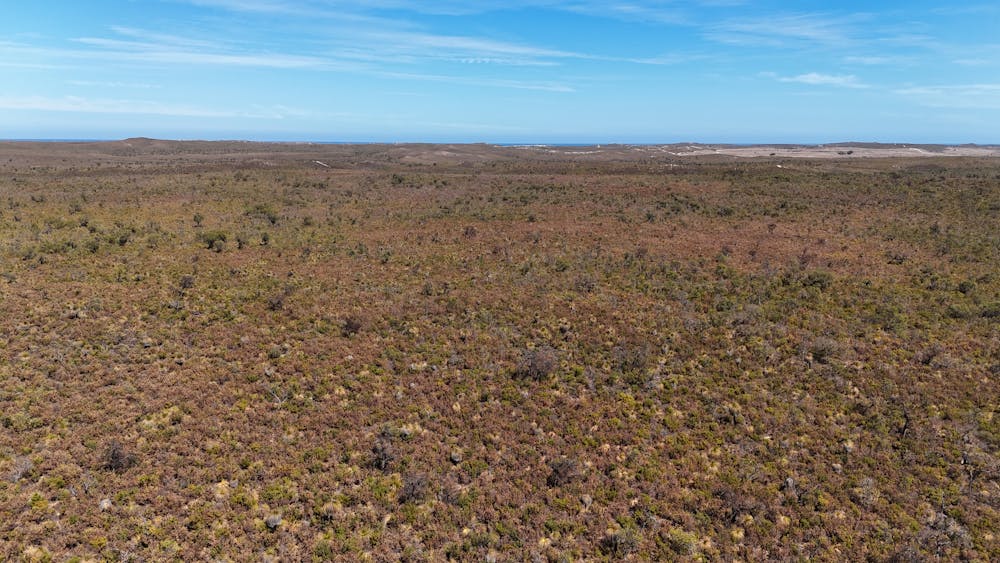 Coastal heath shrublands are dying.
Joe Fontaine, CC BY-NC-ND
Coastal heath shrublands are dying.
Joe Fontaine, CC BY-NC-ND
How hot has it been?
Perth once again smashed temperature records this summer with a record thirteen days over 40°C in 2024 to date. Even in April, we had a 37°C day.
This comes off the back of last year’s spring heatwaves, which broke monthly maximum and minimum temperature records in both September and November.
While much of Australia’s east coast had more than enough rain, the west largely missed out.
Rainfall has been below or very much below average over the past year, with the biggest rainfall deficits seen from Shark Bay’s Gascoyne region right down to the southwest corner at Cape Leeuwin.
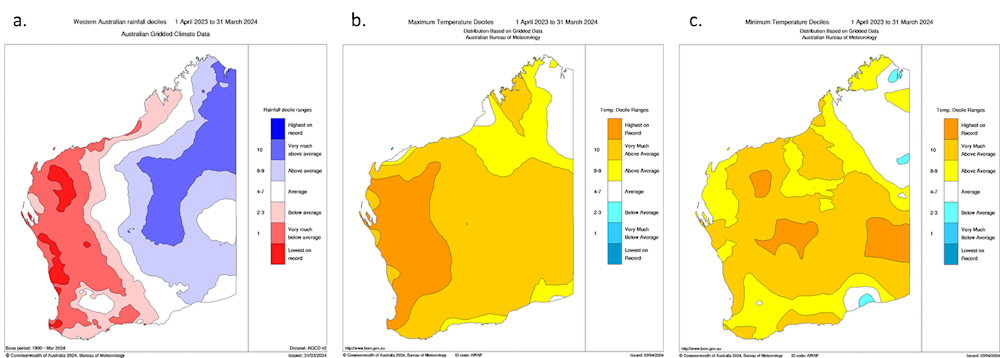 Hot and dry: these decile maps show a. 12-month rainfall, b. maximum temperature, and c. minimum temperatures in Western Australia from April 2023 to March 2024.
Australian Bureau of Meteorology, CC BY-NC-ND
Hot and dry: these decile maps show a. 12-month rainfall, b. maximum temperature, and c. minimum temperatures in Western Australia from April 2023 to March 2024.
Australian Bureau of Meteorology, CC BY-NC-ND
The summer’s heatwaves came from baking desert air, as high pressure systems directed hot dry easterly winds from Australia’s arid interior over the region, just as we saw during the hot summer of 2021-2022,
Long hot and dry periods are expected to become more common as a result of our warming climate.
Declining rainfall will hit the historically wetter southwest hardest. This pocket of Australia is unique, cut off from the rest of the continent by desert. Here and only here live honey possums and numbats, towering karri and jarrah trees and red flowering gums. But it’s the southwest which has lost most rainfall so far, with annual levels already 20% lower than 50 years ago.
Read more: Decades of less rainfall have cut replenishing of groundwater to 800-year low in WA
It’s happened before – but this time is worse
Over the summer of 2010-2011, we saw a similar event sweep south-western Australia. It came about when a winter drought gave way to widespread heatwaves over summer. The result: die-off of forests and vegetation throughout the southwest.
On land, the effects extended over a smaller area than we are seeing now.
How bad was it? Pretty bad. Averaging across the region’s affected areas, 19% of trees and shrubs died, while the forests of the south-west lost approximately 16,000 hectares of canopy, about 1.5% of the forest.
When forests die, the effects ripple through the ecosystem. The endangered Carnaby’s black cockatoo population crashed, declining by 60%, while the jarrah forest east of Perth was so hard hit it was categorised at “risk of collapse” by the Intergovernmental Panel on Climate Change.
This time, the summer has been longer and hotter, with impacts on plants more widespread. Climate change is steadily warming the world. Last year was the hottest on record, with temperatures shooting past predictions.
What can we do?
Our trees and shrubs will keep browning off and dying until we get substantial rain. That means there’s no way to tell when our extraordinary range of forest and shrubland species will have the opportunity to recover.
The longer term trend is not good. As with coral bleaching, the situation will worsen until we reverse climate change. Large-scale plant die-offs like this will become more likely.
What we do need are eyes on the ground to track what’s happening across this enormous state. Our ability to understand, model and respond is hampered by a lack of field data.
If you want to help, take photos of dead or dying trees and upload them to the Dead Tree Detectives citizen science project hosted on the Atlas of Living Australia.
Read more: Decades of less rainfall have cut replenishing of groundwater to 800-year low in WA
Authors: Joe Fontaine, Lecturer, Environmental and Conservation Science, Murdoch University

















