

An education in music makes you a better employee. Are recruiters in tune?
- Written by Diana Tolmie, Senior Lecturer of Professional Practice, Griffith University
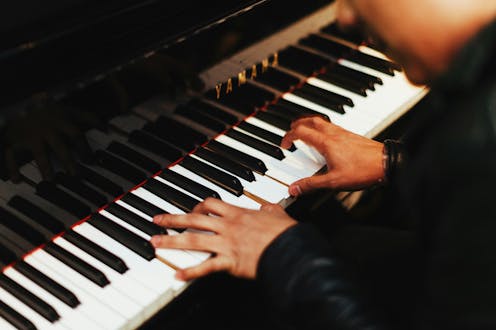
See the word “musician” on a resume and you might not immediately think “stellar employee” or “exceptional leader”.
Perhaps the word evokes the image of a rock star, in trouble for chucking a television out of a hotel room window. Or else someone struggling along in life, who should have picked a “real job”.
But is there more to the profession than meets the stereotype?
It is well known many musicians work simultaneously in arts and non-arts roles, often to create some income security. Less understood is just how well the extensive skillset developed in music transfers to a non-arts, professional workplace.
Read more: A long way to the top: Australian musicians balance multiple roles to make their careers work
My nationwide survey sought to find out. I began by conducting 15 in-depth interviews with musicians simultaneously working dual-careers - one in music, and one somewhere else.
The preliminary findings, which are yet to be peer-reviewed, showed dual-career musicians have a plethora of distinctive workplace skills that had been enabled by their musical education and experience. This was verified by their non-musician co-workers.
The discovery sparked an ongoing second stage of research, investigating the experience of a larger group. These include:
- dual-careerists
- musicians who have exited the profession
- musically-educated individuals who never pursued a music career.
With 165 respondents so far, the emerging results are significant – music education and experience lays the foundation for high levels of future aptitude in a range of workplaces.
Practice makes perfect
One of the most powerful traits instilled by a music education is a deep sense of professionalism. 85% of survey participants identified the trait as the skill that most influenced expectations of themselves and others, and the quality of their work.
A common industry saying about rehearsal reflects this attitude of consistency and punctuality – “early is on time, on time is late, and late is left behind.”
Other notable skills included autonomy and self-direction, resilience and perseverance, and creativity.
Participants attributed the development of these strengths to the disciplined and focused attention required to learn music, and the intrinsic motivation needed to practise and perfect an instrument over a long period of time.
This is increasingly relevant in an age where screens and social media steal our concentration and cost employers’ productivity.
Another key trait identified was creativity, which may reflect findings that the musically trained have more neuronal matter, and therefore increased brain activity.
Interviews with non-musician colleagues showed that out-of-the-box thinking was particularly prevalent amongt jazz musicians, singer-songwriters and composers.
It takes a whole orchestra to play a symphony
Participants unanimously said ensemble work – playing in bands, chamber music, orchestras and so on – has contributed positively to their workplace team dynamics.
As one respondent put it:
It taught me how to be part of something bigger than myself.
Experiences in music translated to a greater appreciation of diversity and inclusivity, exceptional leadership and deep listening skills, and the ability to manage “difficult” conversations respectfully within a team.
Respondents said an ongoing passion for music improved their mental health and workplace resilience. Unsurprisingly, their non-musician co-workers reported better workplace morale and an infectious positive energy from their musical colleagues.
Growth mindset
All respondents reported a healthy relationship with failure – experiences in music had taught them to remain curious, embrace learning and “fail forward” while owning errors.
This attitude directly enhances one’s ability to upskill in a non-music careers, something many respondents have had to do. 82% of the exited and dual-career musicians had re-accredited, and 71% admitted to “learning on the job”.
Their live performance experiences cemented their ability to work under pressure in a variety of situations – public presentations, deadlines, project management. To them it was a no-brainer: “the show must go on.”
Co-workers’ perceptions further verified the musicians’ transferable skills, suggesting they possessed high professional values, a strong work ethic, high intelligence, willingness to learn, and the ability to take the initiative.
Survey respondents work in a much greater variety of fields than you might expect, including:
- health
- science and academia
- building and engineering
- business and finance
- law
- technology
- government
- transportation
- administration
- and religion.
Many also hold leadership positions. Economically, these findings suggest having a musician on the books may be linked to increased productivity, innovation, and profitability.
Lessons for educators and policymakers
The skills of our country’s musically educated are relevant to far more than just the arts. Employers and recruiters need to respect and appreciate the professional contributions of the musically trained.
But the ongoing decline in school music programs and nominal music teacher training, as well as a shift in tertiary training focus to STEM at the expense of the arts, suggest we’re heading the wrong direction.
Including a well-informed understanding of music skills in the proposed National Skills Passport would be a big step forward. So would ensuring all school children have access to proper music education, and that school leavers are not discouraged from pursuing further music training.
Who knows, when the next pandemic comes, it could be a musician who designs the next life-saving vaccine.
Read more: Is it time for Australia to introduce a national skills passport?
Authors: Diana Tolmie, Senior Lecturer of Professional Practice, Griffith University

















