

What if whales took us to court? A move to grant them legal personhood would include the right to sue
- Written by Rachael Evans, Lecturer, Kaupeka Ture | Faculty of Law, University of Canterbury
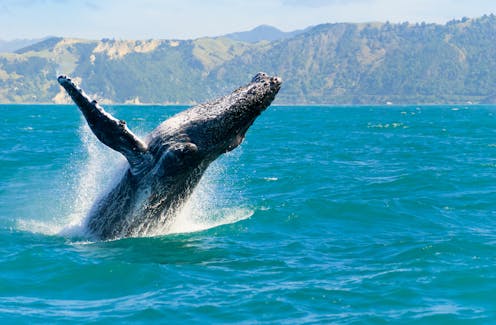
In a groundbreaking declaration earlier this month, Indigenous leaders of New Zealand and the Cook Islands signed a treaty, He Whakaputanga Moana, to recognise whales as legal persons.
Aotearoa New Zealand has already granted legal personhood to a river (Te Awa Tupua Whanganui River), land (Te Urewera) and a mountain (Taranaki maunga), but He Whakaputanga Moana differs from these earlier processes. It is based in customary law, or tikanga Māori, rather than Crown law.
The declaration seeks to protect the rights of whales (tohorā) to migrate freely and to use mātauranga Māori alongside science for better protections. It also aims to set up a dedicated fund for whale conservation.
But a core concept of legal personhood is the idea that the “person” (in this case, whales) can sue to protect their rights.
The declaration was signed by King Tuuheitia Pootatau Te Wherowhero VII of the Kiingitanga movement, Lisa Tumahai who chairs the Hinemoana Halo Ocean initiative, and the Cook Islands leader Kaumaiti Nui Travel Tou Ariki.
It recognises traditional Māori and Pasifika ideas about the importance of whales as ancestral beings. King Tuuheitia described it as “a woven cloak of protection for our taonga”, noting the presence of whales “reflects the strength of our own mana”.
While He Whakaputanga Moana is not a pan-Māori declaration, mana is a shared core concept of tikanga Māori, representing authority and power.
What is legal personhood?
Over the past few hundred years, legal personhood has been developed for companies as a way for individual shareholders to avoid liability. This means a company can go to court, rather than its shareholders.
In the past decade, Aotearoa New Zealand has led the way in developing legal personhood for things in nature into a tool used as part of settlements under Te Tiriti o Waitangi/Treaty of Waitangi. It is important to note that these ideas have been recognised and implemented by the Crown in partnership with Māori.
As part of the signing of the Tūhoe settlement in 2014, the former national park Te Urewera was granted legal personhood. In 2017, legal personhood for the Whanganui river was also part of a settlement. And last year, this idea was extended to Mount Taranaki. The Taranaki Maunga Collective Redress Bill passed its first reading in parliament last week.
These natural features are now not owned by people or the Crown, but by themselves.
Legal personhood has been praised in New Zealand and overseas by people interested in using it to protect the environment.
Read more: What if nature, like corporations, had the rights and protections of a person?
Tikanga key to unlocking legal power
There is currently a shift in the legal system to recognise tikanga as a key source of law alongside statute and common law (the kind of customary law New Zealand inherited from England).
In the recent case of Ellis v R, the Supreme Court recognised and applied ideas about mana. In deciding to overturn the conviction of Peter Ellis posthumously, the court held that Mr Ellis’ mana was affected by the convictions, even after his death.
He Whakaputanga Moana is based on customary concepts like mana rather than being a Crown-drafted piece of law. It is likely it could be recognised by the courts as part of the growing wave of tikanga jurisprudence.
Marine mammals in New Zealand’s territorial waters are protected absolutely by the Marine Mammals Protection Act 1978 (as has recently been highlighted when the Sail GP regatta was held in a marine sanctuary and races were delayed because dolphins were present).
But He Whakaputanga Moana recognises legal personhood above and beyond that legislation.
Whales in court
So what if whales went to court? What if whales sued for plastic pollution in their habitat, the dumping of waste in the oceans or climate change causing warmer waters and depleting their food stocks?
In this case, He Whakaputanga Moana could potentially give a human interest group, perhaps the Kiingitanga, the legal standing to sue on behalf of whales.
In addition to recognising tikanga as a source of law, the Supreme Court has also opened the door to climate change focused litigation, such as the case of Smith v Fonterra.
Here, activist Mike Smith has sued seven major New Zealand polluters for their greenhouse gas emissions. The defendants said the claim could not succeed and applied for a “strike out”, but the Supreme Court has allowed it go to trial.
Among other findings, the court found the litigation should proceed, as it might involve ideas of tikanga and tikanga-based loss that should be tested at trial. This suggests that if the courts were to recognise the validity of He Whakaputanga Moana in customary law, this case might allow those representing whales to run a claim against ocean polluters.
A ruling in favour of whales could have significant ramifications for the health and wellbeing of our oceans, and perhaps the very existence of their species.
Authors: Rachael Evans, Lecturer, Kaupeka Ture | Faculty of Law, University of Canterbury

















