

Australia now has a $70 ‘shadow price’ on carbon emissions. Here’s why we won’t see a real price any time soon
- Written by John Quiggin, Professor, School of Economics, The University of Queensland
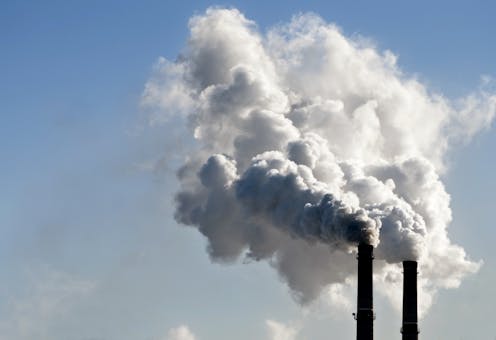
For those who have followed the tortuous path of Australian climate policy over recent decades, a recent report by the Australian Energy Market Commission of a “shadow price” of A$70 a tonne of carbon dioxide equivalent elicits some painful memories.
The announcement is a reminder of what we lost in 2013 when the Abbott government scrapped the Carbon Pollution Reduction Scheme, better known as the “carbon tax” or the “carbon price”. It was the first time globally a carbon price had ever been introduced and subsequently removed.
In 2024, the shadow carbon price described by the commission is not a cost to be paid by carbon emitters. It’s an estimate of the cost to the world of each tonne of carbon emissions. The $70/tonne figure will be included when calculating the benefits and costs of rule changes.
Read more: A carbon tax can have economic, not just environmental benefits for Australia
Poisoned politics
In 2013, it wasn’t the first time Tony Abbott had defeated an attempt to introduce a carbon price. In 2009, after many months of negotiation, then Prime Minister Kevin Rudd and opposition leader Malcolm Turnbull agreed on an emissions trading scheme.
Abbott rejected the idea and challenged Turnbull for the leadership, ultimately prevailing by a single vote. Although his public position was equivocal at the time, Abbott has since emerged as a fully fledged denier of climate science. Last year, he became a director of the anti-science Global Warming Policy Foundation.

Rudd persisted with emissions trading as agreed with Turnbull and refused to consider any changes proposed by the Greens, who ultimately voted against it. This episode has poisoned relations between the two left-of-centre parties ever since.
The scheme was deferred indefinitely, and Rudd was replaced by Julia Gillard shortly afterwards.
Gillard also sought to abandon the emissions trading scheme, but was forced to change tack after the 2010 election produced a minority government dependent on Greens support.
The result was the carbon pollution reduction scheme. This was an emissions trading scheme, but because it began operating with a fixed price of $23 a tonne, it was functionally equivalent to a carbon tax.
Gillard had ruled out such a tax before the election, and lost a great deal of credibility when she admitted the scheme was, in effect, a tax. This contributed to Labor’s defeat in 2013.
Despite its difficult birth, the carbon price worked effectively in the two years it was operating.
Emissions fell by about 2%, with no perceptible effect on the economy as a whole. Nevertheless, Tony Abbott described the tax as a “wrecking ball” through the economy. He scrapped it soon after winning power.
After the repeal, Australia ended up with a series of ad hoc policy responses, most notably the Abbott government’s safeguard mechanism. Introduced as a form of “direct action”, the safeguard mechanism remains at the centre of climate policy to this day. Labor has moved to strengthen it, not abandon it.
It’s now clear if either the emissions trading or the carbon pricing scheme had been maintained, Australia would be better placed.
Researchers recently found the “continuation of the carbon tax could have enabled a smoother energy transition”.
Europe launched its own emissions trading scheme in 2005 and has persisted despite initial difficulties (at one point the carbon price fell close to zero). The results are clear – across the 31 countries and regions involved, coal’s share of electricity generation has fallen sharply. Last year, just 12% of electricity in these nations came from coal, with further declines on the way.
 Coal power in Europe has fallen sharply, propelled by a price on carbon.
Michael Sohn/AP
Coal power in Europe has fallen sharply, propelled by a price on carbon.
Michael Sohn/AP
What’s the point of a shadow price?
Following Labor’s defeat in the 2019 election, neither major party has been willing to look at imposing a price on carbon emissions.
It’s against this backdrop that Australia’s energy market commission has announced its future decisions will use a shadow price on carbon, set initially at $70/tonne.
That’s significantly higher, in real terms, than the $26 price on carbon set in 2012. Moreover, the price is set to increase to $420/tonne by 2050, when the aim is to achieve net zero emissions.
That sounds promising but, for most of us, the announcement will raise more questions than answers.
First, what is the Australian Energy Market Commission? It’s part of the confusing alphabet soup of agencies involved in overseeing our energy supply.
The commission has the job of setting the rules under which markets operate, including national electricity, gas and retail rules, and provides market development advice to governments.
These rules cover everything from the approval of proposals for new transmission lines to the installation of smart meters for customers.
Second, what is a shadow price?
A shadow price is not a cost to be paid by emitters, as was the case with the carbon price. Rather, it’s an estimate of how much each tonne of CO₂ equivalent costs the world as a whole.
Will it have any effect in the real world? Yes. It means this cost will be included when the commission calculates the benefits and costs of rule changes.
Consider a change to transmission network rules to make it easier for new wind and solar projects to connect to the grid while reducing demand for coal-fired electricity.
In the absence of a shadow price, the costs of the rule change might be assessed as exceeding the benefits. With a shadow price, a benefit beginning at $70 per tonne would be added to account for reduced emissions from the change. If this adjustment was large enough, the rule change would be assessed as beneficial and would go ahead.
None of this would be necessary if we had an economy-wide carbon price.
But rigid opposition from the Coalition and the political caution (some might say cowardice) of Labor mean we won’t see a real price on carbon any time soon.
In the meantime, at least our market rules will take proper account of the damage done by the millions of tonnes of emissions vented into atmosphere for free.
Authors: John Quiggin, Professor, School of Economics, The University of Queensland



















