

I had no photos of my mother’s pregnancy and migration, so I found a way for AI to help fill in the gaps
- Written by Sara Oscar, Senior Lecturer, Visual Communication, School of Design, University of Technology Sydney
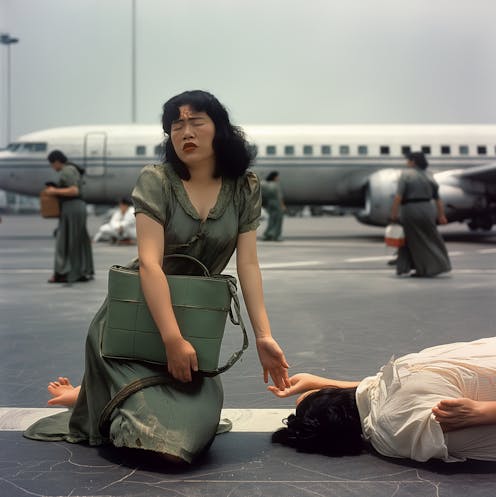
Since last year, I have been working on a project with my Thai mother who migrated to Australia in 1974 while pregnant with me. There are no photographs of this significant event. As a reparative act to fill in the gaps of our family archive, I used a generative AI platform to create photographs of my mother’s migration story, a project I called Counterfactual Departures.
To conjure photographs in MidJourney, I collected information to engineer a range of prompts. I noted details of my mother’s departure from Thailand – her age, the location, her clothing and the trimester of her pregnancy. I also included my own interpretation of how she would have felt as a 30-year-old woman travelling alone to white Australia in the 1970s. She spoke little English and had no family or friends of her own to begin life with my father, who she barely knew.
My attempts to piece together the past using data sets scraped from the collective archive of the internet have led me to question the role photography and memory might play in this new era of generative AI.
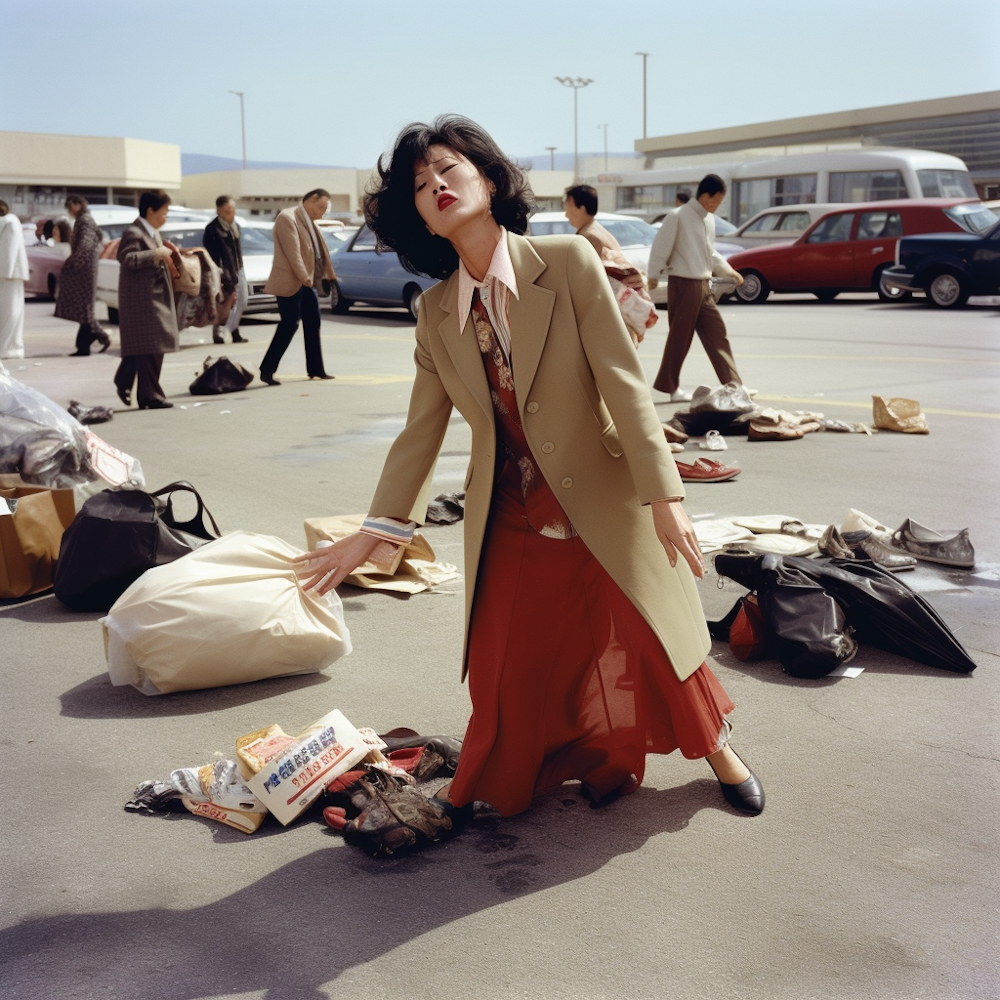
MidJourney and the ‘mean image’
MidJourney, like other AI image-generating platforms, creates images based on aggregates of data trawled from millions of online source photographs.
While they are not strictly photographs, AI-generated images read like photographs, look like photographs, are compared to photographs and challenge our philosophical understanding of photographs.
As relatives of photography, they are associated with qualities like pastness and memory, or even, as photographic theorist Joanna Zylinska suggests, as perceptual devices that can show us the future.
The problem that emerges out of generating images from photographic data sets is the way information is aggregated to form an image as a statistical average. As artist Hito Steyerl has observed:
They represent the norm by signalling the mean. They replace likenesses with likelinesses […] in style and substance they are: mean images.
By sampling from a range of information sources and creating composites, MidJourney accentuates the most prominent features of a dataset, this mean.
The first photographs produced of my mother illustrated this tendency. In the image, my mother and I (in utero) stand in an oversized grey suit, looking out of the frame in a parking lot among suitcases and a wasteland of plastic bags. We appear to be somewhere in Los Angeles, rendered in the style of staged photography. Generated from the statistical mean of data sets, they could also be described adjectivally as mean.
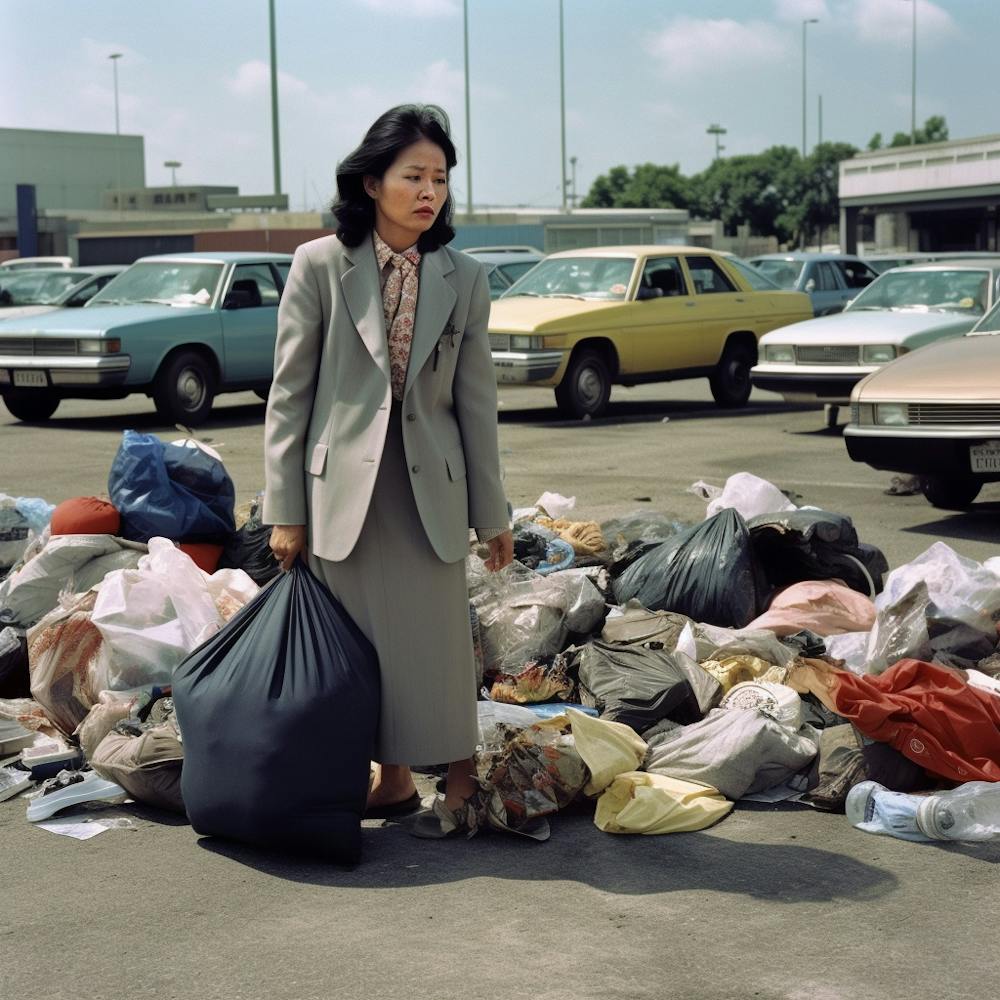 /imagine a hyperrealistic photograph of a pregnant Thai woman 30 wearing a suit in 1974, holding bags in an airport parking lot in Bangkok, Thailand, looking out of the frame, wide shot, cars in background, daylight.
Sara Oscar
/imagine a hyperrealistic photograph of a pregnant Thai woman 30 wearing a suit in 1974, holding bags in an airport parking lot in Bangkok, Thailand, looking out of the frame, wide shot, cars in background, daylight.
Sara Oscar
Looking back on these early photographs, part of the project’s problem was my over-emphasis on how the past should have looked. To shift the way this event was represented as a statistical mean of racial stereotypes, I had to place less emphasis on the generated image and turn image generation into a generative process of dialogue and discussion.
Memory-work as a generative method
The conversations we have about a photograph, whether real or not, can constitute a form of memory-work. Memory-work refers to how we process memories through the social relations we build around artefacts, such as photographs, text, objects or family albums. It is a valuable method for artists who deal with events outside of history because the process of art making serves a reparative function.
For cultural historian Annette Kuhn this cultivates dialogue about the past. She writes, memory-work means we can look at photographs as:
material for interpretation, to be interrogated, mined, for its meanings and its possibilities.
By shifting my emphasis from the generative image to the dialogue it generated, I began performing the act of memory-work. Images were used to generate conversations about this significant event. This created space to identify a gap between my imaginative recreation of events, my mother’s memories and the mean image generated by AI.
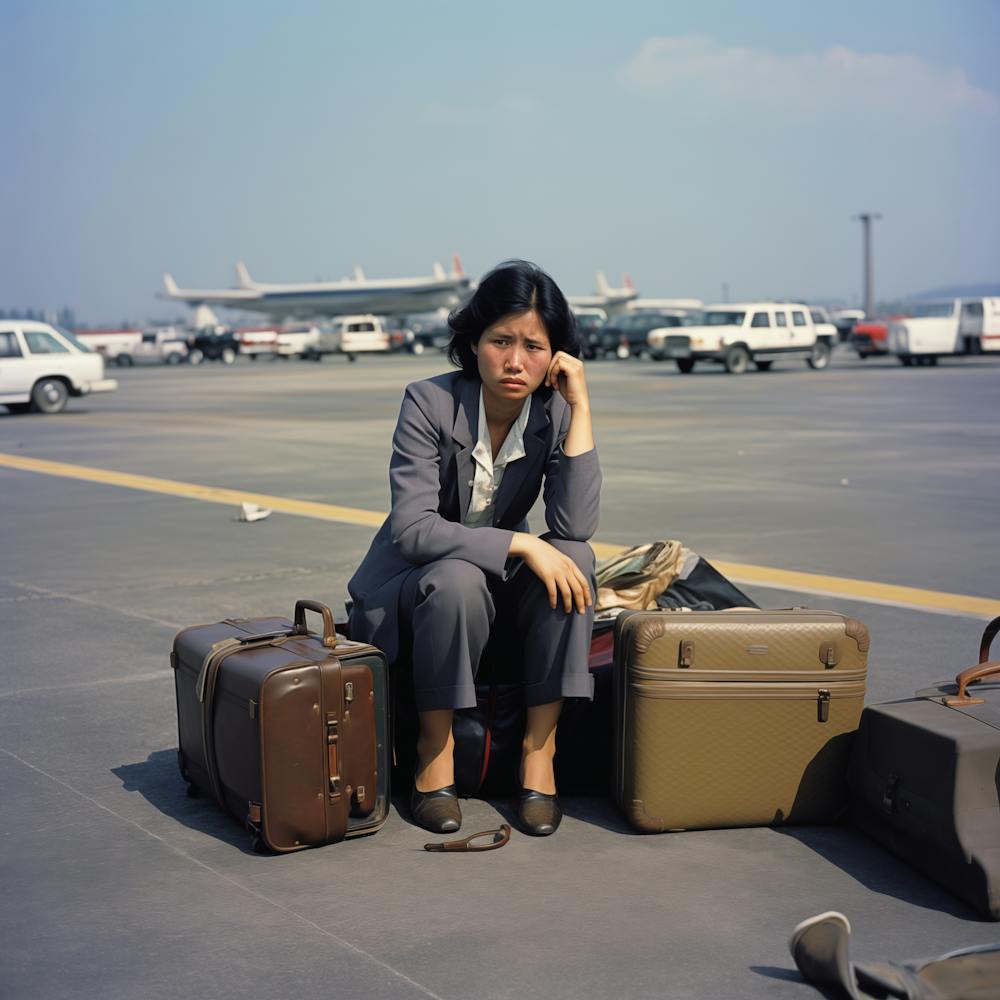 /imagine a Thai woman early 30s, seated on luggage on an airport tarmac wearing a suit, appears to be waiting, looking to the left of the frame into the distance, slight frown, daylight, 1970s.
Sara Oscar
/imagine a Thai woman early 30s, seated on luggage on an airport tarmac wearing a suit, appears to be waiting, looking to the left of the frame into the distance, slight frown, daylight, 1970s.
Sara Oscar
This collaborative process between my mother, AI and me has been revelatory. It has allowed me to fill the gaps in our family biography playfully. It has given my mother an opportunity to say, “no, it wasn’t like that, I came to Australia with dignity” and to recognise racial stereotypes of representation.
AI has the potential to create proxy representations of us and to create a dialogue around significant events and life experiences.
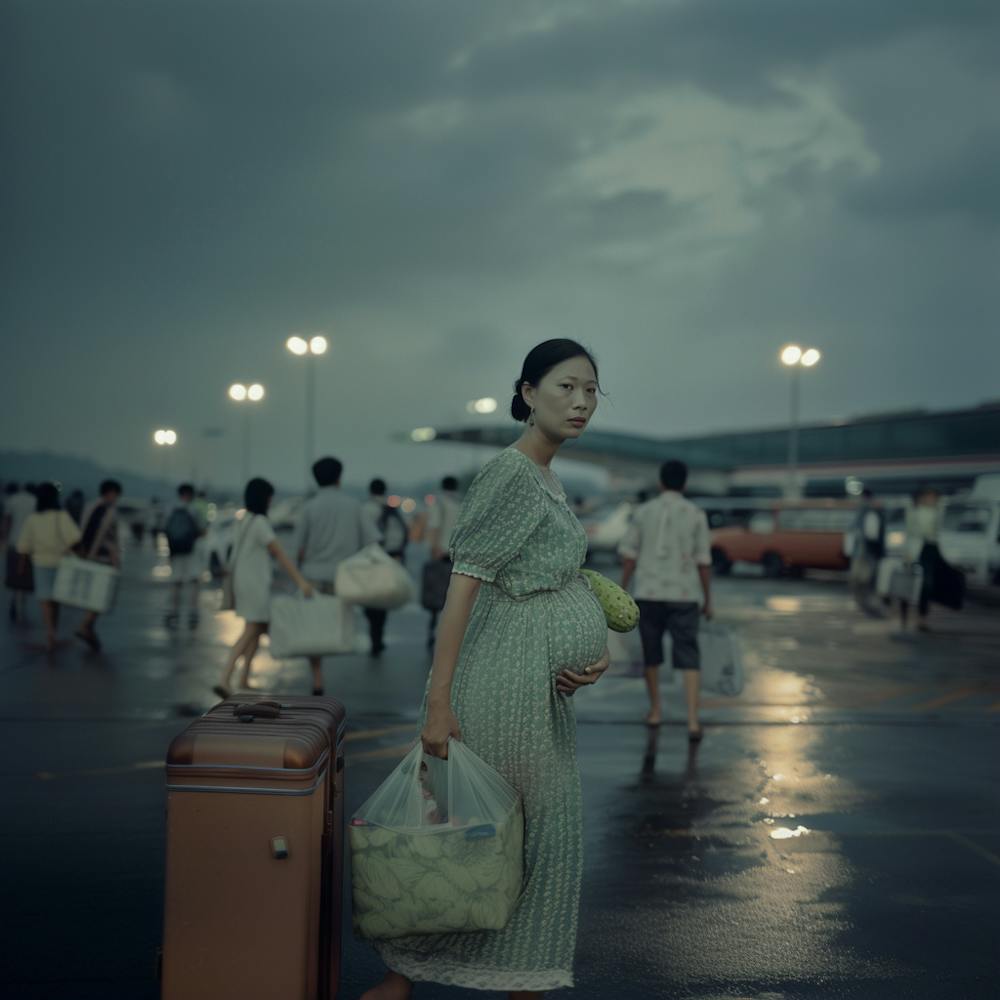 /imagine a photograph of a Thai pregnant woman in a green and white dress carrying papaya and luggage, looking at the camera, airport parking lot, Bangkok, dusk, after rain. 2024.
Sara Oscar
/imagine a photograph of a Thai pregnant woman in a green and white dress carrying papaya and luggage, looking at the camera, airport parking lot, Bangkok, dusk, after rain. 2024.
Sara Oscar
From moral panic to collaboration
Much moral panic around generated images has been fuelled in the media by an inability to discern between the real and the fake.
Mimicry, whether contributing to false memory, fake news, breaches of copyright, or the replacement of humans with machine labour, is at the centre of this debate.
But what if generative AI were able to be put to use as a tool of memory-work, to facilitate dialogue and interaction? This approach reconnects AI-generated images with earlier social and cultural practices of photography. It offers a more intimate example of what AI can do.
Read more: Synthetic futures: my journey into the emotional, poetic world of AI art making
Authors: Sara Oscar, Senior Lecturer, Visual Communication, School of Design, University of Technology Sydney

















