

what cosmic rays tell us about Earth’s changing surface and climate
- Written by Shaun Eaves, Senior Lecturer in Physical Geography, Te Herenga Waka — Victoria University of Wellington
How often do mountains collapse, volcanoes erupt or ice sheets melt?
For Earth scientists, these are important questions as we try to improve projections to prepare communities for hazardous events in the future.
We rely on instrumental measurements, but such records are often short. To extend these, we use geological archives. And at the heart of this research is geochronology – a toolkit of geological dating methods that allow us to assign absolute ages to rocks.
In recent years, we have been using a state-of-the-art technique known as cosmogenic surface exposure dating which allows us to quantify the time a rock has spent on the surface, exposed to signals from outer space.
Using cosmic rays as a clock
Earth is constantly bombarded by high-energy charged particles, known as cosmic rays, coming from the depths of our galaxy. Most are intercepted by Earth’s magnetic field and atmosphere. But some are sufficiently energetic to reach Earth’s surface.
On impact, they break apart atoms of common elements in Earth’s crust, such as silicon and oxygen, to create new rare elements known as cosmogenic nuclides.
The presence of cosmogenic nuclides in rocks and sediments at the Earth’s surface is a clear indicator of atmospheric exposure. Their abundance tells us how long the rock has been exposed.
Cosmic rays were first discovered in the early 1900s, but it took almost a century until sufficiently sensitive particle accelerators became available to accurately count the small number of rare atoms produced when they hit Earth.
Today, cosmogenic surface exposure dating represents a primary technique for quantifying the rates and dates of several processes on Earth’s surface.
Timing mountain collapse
In southeast Fiordland, the Green Lake landslide is one of the largest landslides on Earth. Its large size is especially unusual given the relatively small stature of the mountains from which it came.
Previous research suggested the landslide was induced by the retreat of a large glacier that formerly supported the mountainside.
Given ongoing glacial retreat today, we sought to test this hypothesis by collecting boulders on the surface of the Green Lake landslide. These rocks had previously been shielded from cosmic rays in the mountain interior before becoming exposed by the landslide.
Our measurements yielded an exposure age of about 15,500 years, which postdates the end of the last ice age in the Southern Alps by 3,000 to 4,000 years. From this result, we conclude that deglaciation is unlikely to have been the primary cause of this spectacular mountain collapse. Instead, our findings point to an extremely large earthquake as the more likely trigger.
How often do volcanoes emit lava?
Effusive (lava-producing) volcanic eruptions have built the large cone of Mt Ruapehu, the highest mountain in the North Island.
Despite some explosive episodes during the 20th century, there is no observational record of eruptions producing lava flows. Future effusive events could fundamentally reshape the volcanic cone, with potential implications for local infrastructure.
But how often do such eruptions happen?
Supported by the Resilience to Nature national science challenge, we tested whether cosmogenic dating could help us determine recurrence intervals of lava-producing eruptions on Mt Ruapehu over the past 20,000 years.
We found the mountain ejected lava in clusters of eruptive activity which could last for millennia. The cosmogenic data also provided more precise dates for recent prehistoric eruptions, compared to those produced by other common volcanic dating techniques such as palaeomagnetic and radiometric methods.
Tracking the melting of ice
Before cosmogenic nuclide measurements, glacial geologists trying to determine the age of sediments relied on serendipitous discoveries of fossil plant material for radiocarbon dating. In alpine and polar regions, where most glaciers are, such matter is rarely available.
Cosmogenic nuclides solve this problem as glaciers quarry rocks from their base and transport them to the surface where they rest on hill slopes and moraines and begin accumulating their cosmic signal.
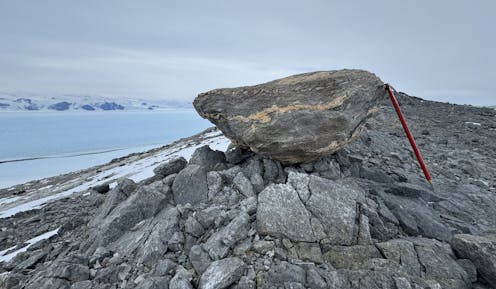
With support from the New Zealand Antarctic Science Platform, we have applied this technique to reconstruct the recent evolution of Byrd Glacier – a large outlet of the East Antarctic Ice Sheet.
Glacial cobbles, transported from the Antarctic interior and deposited on hillsides on either side of the flowing glacier, track how high the glacier was in the past.
Our study shows that the glacier thinned by at least 200 metres about 7,000 years ago during an interval of relative global climate stability. These results provide rare three-dimensional information that can be used to evaluate computer models used to simulate past, present and future ice sheet change.
Rising sea level is one of the biggest challenges facing civilisation this century. However, the uncertain response of ice sheets to climate change currently hampers projections.
Cosmogenic nuclide specialists are now ambitiously attempting to recover rock samples from beneath sensitive portions of the present ice sheets. Testing them for cosmic signals will yield important insights about the potential of future melting of ice sheets.
Authors: Shaun Eaves, Senior Lecturer in Physical Geography, Te Herenga Waka — Victoria University of Wellington

















