

Electric vehicles will start to cut emissions and improve air quality in our cities – but only once they’re common
- Written by John Rose, Professor of Sustainable Future Transport, University of Sydney
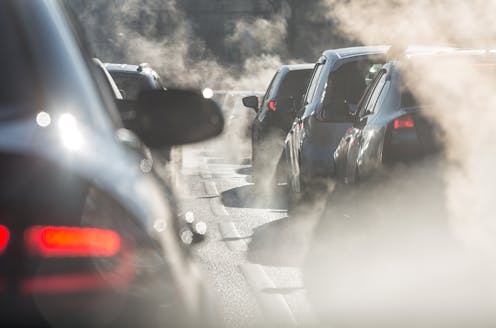
Electric vehicles are often seen as the panacea to cutting emissions – and air pollution – from transport.
Is this view correct? Yes – but only once uptake accelerates. Despite the recent boom in EV purchases, they’re still a tiny minority of the cars on the road.
We would get more immediate benefit by focusing on electrifying buses, which are a surprisingly large source of air pollution, and finding ways to cut rapidly growing emissions from diesel trucks.
While the electricity sector still produces the largest share of emissions in Australia (32.3%), emissions are falling. But emissions from transport (21.1%) are already the third-largest contributor – and are rising faster and faster.
Critics say EVs just shift the emissions and pollution from tailpipe to power plant smokestack. This is only partly true. A grid powered by brown coal could indeed mean EVs are dirtier than we think. But as more and more clean energy pours into the grid (or behind the grid, in the form of solar on our rooftops), this becomes less and less of a concern. Charging your EV from rooftop solar is emissions-free, and charging from a high-renewable grid means very low emissions. But even when powered by a coal grid, EVs are still much cleaner than petrol or diesel cars.

Can EVs really improve air quality?
Combustion engines expel smog-causing chemicals that are dangerous to our health, such as carbon monoxide, soot and nitrogen oxides.
Countries such as Norway and China have embraced EVs faster than others. As Chinese researchers have found, air quality in polluted cities begins to improve as EVs arrive in numbers. American researchers have found even small increases in the proportion of EVs improves air quality and reduces the number of people attending hospital with asthma attacks.
What most people think of as EVs are battery electric vehicles made by companies such as Tesla or BYD. While hybrid cars have small batteries, they still have combustion engines. By contrast, battery-electric cars do away with it entirely in favour of much larger lithium-ion battery packs.
If you look at the entire lifecycle of a vehicle, emissions associated with an average EV – including production, shipping, maintenance, recycling, and of course use – are estimated to be just 12% those of a traditional combustion engine vehicle.
Cutting emissions and cleaning air means actually using EVs
The main challenge in cutting transport emissions is no longer technological – it’s uptake.
Last year, more than 8% of new vehicles sold in Australia were EVs. That’s a big jump up from the previous year’s figure of 3.6%.
But the real figure we should focus on is smaller – 1.2%. That’s the proportion of EVs across Australia’s entire passenger vehicle fleet. That is, of the 15.3 million passenger cars, utes and vans on our roads, just 181,000 are EVs as of the beginning of 2023.
So yes, uptake is accelerating. But based on current market trends, it will be at least 15 years before EVs outnumber internal combustion vehicles in Australia, and at least a decade after before these polluting vehicles disappear from our roads. (It’s likely they won’t disappear entirely, due to hobbyists and collectors.)
This is why government initiatives such as the New Vehicle Energy Standards are important – they speed up this transition. Even with this, it will be decades before we actually see falls in transport emissions.
 Battery electric vehicles rely on many battery cells linked together.
IM Imagery/Shutterstock
Battery electric vehicles rely on many battery cells linked together.
IM Imagery/Shutterstock
What if the grid is dirty?
Critics of EVs claim these vehicles are a form of greenwashing. If the power grid runs on dirty coal, the vehicles run on dirty coal.
Is this correct? Yes and no. First, battery electric vehicles have the benefit of zero tailpipe emissions, meaning city air quality will slowly improve.
But do they just push emissions out of the cities and into the hinterland, where the power plants are?
The answer is, it depends. Take the popular Tesla Model 3 as an example. These battery electric sedans are manufactured in both China and the United States. The Teslas we buy here in Australia are typically made in China.
While China is building out its renewable sector at tremendous speed, for now it is is still heavily reliant on black coal. The US, meanwhile, relies much more on gas, which produces fewer emissions when burned. That means a Tesla made in China is estimated to create 154% more emissions than the same vehicle made in the US.
As such, an Australian Tesla driver is (inadvertently) more polluting than their US counterpart – but still much less so than a driver of an equivalent petrol vehicle.
Where the EV is driven also matters. For example, a Tesla Model 3 driven in New South Wales and charged at public chargers will produce nearly 15,500kg of carbon dioxide equivalent over a 16-year timeframe. That’s because the state still has several coal-fired power stations, though this is changing. By contrast, drive and charge it in hydroelectricity-powered Tasmania and you’ll generate less than 500kg.
Read more: How climate-friendly is an electric car? It all comes down to where you live
Transport emissions are more than just our cars
When we look at how to clean up transport, we have to look at trucks and buses.
Surprisingly, total petrol use has been falling in Australia for almost 20 years. The average car is driven 2,000km less per year than it was ten years ago – a trend that was happening even before COVID.
But demand for diesel has soared, almost doubling over the same period. That’s due to the growth in articulated trucks. While diesel engines produce fewer emissions than petrol, the boom in trucking means emissions keep climbing.
Electric trucks are beginning to appear. These will likely substitute for smaller trucks operating within a city at first, as the weight of batteries makes long-distance trucks less viable.
Electric buses are popping up on the streets of cities such as Melbourne and Perth. But it’s a similar story to cars – while the bus industry is enthusiastic, only around 0.2% of Australia’s buses are electric.
Put this all together, and you have a simple conclusion. Electric cars, trucks and buses can indeed cut transport emissions and clean up air in Australia. But slow adoption rates mean it will be decades before we really see the impact – and we’ll need a much greener grid to charge cleanly.
Read more: Why electric trucks are our best bet to cut road transport emissions
Authors: John Rose, Professor of Sustainable Future Transport, University of Sydney

















