

Confused or playing for time? 3 possible reasons NZ is taking so long to make a call on AUKUS
- Written by Robert G. Patman, Professor of International Relations, University of Otago
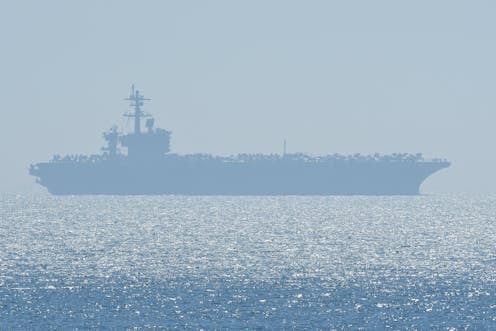
New Zealand governments have been actively exploring the option of joining pillar two of AUKUS for over a year now. But according to foreign minister Winston Peters, the government is “a long way from this point of being able to make such a decision”.
This is puzzling. Strategy, as Prussian general and military strategist Carl von Clausewitz observed, involves a process of effectively applying means to achieve clearly defined ends.
And the core objective of the enhanced security partnership called AUKUS has been very clear from the outset: to deter China.
In September 2021, the governments of Australia, the US and UK announced the formation of AUKUS to bolster the “international rules-based order” in the Indo-Pacific, to make the region “secure, stable and resilient”.
If countering the perceived threat of China’s growing assertiveness is the central purpose of AUKUS, the means to achieve this are also plain: join AUKUS. On the face of it, this should not be a particularly difficult decision. So why is it taking so long?
All about China
New Zealand’s non-nuclear security policy rules out any participation in pillar one of AUKUS, which involves the delivery of nuclear-powered submarines to Australia.
Pillar two, however, envisages the sharing of cutting-edge defence technologies in areas such as artificial intelligence, hypersonic missiles and cyber warfare. In March 2023, the US indicated the door was open for more talks about New Zealand joining pillar two.
Since then, the previous and current governments have been talking with AUKUS members to “carefully weigh up the economic and security benefits and costs of any decision about whether participating in pillar two is in the national interest”.
According to Peters, this “will take time”. But the government must be fully aware of the major components of both pillars of AUKUS and its intended purpose. Assessing whether pillar two is in the national interest does not ultimately depend on obtaining more information about possible membership.
Rather, it comes down to whether the government believes it is vital to counterbalance China’s increasing involvement in the Indo-Pacific and is prepared to participate in pillar two to help make that happen.
Why the wait?
There are several possible reasons for this wait-and-see approach.
First, the government‘s focus on the pros and cons of pillar two membership may be due to a belief that the technology-sharing component is somehow divorced from the overarching AUKUS goal of countering China, New Zealand’s biggest trade partner.
However, it is surely a miscalculation to think partial membership of AUKUS will give the government more diplomatic wiggle room than being a full member.
Second, the government’s position towards pillar two could be largely performative. Given New Zealand received the green light to explore the possibility of membership early last year, Wellington may want to be seen as leaving no stone unturned before making a decision.
The potential downsides of joining pillar two are well known. It could blur New Zealand’s opposition to nuclear proliferation in the Indo-Pacific. And it could indicate to ASEAN and Pacific Island states that New Zealand’s distinctive regional diplomacy had been displaced by a return to an old Anglosphere orientation.
That could also antagonise China, of course. At the same time, saying no to AUKUS too quickly could be interpreted by New Zealand’s Five Eyes intelligence partners as trying to placate Beijing.
In other words, New Zealand could eventually decline membership of pillar two after a lengthy period of consideration – thus avoiding the impression Chinese pressure had forced its hand.
Decision time
Finally, the government may be playing the long game to prepare domestic opinion for a momentous shift in New Zealand foreign policy.
Unlike the previous Labour government, it is clear the current coalition has enthusiastically linked pillar two membership to “working more closely than ever” with the US.
Winston Peters has said there are “powerful reasons” for New Zealand to engage practically with security arrangements like AUKUS “when all parties deem it appropriate”. He has also asserted AUKUS “made a positive contribution” to “peace, security and prosperity in the Indo-Pacific”.
Underpinning the apparent push towards pillar two membership is the foreign minister’s claim that the international security situation is now “the worst that anyone today working in politics or foreign affairs can remember”.
The implication is that New Zealand needs to seek more shelter under the protective umbrella of traditional allies.
Whatever the case, any decision on pillar two must be based on a clear-eyed recognition that AUKUS membership is based on the premise that China is the biggest threat to the international rules-based order – on which New Zealand depends. If Wellington does not share that view, it must say so without equivocation.
Authors: Robert G. Patman, Professor of International Relations, University of Otago

















