

Indigenous women are most affected by domestic violence but have struggled to be heard. It’s time we listened
- Written by Marlene Longbottom, Associate Professor, Indigenous Education & Research Centre, James Cook University
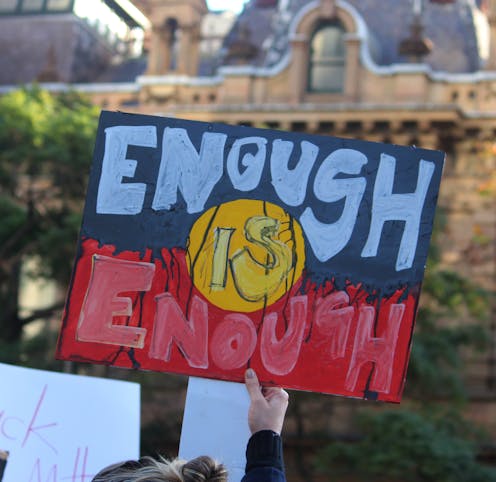
This article contains information on deaths in custody and the violence experienced by First Nations people in encounters with the Australian carceral system. It also contains references to and the names of people who are now deceased.
As the country reels from women being killed due to violence, government has responded by calling urgent meetings and roundtables to address this national crisis. This must properly include Indigenous women, who experience shocking levels of family and domestic violence, and sexual assault.
It must be recognised women are not a homogenous, collective group. The issues experienced by non-Indigenous women are not always the same as those experienced by Indigenous women. As such, it is imperative the voices of Indigenous survivors, researchers and advocates in addressing violence are fully heard and respected in the current debate.
According to recent research led by Kyllie Cripps, Aboriginal and Torres Strait Islander women are 32 times more likely to be hospitalised for injury associated with violence than non-Indigenous women. They are eight times more likely to be a victim of homicide. This figure is higher in some areas, such as Western Australia, which recorded Aboriginal mothers as 17.5 times more likely to be a victim of homicide.
Recently, the Domestic Family and Sexual Violence Commission convened an emergency roundtable. However, we are still concerned the outcomes of the roundtable do not respond to the serious and ongoing structural and systemic barriers Indigenous women face.
There are also concerns a significant investment recently announced in Western Australia will not support Indigenous women. They’re based largely on an expansion of existing services, police, child protection and corrections, and non-Indigenous service responses. These decisions were made contrary to the states own Aboriginal family violence policy and in the absence of research or evidence base.
Potentially harmful reforms
Indigenous women’s sustained advocacy, as well as coronial inquests, and the senate inquiry into missing and murdered Indigenous women, have all shone a light on how Indigenous women and children experience violence at alarming rates, even after formal inquiries and royal commissions over the past two decades.
However, as was identified in the Independent Commission of Inquiry into the Queensland Police Service’s responses to domestic and family violence, reforms are often reactive and short lived. Key recommendations have been ignored, while governments have made services mainstream.

White feminists have pursued a law and order agenda that has been proven not only to be ineffectual, but potentially even harmful to Indigenous women. For example, coercive control laws risk misidentifying Indigenous women as the perpetrators of violence for not presenting as “ideal victims”.
As Aboriginal women with lived experience of violence, we continue to point out the urgency of addressing the abhorrent rates of violence through the inclusion of our voices at national forums. For years, Indigenous researchers, survivors, advocates and allies have called for action. This advocacy, and expertise, is often overlooked.
Failures of policing
Governments promise to address the issue. Emergency services promise to do better. Yet in coronial inquests, inquiries and specialist investigations, we continue to see the services with the mandate to protect the community failing Indigenous women. Indigenous women are reluctant to call the police for many reasons, including ongoing racism and prejudice.
Indigenous women know police may not take their reporting of violence seriously. This is common knowledge in Indigenous communities. Calls are often downgraded in urgency or not responded to at all, even after a victim has repeatedly calling triple zero for support. In many cases, Aboriginal women are wrongly identified as perpetrators, situations that have also resulted in their being murdered.
 Accessing domestic violence support services from remote communities is often delayed.
Shutterstock
Accessing domestic violence support services from remote communities is often delayed.
Shutterstock
The Northern Territory coroner is currently examining the role systemic racism played in the murders of four Aboriginal women. The Queensland Commission of Inquiry also found racism, misogyny and sexism contributed to the negative experiences of victim-survivors. Cripps further found in her study coroners have previously identified systemic racism as being significant in the deaths of Indigenous women.
And while Aboriginal women are at an elevated risk of violence and homicide, culturally safe family and domestic violence services are critically underfunded or non-existent. This is neglectful. The National Family Violence Prevention and Legal Services has funding tied to federal government cycles and is unable to meet demand. It’s currently awaiting the government’s response to a review into the National Legal Assistance Program. This was finalised in March and called for an increase in recurrent funding to enable their services to provide crucial support to Indigenous women and children nationally.
One size doesn’t fit all
Indigenous women have long argued for systemic reforms that address the underlying drivers of violence, support victim-survivors, ensure justice and demand accountability for offenders. This means not every support service can be for all women. They need to be tailored to meet the specific needs of Indigenous women.
The presumption that one size fits all omits the unique factors in different communities across the nation. For example, some regional and remote communities face significant difficulties in accessing telecommunication services. At the same time, the connectedness of cities doesn’t automatically make support easily accessible.
The lives of Indigenous women are at further risk with delays due to distance and access to funds to escape unsafe situations. This was demonstrated through evidence supplied to the Queensland Commission of Inquiry. It found a high likelihood of death in some remote areas. Centralised call centres can be thousands of kilometres away, delaying access to help.
Research jointly led by Marlene Longbottom found accessible services need to ensure Indigenous women are not retraumatised as they share their stories. We should also remember the first responders in these situations are ultimately families. As a result of helping a woman fleeing a violent situation, families also become targets for perpetrators and their networks.
 Policies should be tailored specifically to the needs of Indigenous families.
Marianne Purdie/Getty
Policies should be tailored specifically to the needs of Indigenous families.
Marianne Purdie/Getty
A key deterrent to reporting violence is that police are mandatory reporters of child abuse. Indigenous women know if they report violence against them, police and child protection working together can decide children are at risk and remove them into state care. There is a real risk of child removal as a consequence for Indigenous women who report violence, causing immense harm and trauma to mothers and their children.
While there have been changes that include service integrations and high-risk teams, the implementation of these services can often let Indigenous women down because they are not based on their needs.
As Indigenous women are rightly reluctant to seek support, systems continue violence. Not only must Indigenous women consider the safety of themselves and their children, they also have to navigate multiple services. These service systems are often challenging and overwhelming, and can also offer contradictory advice. This makes decision-making difficult.
When it comes to sexual assault, there are virtually no culturally appropriate services available to Indigenous women and girls, who are at high risk of such violence. According to the World Health Organization, one in three Indigenous women globally will be a victim of rape in their lives. This is certainly true of First Nations women and girls in Australia.
Increasingly, our homicide research is finding links between sexual violence perpetration and subsequent domestic and family violence deaths. It is crucial more research is done in this space to ensure we are identifying casual links and preventive opportunities.
Growing the knowledge base
A recent study by Hannah McGlade with the Australian National Research Organisation on Women (ANROWS), highlights the violence as systemic and structural, also constituting Indigenous femicide. Research on murdered and missing Indigenous women and girls by Indigenous researchers has been neglected by the state, yet is critical to understanding and responding effectively.
Greater investment is required in research by Indigenous researchers. We are part of a new research initiative that aims to address this knowledge gap.
Given the lack of government action over many years, Aboriginal women, including the former Social Justice Commissioner, have led national policy change. Indigenous women’s calls for a separate national action plan, also supported by United Nations treaty bodies and experts, were finally heard.
This plan must be underpinned by Indigenous-led efforts in each state and territory, and including the establishment where needed of Aboriginal family and domestic violence state peak bodies. We say again “nothing about us, without us” and call for genuine engagement with the state and sector. There’s a lot of work to do to save the lives of First Nations women and it must start now.
Authors: Marlene Longbottom, Associate Professor, Indigenous Education & Research Centre, James Cook University

















