

What causes the different colours of the aurora? An expert explains the electric rainbow
- Written by Timothy Schmidt, Professor of Chemistry, UNSW Sydney
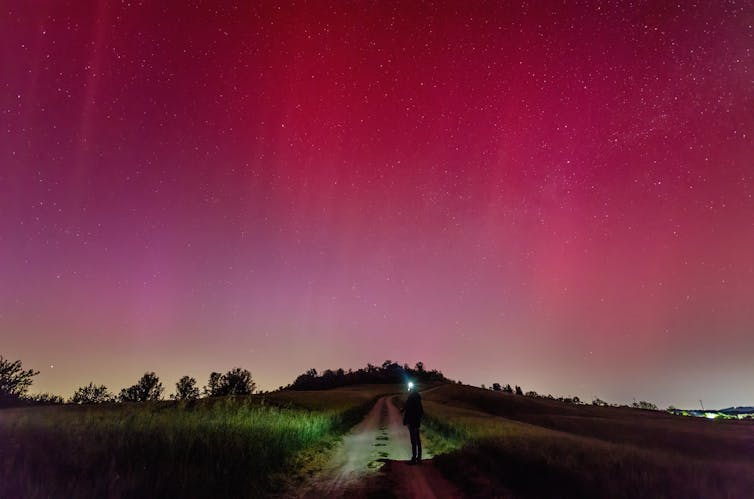
Last week, a huge solar flare sent a wave of energetic particles from the Sun surging out through space. Over the weekend, the wave reached Earth, and people around the world enjoyed the sight of unusually vivid aurora in both hemispheres.
While the aurora is normally only visible close to the poles, this weekend it was spotted as far south as Hawaii in the northern hemisphere, and as far north as Mackay in the south.
This spectacular spike in auroral activity appears to have ended, but don’t worry if you missed out. The Sun is approaching the peak of its 11-year sunspot cycle, and periods of intense aurora are likely to return over the next year or so.
If you saw the aurora, or any of the photos, you might be wondering what exactly was going on. What makes the glow, and the different colours? The answer is all about atoms, how they get excited – and how they relax.
When electrons meet the atmosphere
The auroras are caused by charged subatomic particles (mostly electrons) smashing into Earth’s atmosphere. These are emitted from the Sun all the time, but there are more during times of greater solar activity.
Most of our atmosphere is protected from the influx of charged particles by Earth’s magnetic field. But near the poles, they can sneak in and wreak havoc.
Earth’s atmosphere is about 20% oxygen and 80% nitrogen, with some trace amounts of other things like water, carbon dioxide (0.04%) and argon.

When high-speed electrons smash into oxygen molecules in the upper atmosphere, they split the oxygen molecules (O₂) into individual atoms. Ultraviolet light from the Sun does this too, and the oxygen atoms generated can react with O₂ molecules to produce ozone (O₃), the molecule that protects us from harmful UV radiation.
But, in the case of the aurora, the oxygen atoms generated are in an excited state. This means the atoms’ electrons are arranged in an unstable way that can “relax” by giving off energy in the form of light.
What makes the green light?
As you see in fireworks, atoms of different elements produce different colours of light when they are energised.
Copper atoms give a blue light, barium is green, and sodium atoms produce a yellow–orange colour that you may also have seen in older street lamps. These emissions are “allowed” by the rules of quantum mechanics, which means they happen very quickly.
When a sodium atom is in an excited state it only stays there for around 17 billionths of a second before firing out a yellow–orange photon.
But, in the aurora, many of the oxygen atoms are created in excited states with no “allowed” ways to relax by emitting light. Nevertheless, nature finds a way.
 Aurora australis visible from Oatlands, Tasmania on May 11 2024.
AAP Image/Ethan James
Aurora australis visible from Oatlands, Tasmania on May 11 2024.
AAP Image/Ethan James
The green light that dominates the aurora is emitted by oxygen atoms relaxing from a state called “¹S” to a state called “¹D”. This is a relatively slow process, which on average takes almost a whole second.
In fact, this transition is so slow it won’t usually happen at the kind of air pressure we see at ground level, because the excited atom will have lost energy by bumping into another atom before it has a chance to send out a lovely green photon. But in the atmosphere’s upper reaches, where there is lower air pressure and therefore fewer oxygen molecules, they have more time before bumping into one another and therefore have a chance to release a photon.
For this reason, it took scientists a long time to figure out that the green light of the aurora was coming from oxygen atoms. The yellow–orange glow of sodium was known in the 1860s, but it wasn’t until the 1920s that Canadian scientists figured out the auroral green was due to oxygen.
What makes the red light?
The green light comes from a so-called “forbidden” transition, which happens when an electron in the oxygen atom executes an unlikely leap from one orbital pattern to another. (Forbidden transitions are much less probable than allowed ones, which means they take longer to occur.)
However, even after emitting that green photon, the oxygen atom finds itself in yet another excited state with no allowed relaxation. The only escape is via another forbidden transition, from the ¹D to the ³P state – which emits red light.
This transition is even more forbidden, so to speak, and the ¹D state has to survive for about about two minutes before it can finally break the rules and give off red light. Because it takes so long, the red light only appears at high altitudes, where the collisions with other atoms and molecules are scarce.
Also, because there is such a small amount of oxygen up there, the red light tends to appear only in intense auroras – like the ones we have just had.
This is why the red light appears above the green. While they both originate in forbidden relaxations of oxygen atoms, the red light is emitted much more slowly and has a higher chance of being extinguished by collisions with other atoms at lower altitudes.
Other colours, and why cameras see them better
While green is the most common colour to see in the aurora, and red the second most common, there are also other colours. In particular, ionised nitrogen molecules (N₂⁺, which are missing one electron and have a positive electrical charge), can emit blue and red light. This can produce a magenta hue at low altitudes.
All these colours are visible to the naked eye if the aurora is bright enough. However, they show up with more intensity in the camera lens.
There are two reasons for this. First, cameras have the benefit of a long exposure, which means they can spend more time collecting light to produce an image than our eyes can. As a result, they can make a picture in dimmer conditions.
The second is that the colour sensors in our eyes don’t work very well in the dark – so we tend to see in black and white in low light conditions. Cameras don’t have this limitation.
Not to worry, though. When the aurora is bright enough, the colours are clearly visible to the naked eye.
Read more: What are auroras, and why do they come in different shapes and colours? Two experts explain
Authors: Timothy Schmidt, Professor of Chemistry, UNSW Sydney

















