

How a long-lost fish species was brought back to Bendigo
- Written by Sean Buckley, Lecturer in Molecular Ecology and Environmental Management, Edith Cowan University
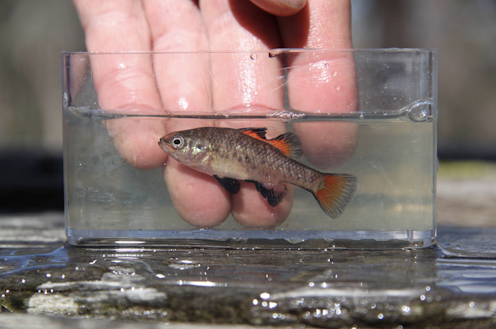
The southern pygmy perch hadn’t been seen in Bendigo Creek since the mid-19th-century goldrush, when a booming town sprang up around the central Victorian waterway. This attractive small fish, which displays bright colours when breeding, is no more than 6–8cm long. Once widespread, the species eventually became locally extinct across the Loddon River catchment, which includes the creek.
But today, thanks to the efforts of community volunteers, scientists and local authorities, there are several thriving local populations of this small fish.
Reintroducing species to their old habitat is complicated. For animal species, we need good information about where to source them from and how many to move. It’s essential to have good habitat ready for the newly restored population.
We should also know how genetically diverse the population is because that can affect its long-term success.
A successful reintroduction depends on researchers, environmental managers and local communities working together. That’s exactly what happened in Bendigo.
Pygmy perch range has shrunk
The southern pygmy perch (Nannoperca australis) was once found in many rivers and streams across New South Wales, Victoria and South Australia. However, the combined pressures of habitat loss and degradation, invasive species such as redfin perch, carp and eastern gambusia, drought and drawing too much water for farming drove many populations to local extinction.
In 2015, recognising the importance of collaboration across management groups and communities, six regional bodies formed the Tri-State Murray NRM Alliance. They developed the “Magnificent Six” project to reintroduce six native freshwater fish species – all small and endangered – in the Murray-Darling Basin, which includes the Loddon River. The southern pygmy perch was first in line.
The Magnificent Six program aims to restore populations of six small fish species in the Murray-Darling Basin.In 2018, through the tri-state alliance, a partnership between local government, environmental managers, an aquarium business, local community and fish hobbyists was formed. The Molecular Ecology Lab at Flinders University was brought in to provide guidance and genetics expertise. The lab had experience of successful captive breeding and reintroduction of southern pygmy perch in South Australia.
Everyone came together to plan the most effective course of action. We consulted local community members. We discussed where best to collect fish from and to move them. We planned planting efforts to restore suitable habitat.

Building up new populations
In September 2018, local volunteers – guided by environmental managers – collected more than 100 wild fish. These came from three creeks in two nearby river systems: the Campaspe and Avoca Rivers.
They took these fish to the Middle Creek Farm, a private aquarium business in Stratford, Victoria, to set up a captive breeding program. The aim was to make sure we had enough fish to sustain new populations. Over the next year, volunteers helped to breed and raise more than 600 fish for release.
At the same time, volunteers created new homes for these fish in three local wetlands by planting aquatic vegetation and building woody habitat. The combination of woody debris and dense reeds provides refuge from predators like aquatic birds and are particularly important nurseries for juvenile fish.
In January 2020, 800 fish from all three creeks were released across four wetlands, including restored urban wetlands and national parks. The team came back in September that year to monitor how they were doing.
A triumph for community action based on expert advice
Local communities can play an integral role in programs like this. To date, relatively few conservation programs include active public participation. Even fewer consider genetic information.
At every stage of the Bendigo reintroduction, we collected DNA from the fish by taking a small clipping of the tail fin. Our aim was to see how well the program had maintained genetic diversity. This is important for populations to persist in the long term.
We showed the genetic diversity of the parents was maintained. This diversity has helped the new populations to thrive.
Interestingly, we found the different source populations had unique genetic variation and the breeding program had caused some fish to become “mixed” (like hybrids). When we monitored the populations after release, we found more of these mixed fish surviving. That suggests genetic mixing might be important for southern pygmy perch.
This information helped us to make recommendations for future reintroductions elsewhere.
Everyone benefits
The program was a huge success. All three populations are thriving – so much so that 2,800 fish were taken from our release sites to start a new population in another site within the Gunbower Forest along the Murray River last September. The species was last recorded there in 1997.
With their voracious appetite for mosquito larvae, these populations of pygmy perch may offer a natural solution for pest management. They are also a key food source for many native freshwater fish and waterbird species.
The community benefited too. Seven new landcare groups and more than 20 landholders are now part of reintroduction programs for other fish species. Volunteer organisations increased their social media and public footprint. Pygmy perch have also become popular fish in dams and backyard ponds.
Aquariums of southern pygmy perch are being used in high schools to teach students about fish conservation, pest management and water chemistry.
How can you get involved?
Communities are working tirelessly to restore lost biodiversity across Australia. To help bring back a lost local species you can:
get involved with your local community “Friends of” conservation groups as well as regional groups, which are great for driving change in your area
approach local councils and government to provide support and contact relevant stakeholders
call in university researchers, of course. Many of us would love to provide our expertise and skills to conservation efforts.
Together, we can improve the conservation status of threatened species and restore our declining biodiversity.
Authors: Sean Buckley, Lecturer in Molecular Ecology and Environmental Management, Edith Cowan University
Read more https://theconversation.com/how-a-long-lost-fish-species-was-brought-back-to-bendigo-225800

















